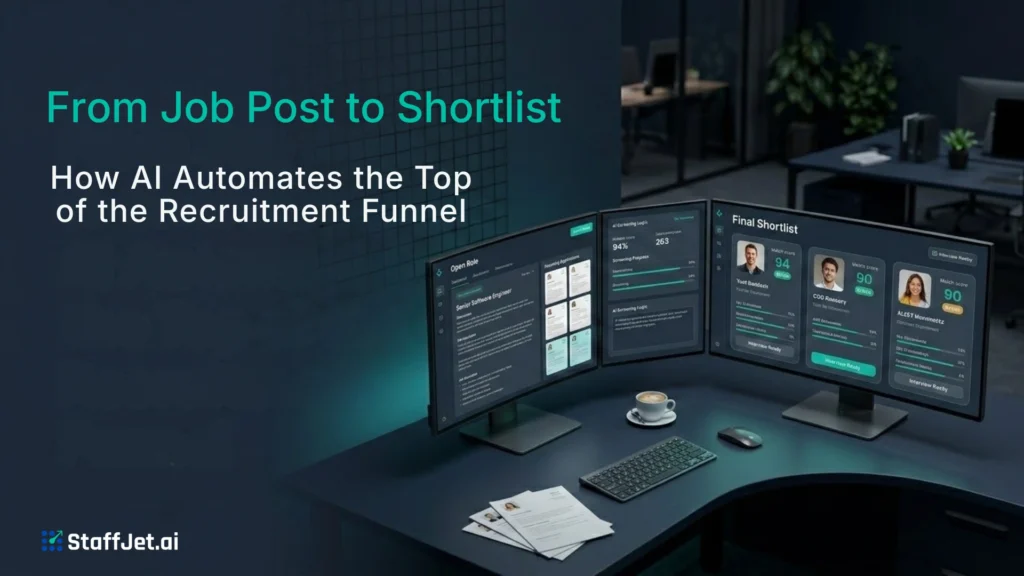
From Job Post to Shortlist: How AI Automates the Top of the Recruitment Funnel
The biggest hiring delay often starts before the first interview.
For many Indian hiring teams, the real bottleneck is not final selection. It is the top of the recruitment funnel. Applications come from different sources. Recruiters screen resumes manually. Hiring managers wait for shortlists. Good candidates move ahead with faster employers.
This is where ai in recruitment process becomes useful. It helps hiring teams move from scattered applications to structured shortlists without losing control of quality.
This article is part of our step-by-step guide to AI in the recruitment process — see the full end-to-end breakdown here: AI in the Recruitment Process
LinkedIn reports that AI is helping recruiters streamline repetitive tasks and spend more time on strategic hiring work [LinkedIn, 2025]. SHRM also notes that AI can support recruiting by automating repetitive work while keeping HR professionals focused on human-centered decisions [SHRM, 2025].
What Is the Top of the Recruitment Funnel?
The top of the recruitment funnel is the early hiring stage where candidates enter the pipeline, resumes are reviewed, and the first shortlist is created.
This stage usually includes job posting, application collection, resume screening, candidate matching, and initial shortlisting.
It sounds simple, but this is where volume creates pressure. A single role can bring hundreds of resumes from job boards, referrals, career pages, and emails. Without automation, recruiters must manually collect, review, and compare each profile.
The top of the funnel decides the quality of the rest of the hiring process. If weak candidates enter the shortlist, hiring managers waste time. If strong candidates are missed, the company loses talent.
Why Does the Top of the Hiring Funnel Slow Teams Down?
The top of the hiring funnel slows teams down because application volume grows faster than recruiter capacity.
Manual screening takes attention. It also creates inconsistency. A recruiter reviewing the first 30 resumes may be sharper than when reviewing the next 200. That affects shortlist quality.
The World Economic Forum says employers are facing fast-changing skill needs, especially around AI, data, and digital roles [World Economic Forum, 2025]. This makes screening harder because recruiters must identify real skill fit, not just keyword matches.
For startups, IT services firms, and enterprises, slow top-funnel hiring affects business output. Open roles delay projects, delivery timelines, and growth plans.
Step 1: Job Applications Come From Multiple Sources
The first top-funnel challenge is that job applications rarely come from one clean source.
Most companies receive applications from LinkedIn, Naukri, Indeed, career pages, referrals, and direct emails. Recruitment agencies may also manage applications across multiple client roles.
This creates scattered candidate data. One recruiter may track resumes in a spreadsheet. Another may rely on email folders. Hiring managers may receive profiles without full context.
When applications are spread across platforms, recruiters lose time before screening even begins. This is not strategic hiring work. It is manual collection and tracking.
Step 2: AI Collects All Applications in One Place
AI improves the top of the funnel by bringing applications from different sources into one structured hiring pipeline.
A centralized pipeline helps recruiters see every candidate for a role in one place. It reduces duplicate tracking and makes the process easier to manage.
This matters most in high-volume hiring. When hundreds of applications arrive, manual collection increases the risk of missed resumes and delayed replies.
A connected hiring system also gives hiring teams better visibility. Recruiters can see who applied, where they came from, and whether they are ready for screening.
When choosing a platform for job posting automation and application management, teams should compare how well each system supports sourcing, screening, and reporting together. For tool evaluation, see Best AI Recruitment Tool in 2026
Step 3: AI Reads Every Resume Automatically
AI resume screening reads each resume and extracts relevant information such as skills, experience, education, and role history.
This step reduces the manual burden of opening every resume one by one.
Manual resume review often depends on speed. Recruiters may spend only a short time on each profile when application volume is high. That can create missed signals.
AI resume screening creates a more structured first pass. It does not make the final hiring decision. It helps recruiters understand which profiles deserve closer attention.
SHRM’s AI guidance says automation can help HR teams focus on higher-value work instead of repetitive screening tasks [SHRM, 2025].
Step 4: AI Matches Candidate Profiles With the Job Description
AI profile matching compares the candidate’s resume with the job description to identify role fit.
This is where screening becomes more useful than keyword search.
A good match should consider skills, experience level, role relevance, and job requirements. For example, a backend engineer with the right stack, domain exposure, and years of experience should rank differently from someone who only mentions one matching keyword.
This helps recruiters avoid two common problems: rejecting non-traditional but relevant candidates, and moving keyword-heavy but weak-fit resumes forward.
As hiring becomes more skills-based, matching accuracy becomes more important. Randstad’s Workmonitor 2026 shows rising demand for AI-related skills and changing workforce expectations [Randstad, 2026].
H2: Step 5: AI Gives Each Candidate a Match Score
AI match scores help recruiters prioritize candidates instead of reviewing resumes in random order.
A match score gives structure to shortlisting. It shows how closely each candidate fits the role based on available profile data.
This does not mean recruiters should blindly trust the score. It means they can start with the strongest signals first.
For busy hiring teams, this changes the order of work. Instead of spending hours finding the first few good candidates, recruiters can review the strongest matches earlier.
This is especially useful when hiring managers want speed but still expect quality.
H2: Step 6: AI Filters Out Unqualified Candidates Early
AI filters out clearly weak-fit candidates early so recruiters can spend more time on people who have a realistic chance of moving forward.
Not every applicant needs the same level of human review.
Some candidates may lack must-have skills. Some may not match the experience level. Some may be applying for a role that does not fit their background.
Early filtering protects recruiter time and hiring manager time. It also improves candidate experience because unsuitable candidates are not kept waiting in a slow process.
This is where top-funnel automation becomes practical. It does not replace judgment. It reduces avoidable noise.
Step 7: AI Creates a Ranked Shortlist for Recruiters
AI creates a ranked shortlist by moving the strongest candidates to the top based on fit, relevance, and screening results.
This is the point where the funnel becomes useful.
Recruiters no longer need to start from hundreds of unstructured applications. They can begin with a focused shortlist and decide who should move to the next stage.
For a deeper look at how AI narrows large applicant pools, read AI-Powered Candidate Shortlisting: 500 to 10
A ranked shortlist also helps hiring managers. Instead of receiving random profiles, they receive candidates with clearer reasoning behind why they were selected.
How AI Improves Recruiter Productivity
AI improves recruiter productivity by reducing manual screening, repetitive tracking, and low-value administrative work.
Recruiters should spend time on candidate conversations, stakeholder alignment, and offer management. These are human tasks.
Manual resume screening, application sorting, and profile ranking are repeatable tasks. AI can support these stages without taking over final decisions.
LinkedIn’s 2025 recruiting research says recruiters are using AI to streamline repetitive tasks and spend more time on strategic work [LinkedIn, 2025].
For lean TA teams, this matters because one recruiter often manages multiple roles at once. Automation helps protect focus.
How AI Helps Hiring Teams Avoid Resume Screening Errors
AI helps reduce screening errors by applying the same evaluation logic to every candidate at the first review stage.
Manual screening is affected by fatigue, time pressure, and personal interpretation.
A recruiter may miss a strong candidate because the resume format is poor. Another may overvalue a known company name or familiar college. These are common screening risks.
AI creates a consistent first pass. It checks each candidate against the same job criteria. Human review is still needed, but the starting point becomes more structured.
This is useful for compliance-conscious teams because consistent criteria are easier to explain than informal screening decisions.
What Makes an AI Shortlist Better Than a Manual Shortlist?
An AI shortlist is better when it is faster, more structured, and based on consistent role-fit signals.
A manual shortlist may depend on who reviewed the resumes, how much time they had, and which profiles appeared first.
An AI-supported shortlist gives recruiters a clearer order of priority. It can include match scores, screening notes, and profile relevance. This helps teams compare candidates more fairly.
The main benefit is not only speed. It is consistency.
A good shortlist should answer three questions: Why this candidate? Why now? Why ahead of others?
Where Human Recruiters Still Matter in the Funnel
Human recruiters still matter because hiring requires judgment, communication, persuasion, and context that automation cannot fully own.
AI can rank candidates. It cannot fully understand motivation, career intent, team dynamics, or offer risk.
Recruiters still need to speak with candidates, understand expectations, manage hiring managers, and keep strong people engaged.
This is important in India, where offer drops, notice periods, and counteroffers can affect hiring outcomes. These areas need human follow-up and relationship-building.
AI should make recruiters more effective, not invisible.
Final Thoughts: From Resume Overload to Ready Shortlists
The future of top-funnel hiring is not more resumes. It is better shortlists created faster with structured automation.
Hiring teams do not need another place to store resumes. They need a better way to move from job post to qualified shortlist.
AI helps by collecting applications, reading resumes, matching profiles, assigning scores, filtering weak-fit candidates, and creating ranked shortlists.
The best next step is not to automate everything at once. Start with one high-volume or hard-to-screen role. Measure shortlist speed, candidate quality, recruiter hours saved, and hiring manager satisfaction.
For a broader roadmap, read How to Build an AI-First Recruitment Strategy
Key Takeaways
- The top of the recruitment funnel includes application collection, resume screening, profile matching, and shortlisting.
- Most delays begin before interviews because applications are scattered and screening is manual.
- AI helps recruiters collect applications, read resumes, match profiles, and rank candidates faster.
- AI shortlists are useful because they create structure, consistency, and clearer candidate prioritization.
- Recruiters still own judgment, candidate relationships, and final hiring decisions.
- The best starting point is one role where application volume is high and manual screening is slowing the team down.