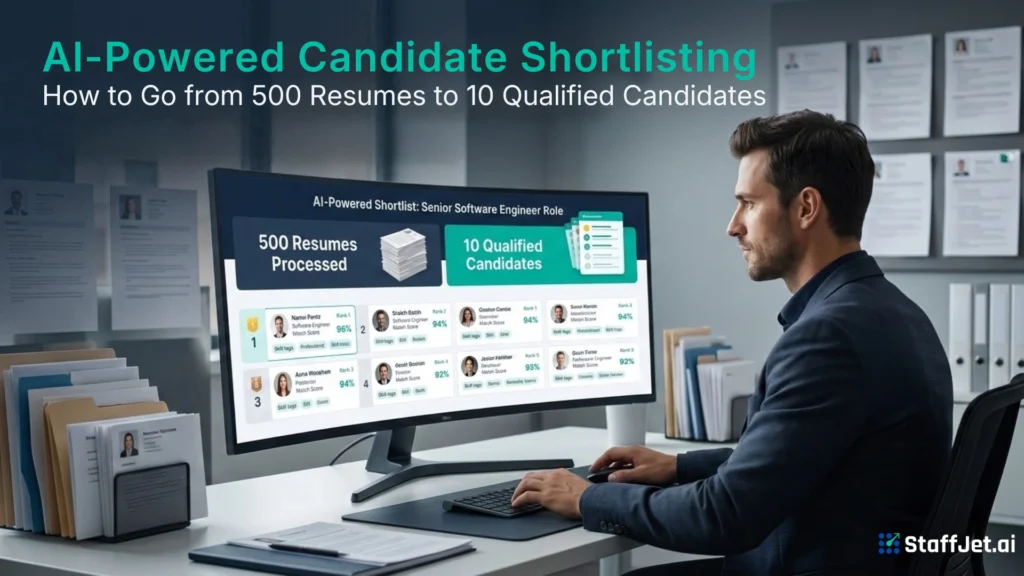
AI Candidate Screening: How to Go From 500 Resumes to 10 Qualified Candidates
A hiring team does not lose time because candidates are unavailable. It loses time because the right candidates are buried under hundreds of resumes.
AI candidate screening helps teams reduce that volume without depending only on manual review. It reads resumes, compares profiles with job requirements, scores relevance, and helps recruiters focus on the strongest applicants first.
Shortlisting is a critical step in the AI recruitment process — read the full step-by-step guide here: AI in the Recruitment Process
LinkedIn says AI is helping recruiters automate repetitive work and spend more time on strategic hiring tasks [LinkedIn, 2025]. SHRM also notes that AI can support recruiting by reducing repetitive screening work while keeping human judgment central [SHRM, 2025].
What Is an AI-Powered Candidate Shortlisting?
AI-powered candidate shortlisting is the process of using AI to screen, score, and rank applicants based on how well they match a job requirement.
It does not mean the system makes the final hiring decision. It means recruiters get a structured shortlist instead of a large, unfiltered resume pile.
The goal is simple: reduce noise early so human recruiters can spend more time on qualified candidates.
Why Manual Resume Shortlisting Breaks at 500 Applications
Manual shortlisting breaks at high volume because recruiter time, attention, and consistency do not scale with application count.
When 500 people apply for one role, every resume cannot receive a deep review. Recruiters must move quickly. That can lead to missed candidates, weak shortlists, and delayed responses.
This matters more now because skill requirements are changing fast. The World Economic Forum says analytical thinking, AI, big data, and digital skills are becoming more important across jobs [World Economic Forum, 2025].
Manual screening can still work for small applicant pools. It becomes risky when volume is high and timelines are tight.
How Can AI Turn 500 Resumes Into 10 Qualified Candidates?
AI turns 500 resumes into 10 qualified candidates by applying the same screening rules to every applicant, then ranking the strongest matches first.
The process usually starts with application collection, then resume reading, job description matching, match scoring, filtering, skills checks, and final ranking.
This is not only about speed. It is about structure.
For upstream context on how candidates enter the pipeline before shortlisting happens, read From Job Post to Shortlist
Step 1: Collect All Applications in One Hiring System
Candidate shortlisting improves when all applications are collected in one hiring system before screening begins.
Applications often come from job boards, career pages, referrals, and email. When these sources are scattered, recruiters spend time tracking instead of evaluating.
A single hiring system gives the team one clean candidate pool. It also reduces duplicate profiles and missed applications.
This step is basic, but it is important. Poor application collection creates poor shortlisting.
Step 2: Read and Analyse Every Resume Automatically
AI reads every resume automatically and extracts details such as skills, experience, education, and role history.
This replaces the first layer of manual resume reading.
A recruiter may be forced to skim quickly when volume is high. AI can review every profile using the same structure. That gives the hiring team a more consistent starting point.
SHRM says AI can help HR teams focus on higher-value work by automating repetitive tasks [SHRM, 2025].
Step 3: Match Candidate Profiles With the Job Description
AI matches candidate profiles with the job description to check whether the applicant fits the role requirement.
This is where AI screening becomes more useful than keyword search.
A candidate may use different words for the same skill. Another may mention the right keywords but lack relevant experience. A good matching process checks broader role fit, not only exact terms.
The strongest match comes from comparing skills, experience, role relevance, and must-have criteria together.
Step 4: Give Every Candidate an AI Match Score
An AI match score helps recruiters understand which candidates are most relevant before manual review begins.
A score gives order to the shortlist.
Instead of opening resumes randomly, recruiters can start with candidates who show stronger job fit. This saves time and creates a clearer review sequence.
The score should support recruiter judgment. It should not replace it.
A practical use is simple: review high-match profiles first, check borderline profiles next, and filter clear mismatches early.
Step 5: Filter Out Clearly Unqualified Candidates
AI filters out clearly unqualified candidates so recruiters can focus on applicants who have a realistic chance of moving forward.
Some candidates may lack required skills. Some may not match the seniority level. Some may apply to unrelated roles.
Filtering these profiles early protects recruiter time and hiring manager attention.
This is where AI screening replaces repetitive manual shortlisting. For a deeper comparison, see AI Resume Screening vs. Manual Screening
Step 6: Verify Skills Before Final Shortlisting
Skills verification helps hiring teams confirm whether shortlisted candidates can perform the work, not just describe it on a resume.
A resume can show claims. An assessment can show ability.
This is useful for engineering, data, sales, support, writing, and other role-based hiring. Skills assessments help teams avoid moving weak-fit candidates into interviews.
Randstad’s Workmonitor 2026 shows rising demand for AI-related skills and faster change in workforce expectations [Randstad, 2026]. That makes skills verification more important.
Step 7: Use Video Screening to Check Communication Fit
Video screening helps recruiters check communication, clarity, and role understanding before deeper interviews.
This matters for roles where communication affects performance. Sales, support, consulting, project delivery, and customer-facing technical roles all need more than resume fit.
Video screening does not need to replace recruiter conversations. It can help the team understand who deserves the next human interaction.
Used carefully, it reduces unnecessary calls and improves candidate prioritization.
Step 8: Rank the Best 10 Candidates for Recruiter Review
The final shortlist should rank the best 10 candidates based on resume fit, match score, skills evidence, and communication signals.
This gives recruiters a focused list.
The goal is not to remove human review. The goal is to make human review more valuable.
A strong 10-candidate shortlist should help recruiters answer three questions: who fits the role, why they fit, and who should be contacted first.
What Makes AI Shortlisting More Reliable Than Manual Screening?
AI shortlisting is more reliable when it uses consistent criteria for every candidate and produces explainable ranking signals.
Manual screening can be affected by fatigue, resume format, known company names, or reviewer preference.
AI-supported shortlisting applies the same first-pass logic across the full applicant pool. That creates consistency.
Recruiters should still review the final shortlist, especially for context, motivation, compensation fit, and role expectations.
How AI Shortlisting Saves Recruiter Time
AI shortlisting saves recruiter time by reducing manual resume review, repetitive filtering, and low-value candidate sorting.
Recruiters should not spend most of their day opening resumes one by one.
They should spend time on candidate conversations, hiring manager alignment, offer discussions, and pipeline quality.
LinkedIn says AI is changing recruiting by automating time-consuming work and helping recruiters focus on higher-impact tasks [LinkedIn, 2025].
How Hiring Teams Can Use the Final 10-Candidate Shortlist
Hiring teams can use the final 10-candidate shortlist to run faster reviews, align with hiring managers, and move top candidates into interviews.
The shortlist should not be just names and resumes.
It should include match reasons, strengths, gaps, and next-step recommendations. That helps hiring managers review candidates faster.
Once the shortlist is ready, the next delay is often interview coordination. To reduce that gap, read Automated Interview Scheduling
Where Human Recruiters Still Add Value After AI Shortlisting
Human recruiters add value after AI shortlisting by checking context, motivation, culture fit, compensation expectations, and offer risk.
AI can rank profiles. It cannot fully judge human intent.
Recruiters still need to speak with candidates, understand career goals, manage hiring managers, and keep strong applicants engaged.
This is especially important in India, where notice periods, counteroffers, and offer drops can affect hiring outcomes.
Final Thoughts: From Resume Volume to Interview-Ready Talent
The future of shortlisting is not reading more resumes. It is building a faster path from resume volume to interview-ready talent.
AI can help teams move from 500 applications to a smaller, clearer, and more qualified shortlist.
The best approach is practical. Start with one role. Track shortlist quality, recruiter time saved, hiring manager feedback, and candidate drop-off.
AI should not replace recruiters. It should give them a stronger starting point.
Key Takeaways
- AI-powered candidate shortlisting helps hiring teams reduce resume volume without losing structure.
- AI reads resumes, matches profiles, gives match scores, filters weak profiles, and ranks stronger candidates.
- Skills verification and video screening improve shortlist quality beyond resume fit.
- Recruiters still own judgment, candidate conversations, and final hiring decisions.
- The best first test is one high-volume role with clear screening criteria.