How to Build an AI-First Recruitment Strategy: A Framework for Talent Acquisition Leaders
Introduction
Talent acquisition leaders are no longer judged only by how many roles they close.
They are expected to improve hiring speed, cost-per-hire, candidate quality, recruiter productivity, and visibility across the hiring process. That is why ai in talent acquisition is becoming a strategy issue, not just a tool decision.
An AI-first recruitment strategy helps teams automate repetitive hiring work while keeping human judgment for final decisions.
This framework operationalizes the process covered in our complete guide to AI in the recruitment process: AI in the Recruitment Process
LinkedIn says AI is helping recruiters streamline repetitive tasks and spend more time on strategic hiring work [LinkedIn, 2025]. SHRM also says AI can help HR leaders align recruitment strategy with business goals when human intelligence remains central [SHRM, 2025].
What Is an AI-First Recruitment Strategy?
An AI-first recruitment strategy is a structured plan for using AI across hiring tasks while keeping recruiters responsible for judgment, relationships, and final decisions.
It is not about replacing recruiters. It is about redesigning the hiring process.
The strategy defines what AI should automate, what humans should own, what data leaders should track, and how hiring quality will be measured.
Why Talent Acquisition Leaders Need an AI-First Hiring Approach
Talent acquisition leaders need an AI-first hiring approach because manual hiring cannot scale with rising role complexity and candidate volume.
Recruiters face more applications, faster skill changes, and higher expectations from hiring managers.
The World Economic Forum says AI, big data, networks, cybersecurity, and digital skills are among the fastest-growing skill areas for employers [World Economic Forum, 2025].
When skills change quickly, old resume-first processes become weaker. Leaders need systems that can screen, assess, and compare candidates faster.
How AI Changes the Recruitment Process From Manual to Structured
AI changes recruitment by turning scattered manual tasks into a structured workflow with clearer candidate data and faster decisions.
Manual recruitment often depends on emails, spreadsheets, job board exports, interview notes, and delayed feedback.
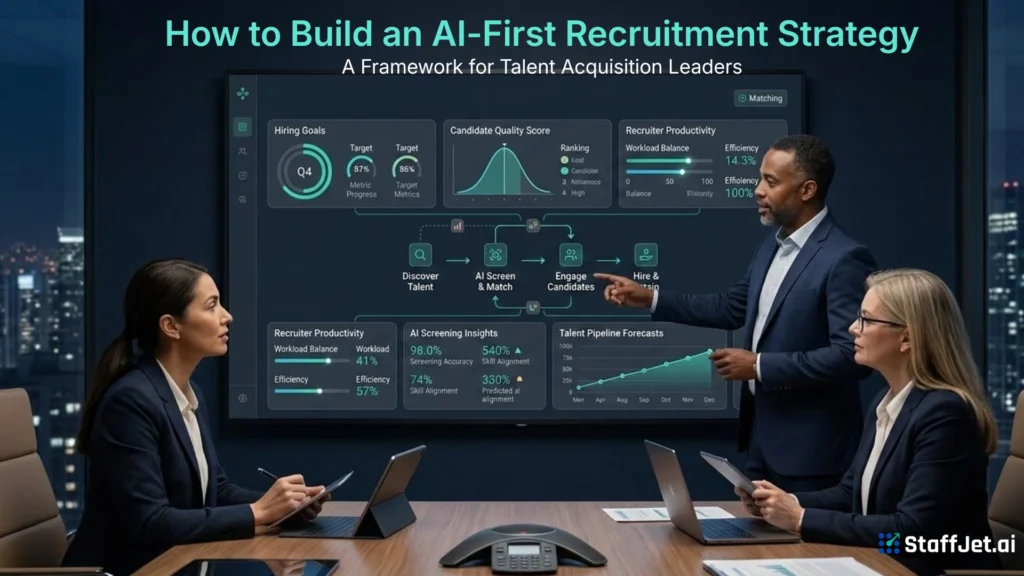
AI creates structure across the process: job posting, profile matching, resume screening, skills assessment, AUTO INTERVIEW, and dashboard reporting.
The result is not fully automated hiring. The result is a clearer decision path.
Step 1: Identify Where Your Hiring Process Slows Down
The first step is to find the stages where hiring delays, candidate drop-off, or recruiter workload are highest.
Most teams feel hiring is slow, but they do not always know where the delay starts.
Check four areas: application collection, resume screening, interview scheduling, and hiring manager feedback.
If roles stay open because resumes are not screened fast enough, top-funnel automation should be the first priority.
Step 2: Choose Which Recruitment Tasks AI Should Automate
AI should automate repetitive tasks that slow recruiters down but do not require deep human judgment.
Good automation candidates include resume screening, profile matching, assessment delivery, interview scheduling, reminders, report generation, and dashboard updates.
Human recruiters should keep ownership of candidate conversations, employer selling, offer discussions, and final judgment.
When selecting tools, TA leaders should evaluate the full workflow, not just one feature. Use this guide for tool selection: What to Look for in AI Recruitment Tools
Step 3: Use AI Resume Screening to Build Faster Shortlists
AI resume screening helps teams move from large applicant pools to stronger shortlists faster.
This is often the best first use case because manual screening creates heavy recruiter workload.
AI can read resumes, identify relevant skills, compare profiles against job descriptions, and rank candidates for review.
For Phase 1, automate the top of funnel first. Start here: From Job Post to Shortlist
For deeper shortlisting detail, see AI-Powered Candidate Shortlisting: 500 to 10
Step 4: Add Skills Assessments to Verify Candidate Ability
Skills assessments help teams verify what candidates can do before they reach final interviews.
This reduces the risk of shortlisting candidates based only on resume claims.
For technical roles, assessments can test coding, logic, or domain knowledge. For non-technical roles, they can test communication, writing, reasoning, or role-specific judgment.
The point is simple: verify ability before using senior interview time.
Step 5: Use AI Interviews for Consistent First-Round Evaluation
AI interviews help hiring teams apply consistent first-round evaluation criteria across candidates.
A live AUTO INTERVIEW of 20–30 minutes at a booked time slot can evaluate candidate responses using a structured framework.
This helps reduce variation between interviewers. One interviewer may ask deeper questions than another. A structured first-round process creates more consistency.
Human review should still remain part of the decision.
Step 6: Centralize Candidate Data in One Hiring Dashboard
A hiring dashboard gives TA leaders one place to track candidate progress, scores, interviews, and reports.
This is where AI recruitment becomes manageable at scale.
Without a dashboard, candidate data sits across email, spreadsheets, job boards, assessment tools, and interview notes.
For Phase 3, unify data and reporting. Use this dashboard guide: Unified Hiring Dashboards
Step 7: Keep Human Recruiters Focused on Final Decisions
Human recruiters should focus on candidate context, motivation, offer risk, stakeholder alignment, and final recommendations.
AI can screen and organize. It cannot fully understand intent.
Recruiters still need to speak with candidates, check expectations, manage hiring managers, and keep top candidates engaged.
This is especially important in India, where notice periods, counteroffers, and offer drops can affect hiring outcomes.
Step 8: Track Hiring Metrics to Improve the Strategy
An AI-first recruitment strategy must be measured through hiring metrics, not only tool adoption.
Track time-to-shortlist, time-to-interview, cost-per-hire, recruiter hours saved, candidate drop-off, shortlist quality, and hiring manager feedback.
Locked platform benchmarks may include 10x faster candidate shortlisting, 60% lower cost-per-hire, 70% hours saved per year, and a 24-hour hiring timeline. Treat these as platform-reported metrics unless independently validated.
What Should Talent Acquisition Leaders Measure in AI Recruitment?
TA leaders should measure whether AI improves speed, quality, productivity, visibility, and candidate movement through the funnel.
Do not measure only how many resumes the system screens.
Measure whether hiring managers receive better shortlists. Measure whether recruiters spend less time on admin. Measure whether candidates move faster through the process.
Greenhouse’s 2025 workforce hiring research shows candidate experience and hiring process friction remain major concerns for job seekers [Greenhouse, 2025].
How AI-First Recruitment Improves Recruiter Productivity
AI-first recruitment improves recruiter productivity by removing repetitive tasks from the recruiter’s daily workload.
Recruiters should not spend most of their time opening resumes, updating spreadsheets, or chasing interview status.
AI helps shift their work toward higher-value actions: candidate conversations, pipeline building, offer management, and stakeholder alignment.
LinkedIn says AI is reshaping recruiting by automating time-consuming tasks and changing the recruiter role [LinkedIn, 2025].
How AI Helps Standardize Hiring Across Teams and Roles
AI helps standardize hiring by applying consistent screening, assessment, interview, and reporting workflows across roles.
This is important for enterprises, IT services firms, and recruitment agencies managing many hiring needs.
Without standardization, each recruiter or hiring manager may apply different criteria. That creates inconsistent shortlist quality.
A structured AI workflow helps teams compare candidates more fairly while still allowing human decision-making.
What Mistakes Should Leaders Avoid When Adopting AI in Recruitment?
Leaders should avoid adopting AI without clear goals, clean process ownership, human review, and measurement.
Do not start with a tool before defining the problem.
Avoid automating broken workflows. Avoid relying only on match scores. Avoid removing recruiters from important candidate conversations.
Also avoid treating an end-to-end AI hiring intelligence platform as just an ATS. The goal is not storage. The goal is better screening, assessment, interviews, reporting, and decisions.
Final Thoughts: Building a Faster and Smarter Hiring Strategy
A strong AI-first recruitment strategy improves hiring speed while keeping human judgment at the center.
The future of hiring will not be fully manual or fully automated.
It will be structured. AI will handle repetitive screening, assessment, scheduling, interview documentation, and reporting. Recruiters will handle judgment, relationships, and final decisions.
Start small. Pick one role. Map the bottlenecks. Automate the highest-friction stage. Measure the result. Then expand across teams.
Key Takeaways
- An AI-first recruitment strategy starts with process clarity, not tool buying.
- AI should automate repetitive tasks while recruiters keep final judgment.
- Top-funnel automation is often the best first phase.
- Skills assessments and AI interviews improve evaluation structure.
- Dashboards help leaders track hiring performance and bottlenecks.
- Metrics should prove business impact, not just AI usage.