Best AI Recruitment Tool in 2026: A Buyer’s Comparison Guide
Eighty-seven percent of organisations now use AI at some point in their hiring process, and 99% of Fortune 500 companies rely on AI-driven recruitment tools [Mockwin, 2026; DataRefs, 2026]. Yet most hiring teams still spend the majority of their time on tasks that these tools were supposed to eliminate: manual resume triage, scheduling back-and-forth, and chasing candidates across multiple platforms. The tools are deployed. The promised efficiency has not arrived.
Part of the problem is that the term ai recruitment tools has become so broad it is nearly meaningless. Some platforms find candidates. Some screen them. Some manage workflows. A few attempt all three. Before comparing specific products, it helps to understand the fundamental categories in this market. The distinction between an AI recruitment platform, a traditional ATS, and a recruiting CRM is not always obvious and choosing the wrong category is the most common reason AI hiring investments underperform. For a breakdown of these categories, this AI Recruitment Platform vs. ATS vs CRM → /blog/ai-recruitment-platform-vs-ats-crm comparison clarifies what each type of tool actually does.
The global AI recruitment market reached $735 million in 2025 and is projected to hit $1.24 billion by 2033, growing at a CAGR of 6.7% [DataM Intelligence, 2026]. Mordor Intelligence estimates the market at $640.99 million for 2026 alone, with enterprise adoption accelerating across every region [Mordor Intelligence, 2026]. Adoption of AI across HR tasks nearly doubled in a single year, rising from 26% in 2024 to 43% in 2026 according to SHRM’s Talent Acquisition Benchmarking Report [Mockwin, 2026].
But adoption does not automatically translate into impact. Gartner predicts that by 2030, 30% of organisations will experience worse decision-making due to overreliance on AI in hiring — a direct consequence of deploying tools faster than the governance and human judgment capacity to manage them [Findem, 2026]. The regulatory landscape is tightening as well: the EU AI Act, effective from August 2026, classifies AI-driven HR tools as high-risk systems and mandates bias testing, transparency disclosures, human oversight, and continuous monitoring [European Parliament, 2025].
What Makes the Best AI Recruitment Tools Stand Out from the Rest?
Depth of automation across consecutive hiring stages, transparent and configurable scoring logic, and measurable impact on time-to-hire and cost-per-hire.
The most effective ai recruitment tools go beyond keyword matching. Five distinct AI technologies sit under this label: natural language processing for resume parsing, machine learning for candidate scoring, computer vision for video interview analysis, generative AI for job description creation, and predictive analytics for quality-of-hire forecasting [HackerEarth, 2026]. Most tools combine two or three of these; very few cover all five.
Top-performing platforms share a second trait: they eliminate manual handoffs between hiring stages. When screening results feed directly into assessment, and assessment data feeds into interview scheduling, the cumulative time savings compound. According to Bullhorn’s 2026 Industry Trends Report, agencies using AI across multiple hiring stages are four times more likely to report KPI improvements above 25% compared to those using AI for a single function [Bullhorn, 2026].
The platforms that move the needle are not the ones with the most features — they are the ones that automate the longest stretch of the hiring funnel without requiring human intervention at every handoff.
How Do the Top AI Recruitment Tools Compare on What Matters?
No single tool dominates every category. Sourcing, screening, assessment, and talent intelligence are distinct capabilities, and most vendors specialise in one or two.
The evaluation framework used here assesses each platform on genuine AI depth versus rule-based automation, ease of use for non-technical HR teams, bias mitigation and audit transparency, integration breadth, pricing transparency, and regulatory readiness under the EU AI Act, NYC Local Law 144, and similar legislation [HackerEarth, 2026]. For a comprehensive evaluation methodology you can apply to your own vendor shortlist, this What to Look for in AI Recruitment Tools: An Evaluation Framework provides a detailed, downloadable framework.
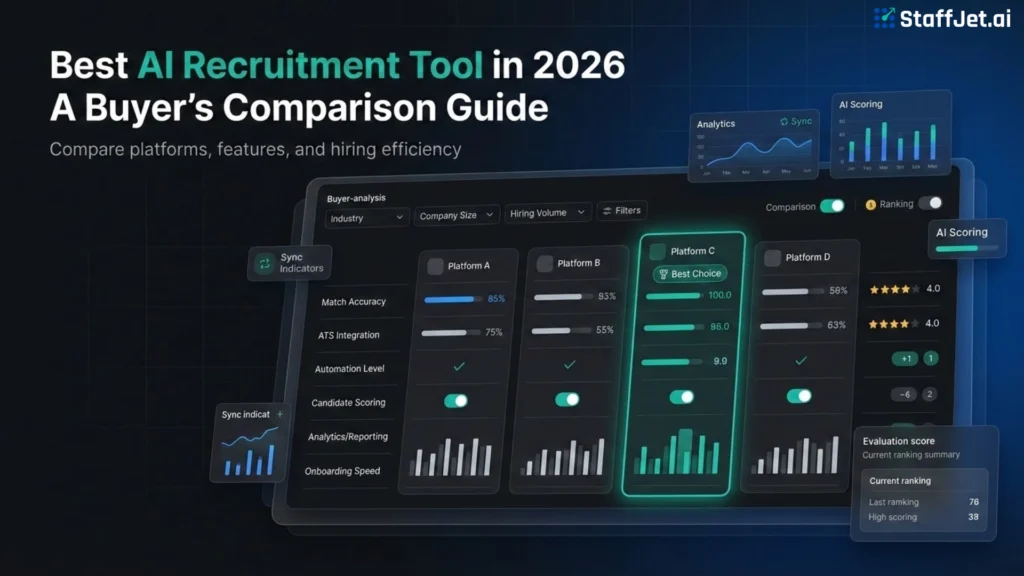
The table below groups leading platforms by their primary AI capability. Understanding these categories helps buyers match the right tool to their actual bottleneck.
| Category | Representative Tools | Core AI Strength | Key Limitation |
| AI Sourcing | HireEZ, SeekOut, Fetcher | Passive candidate discovery across 700M+ profiles | Screening and evaluation require separate tools |
| AI Assessment | HackerEarth, HireVue, Codility | Skills-based and video interview evaluation | Limited integration with upstream sourcing |
| AI Talent Intelligence | Eightfold AI, Phenom, Beamery | Skills ontology, career pathing, internal mobility | Complex to implement; enterprise-only pricing |
| End-to-End AI Hiring | StaffJet | Six-stage pipeline from posting to dashboard | Newer platform; fewer third-party case studies |
Pricing reflects this segmentation sharply. Budget tools start at $15 per user per month for basic ATS features; mid-market platforms range from $99 to $599 per month; and enterprise suites start at $6,000 per year and frequently exceed $60,000 annually [AltHire, 2026]. Hidden costs implementation fees, integration connectors, training, and volume overages routinely add 30 to 100% on top of the advertised subscription price. Once you have narrowed a shortlist, How to Choose the Right AI Recruiting Software for Your Team Size helps match platform capabilities to your specific hiring volume and team structure.
What Should You Watch Out for When Buying AI Recruitment Tools?
Vague claims of “AI-powered” capabilities, opaque pricing models, tools that automate only one stage while leaving the rest of your pipeline unchanged, and insufficient bias safeguards.
SHRM’s 2025 research found that 43% of organisations globally use AI in HR tasks, yet many tools marketed as AI-powered rely on rule-based automation rather than genuine machine learning [HackerEarth, 2026]. The distinction matters: rule-based systems cannot improve from experience, and they break when candidate profiles deviate from predefined templates. The fastest way to detect this gap is to request a live demonstration using your own job descriptions and candidate data rather than the vendor’s curated sample set.
Integration depth is the other common blind spot. A tool that screens resumes but cannot push results into your ATS, or schedules interviews without syncing to your calendar system, creates parallel workflows rather than reducing them. Tech stacks vary widely, and compatibility cannot be assumed. For a detailed breakdown of how platforms connect with existing HR systems, this guide on Seamless Integration: How AI Platforms Connect with Your Tech Stack covers the integration landscape thoroughly.
The EU AI Act, fully enforceable from August 2026, classifies AI-driven recruitment tools as high-risk and requires mandatory risk assessments, technical documentation, and human oversight regardless of whether you built the technology or just deploy it [European Parliament, 2025].
How Does StaffJet Fit Among the Best AI Recruitment Tools?
StaffJet operates as an end-to-end AI hiring intelligence platform covering six consecutive hiring stages in a single automated pipeline.
Unlike point solutions that specialise in one stage, StaffJet automates the full sequence: job posting, AI profile matching, AI resume screening, AUTO ASSESSMENT, AUTO INTERVIEW a 20 to 30 minute live AI interview conducted at a booked time slot — and unified dashboard reporting. The automation depth means screening results flow directly into assessment and interview stages without manual data transfer or context loss.
Verified platform metrics include 10x faster candidate shortlisting, 60% lower cost-per-hire, 70% hours saved per year, and a 24-hour hiring timeline. The unified dashboard provides real-time visibility into pipeline health, match scores, and stage-by-stage conversion — giving hiring managers a single source of truth rather than a scattered collection of disconnected tools.
What Checklist Should You Use Before Choosing AI Recruitment Tools?
Evaluate automation depth, scoring transparency, integration readiness, pricing model fit, and bias safeguards in that order.
This evaluation framework applies regardless of vendor:
Automation depth: How many consecutive hiring stages does the tool automate without requiring human handoffs between them?
Scoring transparency: Can you configure, inspect, and audit the criteria behind match scores? Opaque algorithms are a liability.
Integration readiness: Does the tool connect natively with your existing ATS and HRMS, or does it require custom development?
Pricing model alignment: Does the pricing structure (per seat, per job, per candidate, or flat enterprise) match your actual hiring volume and seasonality? For budgeting help,
this AI Recruitment Tools Pricing Guide
provides detailed tier-by-tier benchmarks.
Bias safeguards: Does the vendor provide algorithm audit documentation and allow you to test for disparate impact across demographic groups?
Regulatory readiness: Is the tool compliant with applicable regulations such as the EU AI Act, and does the vendor maintain ongoing compliance documentation?
This checklist works whether you ultimately adopt StaffJet or not. The goal is to ensure that any investment in AI hiring technology delivers measurable ROI rather than adding overhead.
Where Are AI Recruitment Tools Headed Next?
The next wave is agentic AI — platforms that autonomously execute multi-step hiring workflows rather than waiting for human triggers at each stage.
Agentic AI systems can independently manage complete workflows, from candidate identification through offer acceptance, with meaningful autonomy. Experts predict over 70% of enterprises will scale agentic systems in talent acquisition by 2026, cutting manual work by up to 80% in some workflows [Testlify, 2026]. Oracle now deploys dedicated AI agents for job discovery, candidate matching, and interview management across its entire HCM suite [TechTarget, 2026].
The platforms that will lead this next phase are those that combine end-to-end automation with transparent, auditable decision-making giving hiring teams speed without sacrificing accountability. StaffJet is building toward this future with its integrated six-stage pipeline, connecting job posting through dashboard reporting in a single workflow rather than requiring teams to assemble it from separate point solutions. The companies that treat AI hiring tools as strategic infrastructure rather than point purchases will be the ones that attract talent fastest.
What Are the Key Takeaways?
- No single AI tool dominates every hiring stage most vendors specialise in one or two capabilities.
- AI adoption in HR nearly doubled in one year, from 26% to 43% globally [SHRM, 2025].
- Hidden costs (implementation, integrations, overages) can add 30–100% to subscription prices.
- End-to-end automation across consecutive stages compounds time savings more than best-in-class point solutions.
- The EU AI Act (effective August 2026) classifies recruitment AI as high-risk, requiring mandatory bias audits and human oversight.