AI in the Recruitment Process: A Step-by-Step Guide
Hiring in India is no longer only an HR problem. It is now a business delay problem.
When one engineering role stays open, product delivery slows. When a sales role stays open, revenue gets delayed. When recruiters spend hours reading resumes, the best candidates often move ahead with faster companies.
This is why AI in the recruitment process is becoming a serious priority for HR leaders, TA teams, CTOs, and recruitment agencies. The goal is not to remove people from hiring. The goal is to remove repetitive work from hiring.
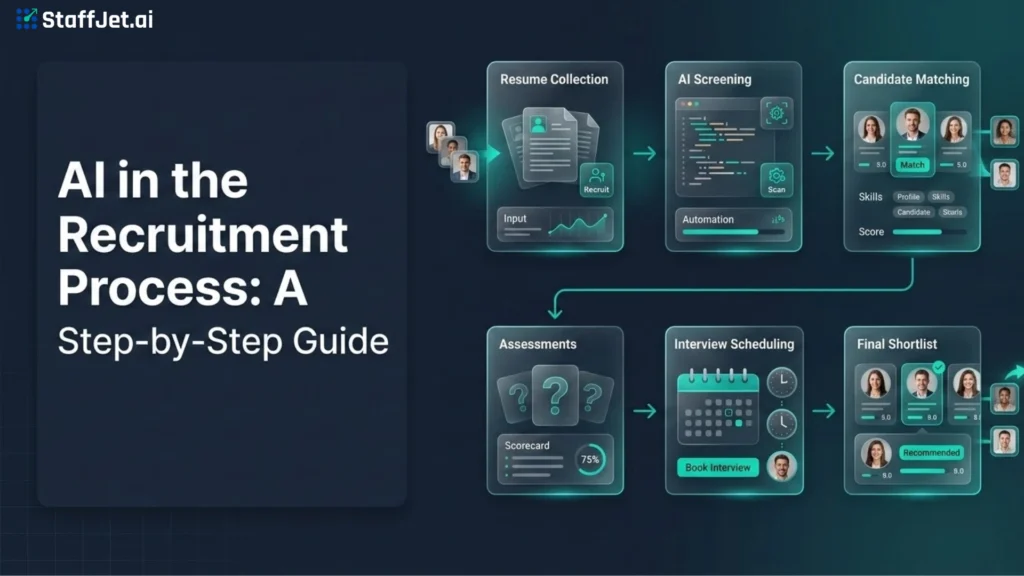
AI helps teams collect applications, screen resumes, rank candidates, test skills, run structured interviews, and view reports in one dashboard. LinkedIn’s 2025 recruiting research says generative AI is helping recruiters spend less time on repetitive tasks and more time on strategic work [LinkedIn Future of Recruiting, 2025].
For teams that want a deeper view of top-funnel automation, read From Job Post to Shortlist
What Is AI in the Recruitment Process?
AI in the recruitment process means using automation to handle repetitive hiring tasks such as screening, scoring, assessments, interviews, and reporting while humans keep control of final hiring decisions.
AI helps hiring teams move faster because it processes candidate data at scale. It can compare resumes against job descriptions, identify relevant skills, rank applicants, and create structured reports.
This matters because hiring is becoming more skills-led. The World Economic Forum says AI, big data, cybersecurity, and digital skills are among the fastest-growing skill areas for employers [World Economic Forum, 2025].
Why Are Companies Using AI in the Recruitment Process?
Companies use AI in the recruitment process because manual hiring is slow, inconsistent, and expensive when application volume is high.
Recruiters are often stuck between speed and quality. If they move too fast, they may miss good candidates. If they review every profile manually, the process becomes too slow.
SHRM notes that AI can support recruiting by automating repetitive tasks and allowing HR teams to focus on high-value, human-centered work [SHRM, 2025]. That is the real value: less admin, better focus.
Step 1: Collect Applications From All Job Boards
AI starts by bringing applications from different job sources into one system so recruiters do not manage scattered resumes across platforms.
Most hiring teams receive applications from LinkedIn, Naukri, Indeed, career pages, referrals, and email. Manual tracking creates duplication and missed follow-ups.
An AI hiring intelligence platform can centralize applications so the recruitment process starts with one clean pipeline instead of multiple disconnected sources.
This is useful for high-volume hiring, where 500 applications for one role can quickly become unmanageable.
Step 2: Screen Resumes Against the Job Description
AI resume screening compares each resume with the job description and identifies candidates whose skills, experience, and role fit match the hiring need.
Manual resume screening depends heavily on recruiter time and attention. Fatigue can affect quality. AI applies the same screening logic to every resume.
In StaffJet, AI resume screening is part of the end-to-end hiring process. The platform is built to screen resumes, evaluate role fit, and move the best-fit candidates forward.
For a more detailed breakdown, see AI Resume Screening Guide
Step 3: Rank Candidates With Match Scores
AI match scores help recruiters see which candidates are most relevant before they spend time reviewing every profile manually.
A match score gives structure to shortlisting. Instead of reading resumes in random order, recruiters can start with candidates who show stronger role alignment.
StaffJet uses AI profile matching and candidate scoring to help teams move from large application pools to focused shortlists. StaffJet’s locked product metric claims 10x faster candidate shortlisting [StaffJet, 2026].
For the full shortlisting flow, read AI-Powered Candidate Shortlisting: 500 to 10
Step 4: How Does AI Video Screening Work in the Recruitment Process?
AI video screening helps teams evaluate communication, clarity, confidence, and role understanding before scheduling deeper interviews.
This is useful when a role needs strong communication, such as sales, customer success, support, consulting, or client-facing technical roles.
The benefit is consistency. Every candidate answers structured questions. Recruiters can review the stronger responses first instead of spending hours on repeated first-round calls.
This also reduces coordination pressure when candidates and hiring teams are in different cities or time zones.
Step 5: How Do AI Skills Assessments Verify Candidate Ability in the Recruitment Process?
AI skills assessments verify whether candidates can actually perform job-related tasks before hiring managers spend interview time on them.
A resume can claim skills. An assessment tests them.
StaffJet’s AUTO ASSESSMENT helps teams verify candidate capability through role-specific assessments. This can include technical, aptitude, coding, or other job-relevant formats listed in the hiring workflow.
For CTOs and TA heads, this protects interview bandwidth. It helps hiring teams meet candidates who have already passed a practical skills check.
Step 6: How Does an AI Interview Evaluate Candidates in the Recruitment Process?
An AI interview evaluates candidates through structured questions, consistent scoring, and complete transcripts so teams can compare responses more fairly.
StaffJet’s AUTO INTERVIEW is a live AI interview of 20–30 minutes at a booked time slot. It is not an on-demand video recording.
This stage helps teams evaluate depth, communication, reasoning, and job fit in a structured way. SHRM’s AI guidance also stresses that AI should support human-centered hiring decisions, not replace them [SHRM, 2025].
For scheduling workflows, read Automated Interview Scheduling
Step 7: How Does AI in the Recruitment Process Create Candidate Reports?
AI creates candidate reports by combining resume scores, assessment results, interview summaries, and evaluation data into one decision-ready format.
This matters because hiring decisions often suffer from scattered information. One recruiter has resume notes. One hiring manager has interview feedback. Assessment data may sit in another tool.
A report brings the evidence together. It helps teams compare candidates using the same criteria instead of relying only on memory or gut feel.
Step 8: How Does the Dashboard Help Recruiters in the AI Recruitment Process?
A dashboard gives recruiters one view of candidate progress, scores, reports, and hiring status across every stage.
This is where AI becomes useful for decision-making, not just screening.
StaffJet’s unified dashboard shows candidate journeys across screening, assessments, AI interviews, and reports. This helps recruiters compare candidates faster and keep hiring managers aligned.
For a deeper dashboard view, see Unified Hiring Dashboards
What Are the Main Benefits of AI in the Recruitment Process?
The main benefits are faster shortlisting, lower cost-per-hire, better recruiter productivity, more consistent evaluation, and stronger hiring visibility.
StaffJet’s locked product metrics include 10x faster candidate shortlisting, 60% lower cost-per-hire, 70% hours saved per year, and a 24-hour hiring timeline [StaffJet, 2026].
These numbers should be understood as StaffJet platform metrics, not independent industry benchmarks.
The broader market direction supports the need for automation. Randstad’s 2026 Workmonitor points to fast-changing skills demand, including sharp growth in AI-related job requirements [Randstad, 2026].
Does AI in the Recruitment Process Replace Recruiters or Support Them?
AI supports recruiters by removing repetitive work, while recruiters still own judgment, relationships, final interviews, and hiring decisions.
Recruitment is not only screening. It includes persuasion, trust-building, negotiation, culture fit, and stakeholder management.
AI is best used where work is repetitive and rule-based. Humans are still needed where judgment and context matter.
A good AI hiring workflow should make recruiters more valuable, not less visible.
Which Teams Benefit Most From AI in the Recruitment Process?
Teams with high application volume, technical hiring needs, limited recruiter bandwidth, or urgent hiring timelines benefit most from AI recruitment automation.
Startups benefit because small HR teams can manage more roles.
IT services companies benefit because project hiring often needs fast shortlists.
Enterprises benefit because they need consistency across departments.
Recruitment agencies benefit because faster screening can improve client delivery.
For technical teams, AI also protects senior engineers from spending too much time with candidates who have not been skills-verified.
What Should Companies Check Before Choosing an AI Recruitment Platform?
Companies should check whether the platform covers the full hiring workflow, supports human decision-making, provides clear reports, and improves speed without reducing quality.
Use this checklist:
- Can it collect applications from multiple sources?
- Can it screen resumes against job descriptions?
- Can it rank candidates clearly?
- Can it verify skills before interviews?
- Can it support structured interviews?
- Can it show all candidate data in one dashboard?
- Can hiring managers still make the final decision?
Avoid tools that only organize resumes but do not improve the hiring workflow. StaffJet should be seen as an end-to-end AI hiring intelligence platform, not just an ATS.
For tool comparison, read Best AI Recruitment Tool in 2026
Final Thoughts: Is AI in the Recruitment Process the Future?
AI in the recruitment process is becoming the future because hiring teams need speed, structure, and better evidence before making decisions.
The next stage of recruitment will not be fully automated hiring. It will be AI-supported hiring.
AI will handle sourcing, screening, scoring, assessments, interview documentation, and reporting. Recruiters and hiring managers will focus on judgment, candidate relationships, and final decisions.
StaffJet fits this future by bringing AI profile matching, AI resume screening, AUTO ASSESSMENT, AUTO INTERVIEW, and dashboard reporting into one hiring workflow.
If your team is planning this shift, start with one role. Measure time saved, shortlist quality, candidate drop-off, and hiring manager satisfaction. Then scale the workflow with a clear roadmap.
For next steps, read How to Build an AI-First Recruitment Strategy
Key Takeaways
- AI in the recruitment process helps teams automate repetitive hiring work while keeping humans in control of final decisions.
- AI is most useful for resume screening, candidate ranking, skills testing, structured interviews, and reporting.
- StaffJet is an end-to-end AI hiring intelligence platform, not just an ATS.
- StaffJet’s locked product metrics include 10x faster shortlisting, 60% lower cost-per-hire, 70% hours saved per year, and a 24-hour hiring timeline [StaffJet, 2026].
- The best way to start is with one role, one workflow, and clear measurement.