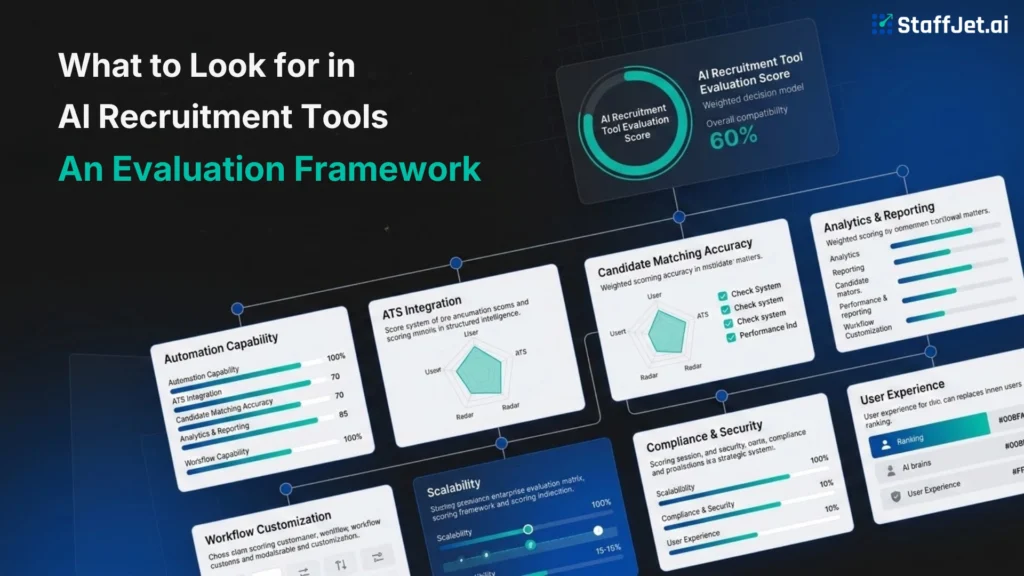
What to Look for in AI Tools for Recruitment: An Evaluation Framework
80% of employers in India report struggling to fill open roles — the highest rate globally [ManpowerGroup India, 2025]. Meanwhile, the average recruiter spends 40–60% of their day on manual resume screening, processing applications that largely miss the mark [BotFriday, 2025]. Talent scarcity is worsening, but the tools most teams use have barely evolved. If you are evaluating ai tools for recruitment, the market will not make it easy. Vendors blur the line between automation and intelligence, pricing models hide real costs, and quality of hire rarely appears on a comparison chart.
Use this framework to cut through the noise, compare vendors objectively, and find the platform that actually moves your hiring numbers. For a head start, you can apply this framework alongside our Best AI Recruitment Tool in 2026 comparison to evaluate the top contenders in one place.
Why Are AI Recruitment Tools Becoming Essential for Indian Hiring Teams?
Because the cost of slow, manual hiring now directly threatens business growth in India’s talent-scarce market.
Only 42.6% of Indian graduates are considered employable [Mercer Mettl, 2025]. The tech sector faces a 25–27% digital talent gap projected to widen by 2028 [NASSCOM, 2025]. Globally, SHRM reports the average time to fill a position at 42 days, with cost per hire at approximately $4,100 [SHRM, 2024]. In India, the timeline stretches to 35–45 days for white-collar roles and up to 60 days for mid-level IT [Voltech HR Services, 2025].
These pressures explain why 85% of recruiters recognise AI’s utility in hiring and 94% confirm it has streamlined their processes [ElectroIQ, 2025]. But adoption without structured evaluation leads to tools that sit unused or introduce new problems. Before selecting a platform, define requirements based on team size, hiring volume, and specific pain points. For a tailored approach, our guide on How to Choose the Right AI Recruiting Software for Your Team Size walks you through aligning criteria with your organisation’s scale.
Does the AI Recruitment Tool Cover the Full Hiring Pipeline?
The most impactful platforms address multiple hiring stages end-to-end, from sourcing through to reporting — not just a single step.
Many products specialise in one function: resume parsing, video interviews, or assessments. Point solutions create data silos — a candidate profile from AI resume screening may not carry over to an assessment stage, forcing recruiters to reconcile information across platforms. This fragmentation adds time and introduces errors at every handoff.
Research indicates that companies using end-to-end AI hiring platforms report up to 75% lower cost-per-screening and a 35% reduction in staff time dedicated to hiring tasks [ElectroIQ, 2025]. When evaluating a tool, map its capabilities against your complete hiring workflow: sourcing and profile matching, resume screening, skills assessment, interviewing, and reporting. If a vendor can only automate two of these stages, ask specifically how candidate data flows between their tool and the rest of your process.
How Do You Measure Screening Accuracy and Fairness in AI Recruitment Tools?
Demand verifiable accuracy metrics from vendors and insist on documented bias audit processes claims of “AI-powered” screening mean little without transparent evidence.
Manual resume screening takes 12–18 hours per 100 CVs; AI processes the same volume in 10–15 minutes plus human review [Marxel, 2025]. But speed without accuracy wastes time in a different way you move through candidates faster, but may miss strong fits or advance weak ones.
Fairness is equally critical. Greenhouse’s 2026 report found 27% of candidates perceived age bias and 17% cited race or ethnicity bias in AI-led interviews, while 30% dropped out after discovering AI was involved largely because they were not informed upfront [Greenhouse, 2026]. Request precision and recall metrics against your own candidate pools, and demand documentation of the vendor’s bias audit methodology.
What Is the True Total Cost of Ownership for AI Recruitment Tools?
Look beyond the monthly subscription to calculate the full cost: implementation, training, integration work, and the hidden expense of a tool that underperforms.
Pricing varies widely: per seat, per hire, or tiered by feature access. But the subscription fee is only the starting point. A tool requiring months of implementation, dedicated IT support, and extensive recruiter training has a real cost far above its sticker price.
SHRM puts average cost per hire at $4,100 [SHRM, 2024]. Factor in recruiter productivity loss (2.5–3 hours daily on resumes), extended time-to-fill, and unfilled-role revenue impact. Build a total cost model including onboarding, integration, and manual workaround costs. For a detailed breakdown, our AI Recruitment Tools Pricing Guide covers common pricing structures and helps you calculate actual spend.
Can the AI Recruitment Tool Integrate Seamlessly With Your Existing Tech Stack?
Integration capability is a non-negotiable criterion a tool that cannot connect to your ATS, HRIS, or communication platforms will create more work than it saves.
Gartner projects that by 2025, 60% of enterprise organisations will adopt a responsible AI framework for HR technology [Gartner, 2024]. An AI recruitment platform that cannot exchange data with existing systems forces recruiters into parallel workflows manually transferring data, duplicating effort, and losing audit trails.
Assess whether the tool offers APIs, pre-built ATS/HRIS connectors, and webhook support for real-time sync. For a deeper technical perspective, our guide on https://staffjet.ai/seamless-integration-how-ai-recruitment-tools-connect-with-your-tech-stack/ outlines key questions to ask vendors.
How Does StaffJet Align With This AI Recruitment Evaluation Framework?
StaffJet addresses the evaluation criteria outlined above as an end-to-end AI hiring intelligence platform, not a point solution.
StaffJet automates six stages of recruitment: job posting, AI profile matching, AI resume screening, skills assessment, live AI interview (AUTO INTERVIEW, 20–30 minutes at a booked time slot), and dashboard reporting. This pipeline coverage eliminates the fragmentation inherent in assembling multiple point solutions.
StaffJet delivers 10x faster candidate shortlisting, 60% lower cost-per-hire, and 70% hours saved per year. The unified dashboard provides a single view across all hiring stages, enabling data-driven decisions without switching platforms. AUTO INTERVIEW ensures candidates are evaluated in a consistent, scored format at a scheduled time slot, addressing both accuracy and the transparency issue that causes candidate drop-off.
What Checklist Should You Use to Evaluate AI Recruitment Tools?
Apply this five-point framework to any vendor whether or not you choose StaffJet.
Pipeline coverage: Map the tool’s capabilities against every stage of your hiring workflow, not just the one causing the most pain today.
Accuracy and fairness: Request precision, recall, and bias audit documentation. Reject tools that cannot explain how they score candidates.
Total cost of ownership: Build a cost model that includes implementation, training, integration, and the hidden cost of a tool that underperforms.
Integration capability: Verify API availability, pre-built connectors, and real-time data sync with your ATS and HRIS.
Pilot before committing: Run a parallel pilot with a representative candidate pool before signing a long-term contract.
Where Is AI-Powered Hiring Headed Next?
The trajectory points toward intelligent orchestration systems that learn from outcomes, adapt evaluation criteria, and provide predictive insights about candidate success.
Gartner estimates AI will automate 50% of HR work by 2030 [Gartner, 2024]. The organisations that build structured evaluation frameworks today will adopt effectively tomorrow. StaffJet continues developing its platform with this trajectory in mind, positioning itself as a hiring intelligence partner rather than a standalone point tool.