How to Integrate AI Recruiting Software with Your Existing ATS and HRMS
Indian companies spent an estimated USD 1.1 billion on HR technology in 2024, yet only 35% of HR leaders believe their current tech approach actually helps achieve business objectives [SHRM, 2024]. The gap between spending and outcomes is not a budget problem. It is an integration problem. Most organizations run an ATS, an HRMS, and a growing stack of point solutions that never communicate with each other. For teams evaluating ai recruiting software, the first step is understanding how these tools connect to existing infrastructure.
Before setting up integrations, make sure you understand the fundamentals in The Complete Guide to AI Resume Screening. When these systems operate in isolation, recruiters spend hours moving data by hand and qualified candidates slip through the cracks.
Why Is Connecting AI Screening to Your Existing ATS and HRMS So Difficult?
Indian HR teams face three main integration barriers: legacy systems with limited API support, data format mismatches between platforms, and vendor lock-in that prevents cross-system communication.
The India ATS market reached USD 0.30 billion in 2024 and is expected to grow at 7.2% annually through 2033 [IMARC Group, 2025]. Yet 44% of companies still struggle with data flowing properly between their recruitment systems [HR Agent Labs, 2025]. Many Indian payroll and compliance platforms were built with limited API support, making real-time data exchange a persistent challenge [Anantasutra, 2025]. A SHRM report found that 90% of CHROs expect AI integration in the workplace to become significantly more prevalent, yet most lack the technical bridge to make it happen [SHRM, 2025].
What Data Actually Flows Between AI Screening and Your ATS?
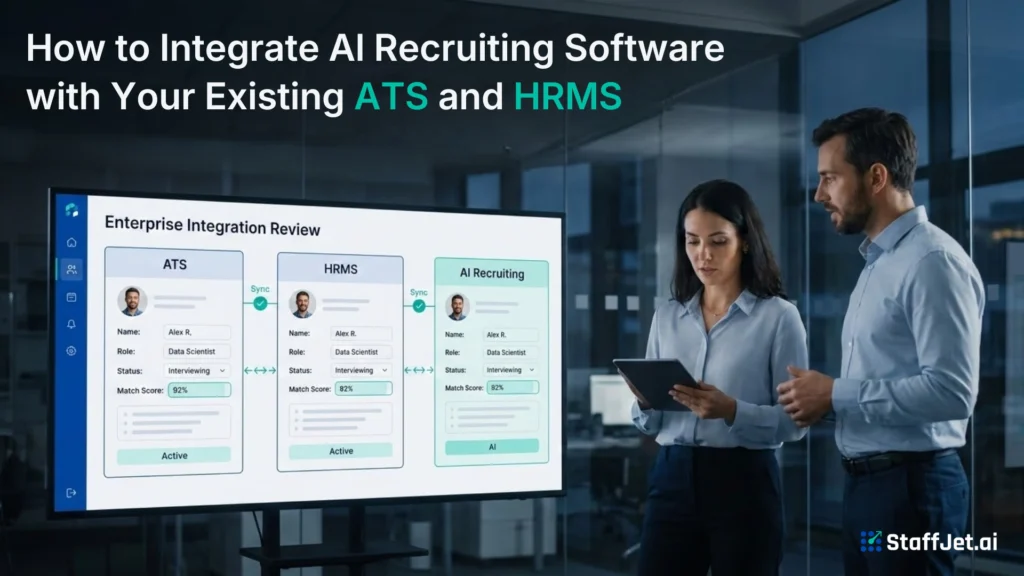
Match scores, candidate rankings, structured evaluation summaries, and stage transition triggers flow from the AI tool into the ATS pipeline, while job requirements and candidate profiles flow in the opposite direction.
When a candidate completes AI resume screening, their profile generates a match score based on skills, experience, and role fit. This score, along with ranked shortlists and evaluation notes, must sync back to the ATS so recruiters can view results inside their existing workflow.
For a deeper explanation of how these scores are calculated, see How Match Score Algorithms Work.
In the other direction, the ATS sends job descriptions and candidate application data to the AI screening tool. Without this two-way flow, the AI tool lacks context needed to score accurately. A 2026 benchmark study of 50,000 AI interviews found that ATS-integrated screening cut time-to-hire by 40% and improved ranking consistency by 35%, but only when scoring data flowed directly into the applicant tracking system [Screenz.ai, 2026].
How Do You Choose the Right Integration Method for Your Tech Stack?
API-based integration is the gold standard for real-time data sync. CSV uploads work for small volumes. Plugin architectures offer a middle-ground approach. The right choice depends on your hiring volume and technical capacity.
API connections allow different software systems to communicate and share data in real time, connecting ATS, HRMS, job portals, and AI-driven platforms into a single workflow [Easy Hire Tool, 2026]. Platforms built with API-first architecture demonstrate 340% faster data processing and 78% lower integration costs compared to traditional systems [HR Agent Labs, 2026].
For teams with moderate technical resources, plugin-based integrations offer faster setup with pre-built connectors. CSV transfers remain a fallback, though they introduce delays that undermine the speed gains AI screening is meant to deliver. If your team screens more than 200 candidates per month, API integration is not optional. It is essential.
What Does It Cost Your Team When AI Screening Stays Siloed?
Siloed AI screening forces recruiters to manually transfer candidate data between platforms, doubling screening time and creating inconsistent records that lead to delayed decisions and missed qualified candidates.
A 2025 analysis found that 72% of enterprise talent teams already use AI-powered sourcing or screening alongside their ATS [The Hire Hub, 2025]. However, when these tools operate independently, recruiters must export results from one platform and import them into another. That manual step consumes the very hours AI was supposed to save. A SHRM report showed that 87% of CHROs anticipate AI will boost workforce productivity, but disconnected systems prevent those gains from materializing [SHRM, 2025].
Beyond time lost, siloed tools create inconsistent candidate records. A score generated in the AI tool may not match the status shown in the ATS, leading to confusion about which candidates to advance and which to decline.
Is Your Hiring Team Ready to Connect AI Screening to Your ATS and HRMS?
Before integrating, confirm your team has clean candidate data, documented screening workflows, and a clear understanding of which stages in your pipeline AI should influence.
Integration amplifies whatever already exists in your process. If your screening criteria are inconsistent, connecting AI to your ATS will automate that inconsistency at scale. Start by auditing candidate data quality: remove duplicate profiles, standardize job titles, and ensure your ATS fields align with what the AI tool expects. Then map your hiring stages and identify where AI screening inputs should appear.
For teams still evaluating whether their process is ready, our diagnostic checklist in 5 Signs Your Resume Screening Process Needs AI can help you identify gaps before investing in integration.
How Does StaffJet Connect with Your Existing ATS and HRMS?
StaffJet operates as an end-to-end AI hiring intelligence platform that can work alongside your ATS, feeding AI-screened candidate profiles, match scores, and assessment results into your existing workflow.
StaffJet is not just an ATS. It automates six stages of recruitment: job posting, AI profile matching, AI resume screening, skills assessment, live AI interviews (AUTO INTERVIEW, conducted as a 20- to 30-minute booked session), and unified dashboard reporting.
Through API-based integration, StaffJet can push structured candidate data, match scores, and evaluation summaries into your existing ATS and HRMS without forcing you to replace systems you have already invested in. Teams using StaffJet have reported 10x faster candidate shortlisting, 60% lower cost-per-hire, and 70% hours saved per year.
What Integration Checklist Should You Follow Before Deploying AI Screening?
Audit your current tech stack, confirm API availability with both vendors, map data fields between systems, define scoring thresholds, and run a pilot with a single job role before scaling.
1. Audit your stack: List every tool in your hiring pipeline. Identify where data gets stuck or requires manual transfer.
2. Confirm API access: Check with both your ATS vendor and AI screening provider that API endpoints are available and documented.
3. Map data fields: Ensure candidate fields such as name, email, skills, experience, and score have matching formats across both systems.
4. Define threshold rules: Decide what match score triggers a candidate to advance, what flags require human review, and what causes an automatic rejection.
5. Pilot with one role: Run a controlled test with a single job opening. Measure time saved, data accuracy, and recruiter experience before expanding.
The future of hiring in India is not about choosing between AI and existing systems. It is about connecting them. As 90% of CHROs expect AI to become more embedded in workplace technology [SHRM, 2025], organizations that invest in genuine integration will build a measurable hiring advantage. StaffJet’s approach as an end-to-end AI hiring intelligence platform is designed to bridge that gap.
Key Takeaways
• 44% of companies still struggle with data flowing between recruitment systems, making integration the biggest obstacle to AI hiring value [HR Agent Labs, 2025].
• API-based integration delivers 340% faster data processing and 78% lower integration costs compared to legacy approaches [HR Agent Labs, 2026].
• ATS-integrated AI screening can cut time-to-hire by 40% and improve ranking consistency by 35% when data flows directly into the pipeline [Screenz.ai, 2026].
• StaffJet’s end-to-end AI hiring intelligence platform offers 10x faster shortlisting, 60% lower cost-per-hire, and 70% hours saved per year through integrated automation.