How Match Score Algorithms Work in AI Recruitment Platforms
Over 70% of recruiters in India report that hiring has become harder, not easier, despite a 40% increase in hiring activity since the pandemic. The reason is not a talent shortage. It is a volume-quality mismatch. Applicants per role have doubled since 2022, and 53% of recruiters say a surge in AI-generated applications has made distinguishing genuine candidates significantly more difficult [The Hindu Business Line, 2026]. The old approach of scanning resumes one by one cannot keep up. Match score algorithms can.
Understanding how these algorithms work is essential for any hiring leader evaluating an AI recruitment platform. This article is part of our The Complete Guide to AI Resume Screening and breaks down the mechanics behind candidate ranking in plain language.
Why Do Match Score Algorithms Matter More Than Ever for Hiring?
Traditional keyword matching filters out 35 to 50% of qualified candidates who use different words for the same skills, making semantic match score algorithms essential for fair and accurate shortlisting [AI Talent Flow, 2025].
Most applicant tracking systems still rely on exact keyword matching. Search for “project management” and the system finds it, but misses “led cross-functional initiatives” or “oversaw delivery of a multi-year program,” even though both describe the same capability [AI Talent Flow, 2025]. This measured false-negative rate of 35 to 50% means nearly half of qualified candidates get filtered out before a human ever sees their resume.
Match score algorithms solve this problem by understanding meaning, not just matching words. For hiring teams processing hundreds of applications per role, this distinction is the difference between finding the right candidate and losing them to a competitor.
How Do Match Score Algorithms Actually Calculate Candidate Rankings?
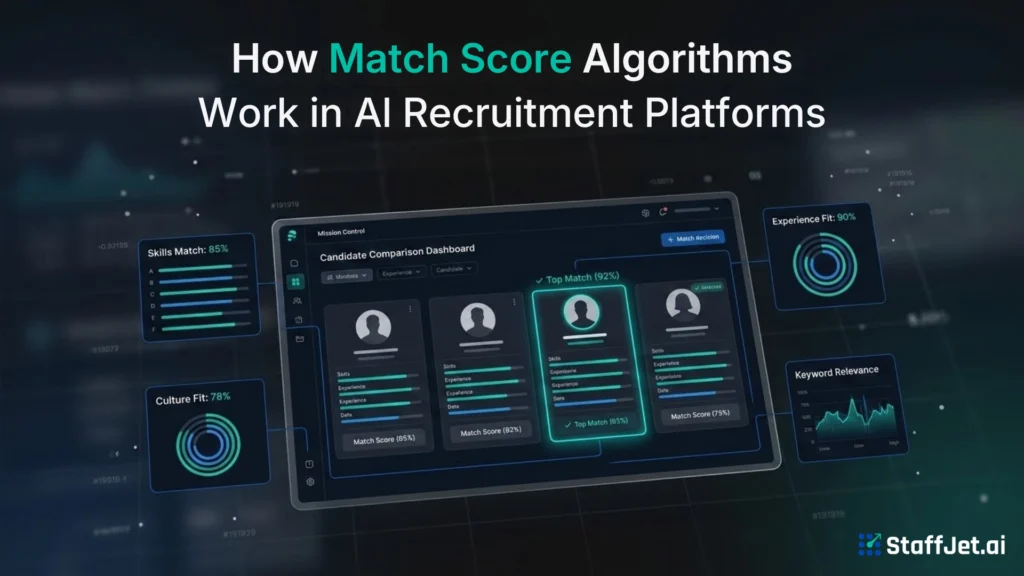
Match score algorithms use natural language processing to convert resumes and job descriptions into numerical vectors, then calculate similarity scores using weighted criteria like skills, experience, and recency [ResearchGate, 2025; Zythr, 2025].
The process works in three stages. First, natural language processing (NLP) reads both the resume and the job description and converts the text into numerical vectors, often with 768 or more dimensions. These vectors capture what a candidate can do, how much experience they have, and at what seniority level they operate [AI Talent Flow, 2025]. The job description receives the same treatment.
Second, the system calculates the mathematical similarity between the two vectors, often using cosine similarity or TF-IDF techniques [ResearchGate, 2025]. But a raw similarity score is not the final ranking. Modern systems layer weighted criteria on top: must-have skills are penalized more heavily when missing, skills used recently are weighted above older experience, and career trajectory is factored in [impress.ai, 2024].
Third, the output is a ranked shortlist where each candidate receives a composite score with a breakdown explaining why they ranked where they did. This transparency is what separates useful tools from black boxes.
Can Match Score Algorithms Outperform Human Screening in Accuracy?
Algorithmic scoring evaluates every resume against identical criteria in under a second, while human reviewers show measurable inconsistency due to fatigue and volume pressure [AI Talent Flow, 2025].
A single resume can be scored against a job description in approximately 0.3 seconds, and research shows that well-tuned NLP matching systems achieve 85% or higher agreement with expert human reviewers [AI Talent Flow, 2025]. By contrast, manual screening carries an estimated 22% error rate driven by cognitive fatigue, with reviewers applying different standards at different times of day.
For a detailed comparison of algorithmic and manual screening across speed, cost, and consistency, read AI Resume Screening vs. Manual Screening.
How Do Match Score Algorithms Handle Bias and Fairness?
Match score algorithms can reduce certain biases by ignoring demographic signals, but they require regular auditing because models trained on biased historical data will reproduce those patterns [Harvard Business Review, 2025].
The advantage of algorithmic scoring over human review is consistency and auditability. A well-configured system evaluates candidates based on skills, experience, and qualifications without being influenced by name, university, or employment gaps. However, if the training data reflects historical hiring biases, the algorithm will learn and replicate those patterns [HBR, 2025].
The solution is not to avoid algorithms but to govern them. Hiring teams should request transparency from their vendors, audit shortlists for demographic patterns regularly, and ensure that scoring criteria prioritize measurable skills over proxy signals that correlate with protected characteristics.
Where Does StaffJet Use Match Score Algorithms Across Its AI Recruitment Platform?
StaffJet’s end-to-end AI hiring intelligence platform uses match score algorithms in AI profile matching and AI resume screening, delivering 10x faster candidate shortlisting and a 24-hour hiring timeline.
StaffJet is not just an ATS. It is an end-to-end AI hiring intelligence platform that automates six stages of recruitment: job posting, AI profile matching, AI resume screening, skills assessment, live AI interviews (AUTO INTERVIEW, conducted as a 20- to 30-minute booked session), and unified dashboard reporting.
In the AI profile matching stage, StaffJet’s algorithms score candidates against role-specific criteria before a human recruiter reviews a single application. AUTO ASSESSMENT then validates candidate skills with structured evaluations. The result is 60% lower cost-per-hire and 70% hours saved per year on screening and assessment activities, freeing recruiters to focus on high-value engagement with shortlisted candidates.
What Should Your Team Check Before Trusting a Match Score Algorithm?
Evaluate any match score system by testing its explainability, verifying its weighting logic, and running parallel comparisons with your existing manual process.
These steps give you a factual basis for trusting or adjusting the algorithm, rather than relying on vendor claims alone.
1. Ask for explainability: A score of 85 out of 100 is useless without a breakdown. Your vendor should show exactly which skills, experience, or qualifications contributed to each candidate’s ranking.
2. Verify the weighting logic: Ensure that must-have requirements are weighted more heavily than nice-to-haves, and that recency and seniority are factored into the scoring model.
3. Run a parallel test: Process the same batch of applications through both your current manual workflow and the algorithm. Compare shortlists and note discrepancies.
4. Audit for bias quarterly: Review scored shortlists for patterns related to gender, age, university prestige, or other demographic proxies that should not influence ranking.
5. Check integration capability: Confirm that the scoring system connects with your existing hiring workflow rather than operating as a standalone tool.
Match score algorithms are not a replacement for human judgment. They are a precision tool that handles the high-volume, repetitive work of initial screening so recruiters can invest their time in conversations, culture-fit evaluation, and offer negotiation. The organizations that will lead in talent acquisition are those that combine algorithmic efficiency with human expertise.
If you are ready to implement algorithmic screening, the next step is understanding how these tools connect to your existing technology stack. Read How to Integrate AI Screening with ATS & HRMS for a practical integration guide.
Key Takeaways
• Traditional keyword matching has a 35 to 50% false-negative rate, filtering out qualified candidates who use different words for the same skills [AI Talent Flow, 2025].
• Match score algorithms use NLP to create numerical vectors from resumes and job descriptions, then calculate weighted similarity scores [ResearchGate, 2025].
• Algorithmic scoring can evaluate a resume in 0.3 seconds with 85% or higher agreement with expert reviewers [AI Talent Flow, 2025].
• Bias mitigation requires regular audits of scored shortlists and transparent weighting logic, not blind trust in the algorithm [HBR, 2025].
• Always run parallel tests and verify explainability before adopting any scoring system for your hiring workflow.