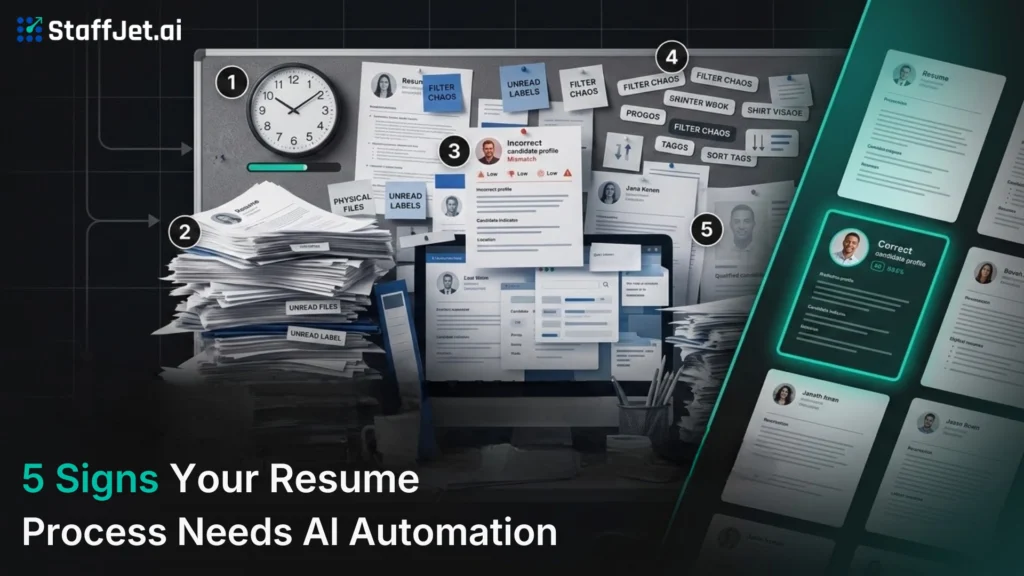
5 Signs Your Resume Screening Process Needs AI Automation
A recruiter at a mid-size IT company spends nine hours a week screening resumes, devoting just 30 to 90 seconds to each one. Out of every 1,000 applications received, only 20 candidates get a meaningful review and just six complete an interview. The entire process takes 44 days on average [Shortlistd, 2026]. If these numbers describe your team, your resume screening process is already broken. You are just measuring the damage.
If you are experiencing these signs, AI screening may be the solution. This document is part of our broader resource, The Complete Guide to AI Resume Screening, which covers the full picture of what modern AI screening can do for hiring teams.
Why Is the Manual Resume Screening Process Breaking Down Now?
Application volumes in India have doubled since 2022, while 53% of recruiters report that AI-generated applications have made distinguishing genuine candidates significantly harder [The Hindu Business Line, 2026].
The hiring ecosystem has shifted. Hiring activity sits 40% above pre-pandemic levels, yet 70% of recruiters in India say finding the right talent has become more difficult [The Hindu Business Line, 2026]. The bottleneck is no longer sourcing. It is processing.
Most teams still rely on manual screening designed for a lower-volume era. Those that adopt recruitment automation tools gain an edge in speed and consistency. The five signs below will help you diagnose whether your team has reached this point.
Is Your Resume Screening Process Making Your Time-to-Hire Uncompetitive?
Average time-to-hire in India has climbed to 44 days, while top candidates are typically gone within 10 days [Shortlistd, 2026; Taggd, 2025].
Time-to-hire directly affects business outcomes. An open engineering position delays product launches. A vacant sales role costs revenue. Average time-to-hire has increased 24% since 2021, climbing from 33 to 41 days, and Indian markets follow a similar trend [Pin, 2025]. The root cause is almost always at the top of the funnel. When manual screening takes days to produce a shortlist, every stage gets pushed back.
For specific data on how AI shortens hiring timelines, read How AI Resume Screening Reduces Time-to-Hire by 70%.
Is Your Resume Screening Process Consuming All of Your Recruiter Productivity?
Recruiters spend 60 to 80% of their week on administrative tasks like screening, leaving just three hours for strategic recruiting work [Shortlistd, 2026].
In a 40-hour week, recruiters allocate 13 hours to sourcing, nine hours to screening, seven to interview scheduling, and eight hours to admin updates. That leaves three hours for strategic work [Shortlistd, 2026]. When recruiters spend most of their day on repetitive screening, they cannot build candidate pipelines or develop hiring strategies. Screening becomes the job instead of supporting it.
Does Your Resume Screening Process Produce Inconsistent Shortlist Quality?
Manual screening carries an estimated 22% error rate due to fatigue, and different reviewers apply different standards to the same resumes [Arahi, 2026].
Consistency is the hidden weakness of manual hiring. Morning reviews tend to be more generous than afternoon ones, the 100th resume receives less attention than the 10th, and different recruiters weigh the same criteria differently [Marxel, 2026]. When shortlist quality depends on which reviewer is working, your hiring decisions are effectively random.
See AI Resume Screening vs. Manual Screening for a detailed comparison across speed, accuracy, and cost.
Is Your Resume Screening Process Losing Good Candidates to Slow Response Times?
After two weeks without communication, up to 60% of candidates disengage, and top talent is often off the market within 10 days [QuestSearch, 2025; Taggd, 2025].
Research shows that candidate interest declines sharply after one week without communication. When screening takes days to produce a shortlist, the delay cascades. By the time a strong candidate reaches an interview, they may already have accepted another offer. Slow screening does not just delay hiring. It actively loses you talent.
Is Your Resume Screening Process Driving Up Cost-Per-Hire Without Improving Results?
Screening 100 CVs manually takes 12 to 18 hours of recruiter time, representing a significant hidden labor cost per role [Marxel, 2026].
Manual screening costs rarely appear on a budget. They show up as recruiter overtime and temp staffing. When this cost repeats across every open position, it becomes a substantial annual expense. If your cost-per-hire keeps rising but quality of hire stays flat, the screening process itself is the problem.
5 Ways to Improve Your Resume Screening Process
If your team recognizes the signs above, the next step is action. Below are five practical ways to modernize your resume screening process, drawn from industry research and real-world implementation patterns.
Standardize Your Screening Criteria Before You Automate
Define clear, weighted must-have and nice-to-have requirements for every role type before introducing any AI tool.
The most common mistake teams make when adopting AI screening is automating a broken process. If your current criteria are vague or inconsistent, the AI will reproduce those problems at scale. Start by documenting exactly what matters for each role: required skills, minimum experience levels, and disqualifying factors. Assign weights to each criterion so the system can rank candidates meaningfully. Research on candidate scoring models shows that well-defined criteria are the single biggest predictor of screening accuracy [Zythr, 2025].
Run a Parallel Test Before Fully Transitioning to AI Screening
Process the same batch of applications through both your manual workflow and an AI tool, then compare shortlists, time spent, and cost.
A parallel test eliminates guesswork from the buying decision. Select a recent batch of 100 to 200 applications for a single role. Have your team screen them manually while the AI tool processes the same set independently. Measure four things: overlap between shortlists (target 70% or higher), time to shortlist, cost per application screened, and any strong candidates that manual review missed. If the AI catches qualified candidates your team overlooked, the business case builds itself.
Separate Signal from Noise by Combining Screening with Structured Assessment
Use AI screening for initial filtering, then validate shortlisted candidates with a structured skills assessment before any human review.
Resume screening alone, whether manual or AI-driven, cannot reliably evaluate technical ability or problem-solving skills. The most effective teams pair screening with structured assessments that test the specific competencies required for the role. This two-stage approach catches candidates who look strong on paper but cannot perform, while surfacing those who may have weaker resumes but strong practical skills. Teams that combine AI screening with structured assessment report measurably higher quality of hire.
Audit Your AI Screening Tool for Bias and Accuracy Quarterly
Review scored shortlists for demographic patterns and recalibrate weights at least once per quarter to maintain fairness and relevance.
AI screening tools are not set-and-forget systems. Models trained on biased historical data will replicate those patterns unless actively monitored. Best practice is to review shortlisted candidates for demographic proxies such as university prestige, employment gaps, or geographic patterns that should not influence ranking. Harvard Business Review research shows that AI reshapes what fairness means in hiring, making regular audits essential [HBR, 2025]. Also recalibrate skill weights when role requirements change to ensure the model stays aligned with current hiring priorities.
Integrate AI Screening Into Your Existing Hiring Technology Stack
Connect your AI screening tool to your ATS or HRMS so shortlisted candidates flow directly into your established hiring workflow.
AI screening delivers the most value when it operates within your existing process, not as a standalone tool. Integration eliminates manual data transfer, ensures candidate records stay synchronized, and provides a single source of truth for reporting. Before selecting a tool, verify compatibility with your current ATS and confirm that the vendor offers dedicated onboarding support.
For a practical guide on connecting AI screening to your existing systems, read How to Integrate AI Screening with ATS & HRMS.
How Does StaffJet Address a Broken Resume Screening Process?
StaffJet is an end-to-end AI hiring intelligence platform that automates screening, assessment, and interviews, delivering 10x faster shortlisting, 60% lower cost-per-hire, and a 24-hour hiring timeline.
StaffJet is not just an ATS. It automates six stages of recruitment: job posting, AI profile matching, AI resume screening, skills assessment, live AI interviews (AUTO INTERVIEW, conducted as a 20- to 30-minute booked session), and unified dashboard reporting.
For teams experiencing the five signs above, StaffJet eliminates the manual bottleneck. Its AI resume screening processes applications against role-specific criteria, while AUTO ASSESSMENT validates candidate skills before a human recruiter reviews a profile. The result is 70% hours saved per year, freeing recruiters to focus on strategic work.
Key Takeaways
• Average time-to-hire has reached 44 days, while top candidates leave the market within 10 days [Shortlistd, 2026; Taggd, 2025].
• Recruiters spend 60 to 80% of their week on admin tasks, leaving just three hours for strategic work [Shortlistd, 2026].
• Manual screening carries a 22% error rate and produces inconsistent shortlists across reviewers [Arahi, 2026].
• Up to 60% of candidates disengage after two weeks without communication [QuestSearch, 2025].
• Standardize criteria before automating, run parallel tests, and audit for bias quarterly to maximize screening ROI.
• StaffJet delivers 10x faster shortlisting, 60% lower cost-per-hire, and 70% hours saved per year through automated screening and assessment.