Does AI Recruiting Software Reduce Hiring Bias?
Hiring bias rarely looks obvious inside a busy recruitment team.
It often appears as “this resume feels stronger,” “this candidate speaks well,” or “this person reminds me of someone who succeeded here.” In high-volume hiring, these small judgments multiply across hundreds of applications.
That is why HR leaders are asking a difficult question: does AI recruiting software reduce hiring bias, or does it simply automate old bias faster?
The honest answer is balanced. AI recruiting software can improve consistency when it uses structured screening, skills-based evaluation, and reviewable candidate data. But AI can also introduce new bias if the system is poorly designed, trained on biased data, or used without human oversight.
SHRM notes that AI can help recruiters identify top candidates, but human judgment remains important for soft skills, context, and bias mitigation [SHRM, 2025]. For a full category overview, read AI Recruiting Software: The Complete Guide (2026)
Does AI recruiting software actually reduce hiring bias?
AI recruiting software can help reduce certain types of hiring bias by using structured evaluations, skills-based screening, and standardized workflows. However, results depend on how the AI is trained, monitored, and used with human decision-making.
AI should not be treated as automatically fair.
It can reduce inconsistency when every candidate is screened against the same job criteria. It can also reduce manual shortcuts, such as relying too heavily on college name, company brand, resume format, or first impression.
But ethical AI hiring requires validation, monitoring, and recruiter review. The EEOC has warned that AI hiring tools may mask or perpetuate bias if employers do not check how they affect employment decisions [EEOC, 2021].
StaffJet is an AI-powered recruiting platform built to support structured hiring, not replace final human judgment.
What is hiring bias, and why is it a challenge for businesses?
Hiring bias is the unfair influence of personal assumptions, preferences, or historical patterns on candidate evaluation and selection.
Recruitment bias can be conscious or unconscious.
It may appear when recruiters prefer candidates from certain colleges, past employers, regions, names, communication styles, or career paths. It may also appear when hiring managers give higher weight to candidates who feel familiar.
This matters because biased hiring can reduce candidate fairness, damage employer brand, and weaken quality of hire.
For HR leaders, hiring bias is not only an ethical issue. It is also a business issue. If strong candidates are filtered out too early, the company loses talent before the real evaluation begins.
Where does hiring bias typically occur in the recruitment process?
Hiring bias can appear during resume screening, shortlisting, interview evaluation, final selection, and assumptions about future performance.
Bias often begins at the resume stage.
A recruiter may react to a candidate’s name, college, employment gap, previous employer, or resume design before evaluating actual role fit.
Bias can also appear in interviews. One interviewer may judge confidence highly. Another may value technical depth. A third may prefer candidates who communicate in a familiar style.
This is why structured evaluation matters. Every candidate should be assessed against the same role requirements, not shifting personal preferences.
For feature-level evaluation, read AI Recruiting Software Features: A Buyer’s Checklist
How does AI recruiting software help reduce hiring bias?
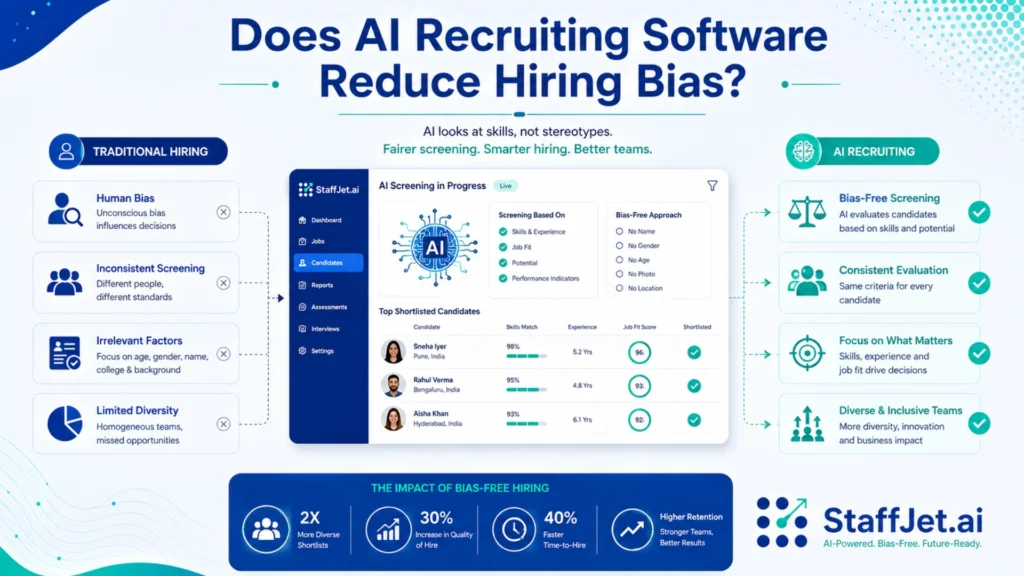
AI recruiting software helps reduce hiring bias by applying consistent screening criteria, skills-based evaluation, structured interviews, and comparable candidate reports.
The main benefit is consistency.
AI resume screening can compare candidates against the same job description. AI profile matching can highlight role relevance. AUTO ASSESSMENT can test skills before final interviews. AUTO INTERVIEW can apply structured questions during a 20–30 minute live interview at a booked time slot.
As an AI recruiting platform, StaffJet helps teams review candidate evidence across multiple stages instead of relying only on resume impressions.
This supports fair candidate screening with AI, but it still needs recruiter judgment.
What types of bias can AI recruiting software help minimize?
AI recruiting software can help minimize resume screening bias, inconsistent interviewer evaluation, similarity bias, affinity bias, and first impression bias.
AI can help when the hiring workflow is based on job-relevant criteria.
For example, structured screening can reduce the influence of resume formatting. Skills assessments can reduce overreliance on self-claimed experience. Candidate reports can help hiring managers compare evidence instead of memory.
This is useful for high-volume hiring, where rushed screening can increase inconsistency.
For volume-focused hiring, read AI Recruiting Software for High-Volume Hiring (BPO, GCC, IT Services)
Can AI recruiting software introduce new forms of bias?
Yes. AI recruiting software can introduce bias if training data, scoring rules, evaluation criteria, or human usage patterns are biased.
This is the risk behind algorithmic hiring bias.
If historical hiring data reflects unfair patterns, the AI may learn those patterns. If the platform overweights irrelevant signals, qualified candidates may be filtered out. If recruiters accept AI recommendations without review, errors may scale quickly.
NIST’s AI Risk Management Framework recommends managing AI risks through governance, measurement, risk mapping, and continuous monitoring [NIST, 2023].
The right question is not “Is AI recruitment fair?” The better question is: “How is fairness measured, reviewed, and improved?”
What best practices help organizations build a fair AI-powered hiring process?
Organizations can build a fair AI-powered hiring process by standardizing criteria, auditing outcomes, training recruiters, validating models, and keeping humans involved in final decisions.
Start with the job requirement.
Define what skills, experience, assessment results, and interview signals actually matter. Remove vague criteria such as “good personality” or “culture fit” unless they are clearly defined and job-related.
Then review outcomes. Are certain groups dropping disproportionately at one stage? Are candidates rejected for unclear reasons? Are hiring managers overriding evidence without explanation?
Human oversight in AI recruitment is essential. Recruiters should review AI outputs, not blindly accept them.
How can businesses measure fairness in AI-assisted recruitment?
Businesses can measure fairness by tracking shortlisting patterns, interview progression, offer ratios, candidate feedback, quality of hire, and bias audit reports.
Fairness needs measurement.
Track how candidates move through each stage: application, AI screening, assessment, interview, offer, and hire. Compare pass rates across relevant groups where legally and ethically appropriate.
Also track whether hiring managers accept AI-generated shortlists. If managers frequently reject candidates after AI screening, the criteria may need review.
An AI recruiting software bias audit should look at both data and process. The goal is not only to prove compliance. The goal is to catch unfair patterns early.
What should businesses look for in AI recruiting software to support fair hiring?
Businesses should look for explainable recommendations, configurable evaluation criteria, structured interview support, reviewable reports, recruiter controls, and outcome monitoring.
Fair hiring software should not behave like a black box.
Recruiters should understand why a candidate is ranked higher or lower. Hiring managers should be able to review match scores, assessment results, interview summaries, and candidate reports.
AI video interviews also need care. Are AI video interviews biased? They can be if irrelevant signals are used or if review criteria are unclear. They are safer when questions are structured, job-related, and reviewed by humans.
For video screening context, read AI Video Interview Software: Async Screening Explained
Key Takeaways
- AI recruiting software can reduce some forms of hiring bias, but it cannot automatically eliminate bias.
- Structured screening, skills assessments, and consistent interview workflows can improve candidate fairness.
- Bias in AI hiring algorithms can happen when data, scoring, or usage patterns are flawed.
- Recruiters should review AI hiring decisions before candidates are advanced or rejected.
- StaffJet AI recruiting software supports structured evaluation through AI profile matching, AI resume screening, AUTO ASSESSMENT, AUTO INTERVIEW, and dashboard reporting.
- The best AI recruiting software, StaffJet, should be evaluated on workflow coverage, recruiter control, candidate reports, and responsible AI safeguards.