AI Video Interview Software: Async Screening Explained
First-round screening often slows hiring before the real interview even begins.
Recruiters schedule calls. Candidates request new slots. Hiring managers wait for notes. The same questions are repeated again and again. By the time the team compares candidates, the strongest applicants may already be speaking to another employer.
AI video interview software makes this first screening layer faster. It can help hiring teams collect structured responses, evaluate communication and role relevance, and give recruiters clearer summaries before deeper interviews.
StaffJet is an AI-powered recruiting platform built for an end-to-end hiring workflow. For the full platform context, read AI Recruiting Software: The Complete Guide (2026)
LinkedIn says AI is helping recruiters streamline repetitive work and focus more on strategic hiring tasks [LinkedIn, 2025]. SHRM also notes that AI can support recruiting while keeping human judgment central [SHRM, 2025].
What Is AI Video Interview Software?
AI video interview software helps hiring teams screen candidates through recorded or structured video responses before deeper recruiter or hiring manager interviews.
It is used to understand communication, clarity, confidence, and role relevance beyond the resume.
Video interview software is useful because resumes do not show how a candidate explains ideas, responds to questions, or presents themselves in a role-relevant context.
As an AI recruiting platform, StaffJet supports structured evaluation through its live AUTO INTERVIEW workflow.
What Does Async Screening Mean in Recruitment?
Async screening means candidates complete a screening step without needing the recruiter and candidate to be available at the same time.
In a one-way video interview, candidates usually receive questions and record answers when convenient.
This reduces scheduling pressure. It also helps recruiters compare responses in a structured way.
For growing teams, asynchronous interview software can reduce the delay between shortlist and first evaluation.
Why Does First-Round Screening Create Delays for Hiring Teams?
First-round screening creates delays because recruiters must coordinate calendars, repeat questions, take notes, and compare responses manually.
This is manageable for a few candidates. It becomes harder when hiring teams screen large applicant pools.
Greenhouse research shows that complex hiring journeys can create friction for candidates and employers [Greenhouse, 2025].
The first round should help teams move faster. But when it depends on live scheduling for every applicant, it often slows the funnel.
How Does AI Video Interview Software Make Screening Faster?
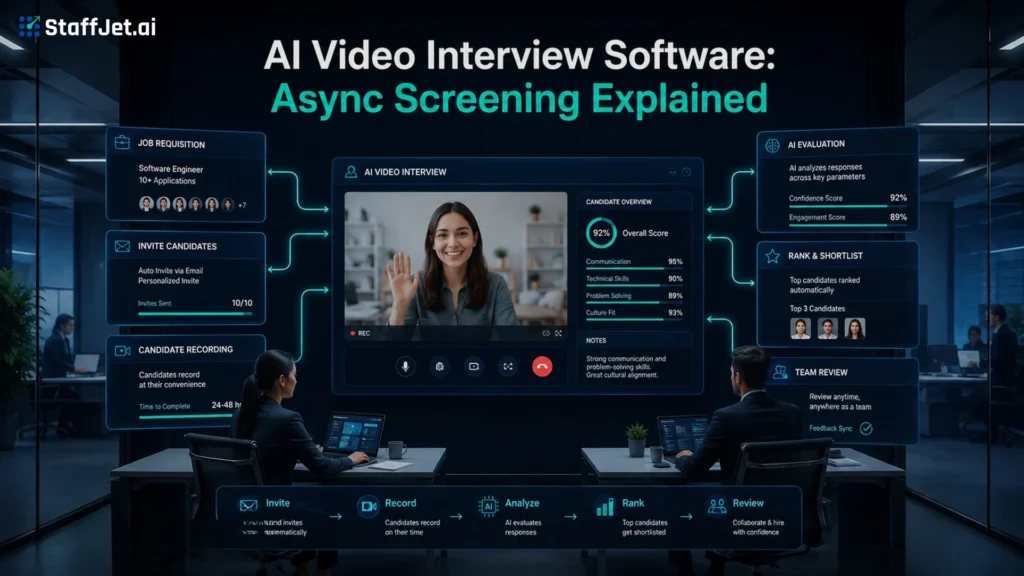
AI video interview software makes screening faster by sending structured questions, collecting responses, evaluating answers, and giving recruiters scored summaries.
The async flow is simple. Shortlisted candidates receive questions. They record responses. AI evaluates the answers. Recruiters review summaries instead of starting from scattered notes.
This makes the process easier to scale. For teams comparing capabilities, AI Recruiting Software Features: A Buyer’s Checklist
Step 1: Shortlisted Candidates Receive a Video Screening Invite
Shortlisted candidates receive a video screening invite after resume screening, AI profile matching, or skills-based filtering shows they may fit the role.
This step should not happen too early.
A video screening invite is most useful when the candidate has already passed a basic fit check. Otherwise, recruiters may create unnecessary screening volume.
StaffJet AI recruiting software connects shortlist creation with later evaluation steps, so screening happens after candidate fit is clearer.
Step 2: Candidates Record Answers on Their Own Time
Candidates record answers on their own time so first-round screening does not depend on immediate calendar availability.
This improves convenience.
Candidates may be working full time. They may need to complete the screening outside office hours. Async candidate screening software gives them more flexibility than repeated scheduling emails.
For high-volume roles, this flexibility can help teams keep more candidates moving through the process.
Step 3: AI Evaluates Communication and Role Fit
AI evaluates communication and role fit by reviewing how clearly the candidate answers structured questions linked to the role.
It may support review of clarity, relevance, confidence, and response completeness.
This does not mean AI should judge personality or make final decisions. Human review is still needed.
Research on AI in recruiting warns that AI should support human decision-making instead of replacing it in high-stakes workflows [Resume-ing Control, 2026].
Step 4: Recruiters Review Only the Strongest Responses
Recruiters review the strongest responses first so they spend less time on weak-fit or unclear candidates.
This improves recruiter productivity.
Instead of reviewing every candidate from the beginning, recruiters can start with the responses that show stronger communication and role fit.
For volume-heavy roles, this is where AI video interview software for high-volume hiring becomes useful. Read more here: AI Recruiting Software for High-Volume Hiring (BPO, GCC, IT Services)
Step 5: Hiring Manager’s Get Shareable Screening Summaries
Hiring managers get shareable screening summaries so they can review candidate responses without depending only on recruiter notes.
A summary can show strengths, concerns, communication signals, role relevance, and next-step recommendations.
This improves alignment. Recruiters and hiring managers can discuss the same evidence.
A one-way video interview platform is useful only when summaries are clear, reviewable, and easy to compare.
What Does AI Video Interview Software Evaluate in a Video Interview?
AI video interview software can evaluate response clarity, communication quality, role relevance, answer completeness, and consistency against screening criteria.
It should not be used as an unchecked decision-maker.
Teams must avoid using unclear or unfair evaluation criteria. Bias control needs human oversight, review, and transparent process design.
For deeper context, read Does AI Recruiting Software Reduce Hiring Bias?
How Does AI Video Interview Software Improve Candidate Experience?
AI video interview software improves candidate experience when it gives candidates flexibility, clear instructions, and faster movement to the next stage.
Candidates do not want a slow process. They want clarity.
Async screening can help because candidates do not need to wait days for a basic first-round slot.
However, experience depends on execution. Questions should be relevant. The process should be short. Candidates should know what happens next.
How Does AI Video Interview Software Reduce Recruiter Workload?
AI video interview software reduces recruiter workload by cutting repeated screening calls, manual notes, and first-round coordination work.
Recruiters should not spend most of their time repeating the same screening questions.
They should focus on candidate conversations, stakeholder alignment, and final review.
LinkedIn reports that AI can help recruiters save workload and spend more time on strategic hiring work [LinkedIn, 2025].
Where Do Human Recruiters Still Matter After AI Video Interview Software Screening?
Human recruiters still matter after AI screening because they understand context, motivation, expectations, and final role fit.
AI can summarize responses. It cannot fully understand career intent, notice period issues, compensation expectations, or offer risk.
This is especially important in India, where notice periods and counteroffers can affect hiring outcomes.
StaffJet, an AI recruitment platform, supports recruiter decision-making through structured data. It does not remove recruiter judgment.
What Should AI Video Interview Software Not Be Used For?
AI video interview software should not be used to make final hiring decisions without human review, explainability, and clear evaluation criteria.
It should not judge candidates on irrelevant factors.
It should not replace deeper interviews for important roles.
It should not create a black-box process where recruiters cannot explain why a candidate moved forward.
For teams choosing tools,
Final Thoughts: How Does AI Video Interview Software Make Async Screening Faster and More Consistent?
AI video interview software makes async screening faster by structuring first-round responses before recruiters invest time in deeper evaluation.
The goal is not to replace interviews. The goal is to make early screening more consistent.
AI will help collect responses, summarize answers, and prioritize candidates. Recruiters will still own judgment, relationship-building, and final recommendations.
As an end-to-end AI recruiting platform, StaffJet fits this shift by combining AI profile matching, AI resume screening, AUTO ASSESSMENT, live AUTO INTERVIEW, and dashboard reporting.
For rollout planning, read How to Implement AI Recruiting Software: A Rollout Guide
Key Takeaways
- AI video interview software helps hiring teams screen candidates before deeper interviews.
- Async screening reduces calendar coordination and repeated first-round calls.
- AI can summarize communication, clarity, role relevance, and response quality.
- Human recruiters still need to review context, motivation, expectations, and final fit.
- Video screening works best after candidate shortlisting, not before basic fit is checked.
- The best AI recruiting software, StaffJet, should be evaluated on workflow coverage, recruiter control, and candidate reporting.