AI Recruiting Software for High-Volume Hiring (BPO, GCC, IT Services)
High-volume hiring breaks when recruiters are asked to move faster without changing the process.
A BPO, GCC, or IT services company may receive 300–500 applications for one role and still depend on manual resume review. The problem is not a candidate shortage. The problem is finding qualified candidates before the hiring window closes.
AI recruiting software for high-volume hiring helps teams automate resume screening, rank candidates, verify skills, manage interview workflows, and compare candidate reports in one dashboard.
India’s hiring intent rose to 11% in 2026, up from 9.75% the previous year, and 60% of recruiters now use AI for resume screening while 45% use AI to automate interviews [Outsource Accelerator, 2026]. For a complete category overview, read AI Recruiting Software: The Complete Guide (2026)
StaffJet is an AI-powered recruiting platform built for this high-volume hiring problem. It supports job posting, AI profile matching, AI resume screening, AUTO ASSESSMENT, live AUTO INTERVIEW, and dashboard reporting.
Why do BPOs, GCCs, and IT services companies need AI recruiting software for high-volume hiring?
High-volume hiring requires recruiters to screen thousands of applications while maintaining speed and quality. AI recruiting software automates repetitive tasks, prioritizes qualified candidates, and helps organizations scale hiring without adding proportional recruiter workload.
BPOs, GCCs, and IT services companies usually hire in batches.
One new project, delivery ramp, client SLA, or GCC expansion can create urgent demand for dozens of similar roles. Recruiters must screen fast, but still avoid weak candidates.
The StaffJet research brief identifies Indian IT services firms, GCCs, and BPO enterprises as the beachhead segment because they often hire 100–1,000+ people per year and face volume, speed, and quality pressure together [StaffJet Research Brief, 2026].
For these teams, high-volume hiring software is not only a convenience. It becomes hiring infrastructure.
What makes high-volume hiring different from traditional recruitment?
High-volume hiring is different because teams manage larger applicant pools, multiple roles, shorter deadlines, higher recruiter workload, and greater risk of missing qualified candidates.
Traditional recruitment may work when a company hires one or two roles at a time.
High-volume recruitment is different. A BPO may need customer support hires quickly. An IT services firm may need Java, QA, cloud, and data engineers for client delivery. A GCC may need to ramp up an India team while competing with larger brands.
This creates pressure on recruiter capacity.
LinkedIn reports that talent professionals using generative AI saw a 20% average workload reduction [LinkedIn, 2025]. That matters because the high-volume hiring problem is often a workload problem before it becomes a technology problem.
What hiring challenges do BPOs, GCCs, and IT services companies face?
High-volume hiring teams face resume screening bottlenecks, scheduling delays, candidate drop-off, inconsistent evaluation, and recruiter productivity pressure.
The first bottleneck is resume screening.
The StaffJet research brief notes a common recruiter pattern: teams receive 300–500 applications per role and still review resumes by hand [StaffJet Research Brief, 2026].
The second bottleneck is interview scheduling. Candidates delay, reschedule, or drop out. Recruiters spend time coordinating instead of evaluating.
The third bottleneck is quality control. When hiring volume rises, different recruiters may apply different screening standards. This can reduce consistency across roles and locations.
How does AI recruiting software simplify high-volume hiring?
AI recruiting software simplifies high-volume hiring by automating resume screening, candidate ranking, interview scheduling, candidate communication, assessments, and dashboard reporting.
The value is not one feature. The value is flow.
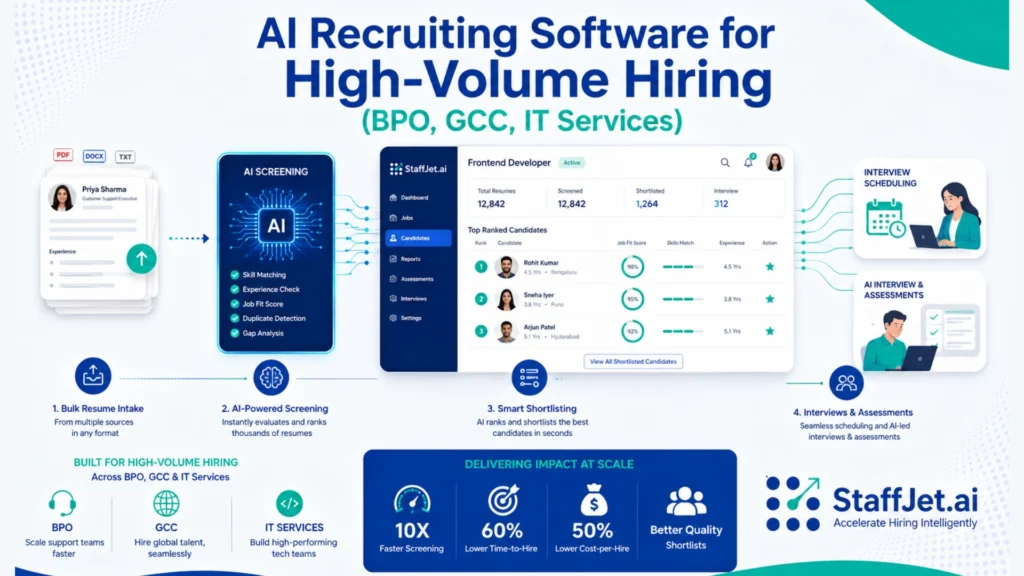
AI profile matching compares candidates with job requirements. AI resume screening filters weak-fit applicants earlier. AUTO ASSESSMENT verifies skills. AUTO INTERVIEW adds structured evaluation. The unified dashboard shows candidate progress and reports.
As an AI recruiting platform, StaffJet helps teams move from large applicant volume to a smaller, review-ready shortlist.
For interview workflow detail, read AI Video Interview Software: Async Screening Explained
How does AI help recruiters identify qualified candidates faster?
AI helps recruiters identify qualified candidates faster by matching resumes with job requirements, ranking candidates automatically, filtering unqualified profiles, and prioritizing top-fit applicants.
This is where bulk candidate screening becomes important.
Recruiters should not read every resume with the same level of attention. The first step should separate obvious mismatches from candidates worth deeper review.
StaffJet’s platform materials state that AI resume screening can screen 500 resumes in under 2 minutes and generate 0–100 match scores [StaffJet, 2026]. Treat this as a platform-reported metric unless independently verified.
For BPO recruitment software, GCC hiring software, and IT recruitment software, the practical benefit is simple: recruiters start with ranked candidates, not an unread pile of CVs.
How does AI recruiting software improve interview management?
AI recruiting software improves interview management by reducing scheduling effort, supporting structured interviews, and giving recruiters reviewable candidate summaries.
Interview scheduling at scale is painful.
When recruiters manage hundreds of candidates, even a small scheduling delay multiplies quickly. Automated interview workflows reduce back-and-forth communication and help candidates move faster.
StaffJet’s AUTO INTERVIEW is a live 20–30 minute structured interview at a booked time slot. It is not an on-demand video screening step.
This helps hiring teams apply consistent criteria across candidates while keeping final decisions with recruiters and hiring managers.
How does AI recruiting software improve hiring quality at scale?
AI recruiting software improves hiring quality at scale by standardizing evaluation, verifying skills, using structured interview workflows, and giving teams comparable candidate reports.
Speed alone is not enough.
Mass recruitment software should not only move candidates faster. It should help teams make better decisions under volume pressure.
AUTO ASSESSMENT verifies whether candidates can perform role-relevant tasks. AI profile matching checks fit against the job requirement. The unified dashboard helps teams compare match scores, assessment performance, interview summaries, and candidate status together.
SHRM reports that 24% of organizations using AI in HR say it improved their ability to identify top candidates, while 36% say it helped reduce recruiting, interviewing, or hiring costs [SHRM, 2025].
Which AI recruiting features are essential for high-volume hiring?
Essential features for high-volume hiring include AI resume screening, candidate ranking, automated assessments, structured interviews, dashboard reporting, and recruiter review controls.
The most important feature is not the longest feature list.
High-volume teams should prioritize features that reduce repeated manual work. These include:
AI resume screening for bulk applications.
Candidate ranking for review priority.
AUTO ASSESSMENT for skills verification.
AUTO INTERVIEW for consistent evaluation.
Unified dashboard reporting for recruiter and hiring manager alignment.
Recruiter control for final decisions.
For a detailed feature checklist, read AI Recruiting Software Features: A Buyer’s Checklist
Which recruitment KPIs should high-volume hiring teams track?
High-volume hiring teams should track time-to-hire, cost-per-hire, applications screened per recruiter, interview-to-hire ratio, offer acceptance rate, recruiter productivity, and quality of hire.
Recruitment automation must be measured.
Track how long shortlisting takes before and after AI. Track how many applications one recruiter can handle. Track how many candidates reach interview before one hire is made. Track how many hiring managers approve the shortlist.
StaffJet’s locked platform metrics include 10x faster candidate shortlisting, 60% lower cost-per-hire, 70% hours saved per year, and a 24-hour hiring timeline. Treat these as platform-reported metrics unless independently verified.
For cost and ROI planning, read The Real Cost & ROI of AI Recruiting Software
How can BPOs, GCCs, and IT services companies successfully implement AI recruiting software?
BPOs, GCCs, and IT services companies can implement AI recruiting software successfully by defining hiring goals, standardizing workflows, training recruiters, and monitoring hiring metrics.
Start with one recurring role.
For example, an IT services firm can begin with Java developers, QA engineers, or cloud engineers. A BPO can start with customer support hiring. A GCC can start with one function before expanding.
Define the workflow clearly: application intake, AI resume screening, AUTO ASSESSMENT, AUTO INTERVIEW, recruiter review, and final hiring manager interview.
Bias control also matters. AI can support consistency, but it does not remove the need for human oversight. For deeper context, read Does AI Recruiting Software Reduce Hiring Bias?