The Real Cost & ROI of AI Recruiting Software
Hiring cost is not only the monthly price of recruitment software. It is also the cost of slow shortlisting, vacant roles, recruiter hours, agency dependency, repeated interviews, and poor-fit hires.
That is why AI recruiting software cost and ROI should be measured as a full business case.
For Indian hiring teams, the cost question is urgent. If one role takes 45–60 days to close, the company loses productivity, recruiter time, and candidate momentum.
LinkedIn reports that talent acquisition professionals using generative AI saw a 20% average workload reduction [LinkedIn, 2025]. SHRM also reports that average cost-per-hire and time-to-hire have increased over recent years, making hiring efficiency a leadership-level issue [SHRM, 2025].
For the full category context, read AI Recruiting Software: The Complete Guide (2026)
What does AI recruiting software cost, and is it worth the investment?
AI recruiting software is worth the investment when savings from faster hiring, lower manual workload, better shortlist quality, and reduced coordination exceed the total platform cost.
AI recruiting software pricing in India can vary widely.
Basic ATS-style recruitment software may start around ₹1,500–₹3,000 per recruiter per month, based on publicly listed entry-level recruitment software pricing such as Zoho Recruit [Zoho Recruit, 2026].
Mid-level AI recruitment software pricing can range from an estimated ₹10,000–₹75,000 per month for growing teams. High-volume hiring teams may pay an estimated ₹75,000–₹2,00,000+ per month depending on usage, assessments, interviews, and dashboard depth.
Enterprise pricing is usually custom.
These are market estimates because many AI recruiting vendors do not publish fixed pricing. Buyers should ask for software licensing, setup, integration, assessment, video interview, training, and support costs before comparing vendors.
Estimated AI recruiting software pricing in India
| Business type | Estimated monthly cost | What it usually includes |
| Small team / basic ATS | ₹1,500–₹10,000 per recruiter/month | Applicant tracking, resume database, basic workflows |
| Growing hiring team | ₹10,000–₹75,000/month | AI screening, candidate ranking, scheduling, basic reports |
| High-volume hiring team | ₹75,000–₹2,00,000+/month | Bulk screening, assessments, interviews, dashboards |
| Enterprise | Custom pricing | Advanced workflows, integrations, onboarding, reporting, support |
StaffJet is an AI-powered recruiting platform built for end-to-end hiring automation. It combines AI profile matching, AI resume screening, AUTO ASSESSMENT, live AUTO INTERVIEW, and dashboard reporting.
What factors determine the cost of AI recruiting software?
AI recruiting software pricing depends on company size, hiring volume, recruiter seats, automation depth, assessment usage, interview volume, integrations, and onboarding needs.
A startup hiring 5–10 people a year will not have the same cost structure as an IT services firm hiring 100–1,000 people annually.
Main pricing factors include:
- Number of recruiter seats
- Number of active jobs
- Resume screening volume
- Assessment usage
- Video interview or AUTO INTERVIEW usage
- Dashboard and reporting depth
- Integration costs
- Onboarding and training
- Support level
AI hiring software pricing models may be monthly, annual, per recruiter, per job, per candidate, or custom enterprise contracts.
As an AI recruiting platform, StaffJet should be evaluated as a complete system, not as a single resume screening add-on.
What are the direct costs of implementing AI recruiting software?
The direct costs of AI recruiting software include subscription fees, implementation fees, integration costs, onboarding cost, user training, and support.
The subscription price is only the first cost.
A realistic budget should include implementation. This may cover hiring stage setup, role templates, dashboard configuration, assessment setup, recruiter onboarding, and workflow mapping.
Integration costs may apply if the company wants the platform to connect with an ATS, HRMS, job boards, calendar tools, or reporting systems.
Training is another real cost. If recruiters do not understand how to read match scores, candidate reports, and dashboard signals, adoption will be weak.
For example, a team paying ₹75,000 per month for AI recruiting software may still need one-time implementation support. A basic setup may cost ₹25,000–₹1,00,000 as an estimate. Enterprise setup may be higher if workflows, integrations, and reporting are complex.
What hidden recruitment costs can AI recruiting software reduce?
AI recruiting software can reduce hidden recruitment costs such as manual screening time, vacant-role delays, interview coordination, agency dependency, and repeated admin work.
Most hiring costs never appear as software costs.
Recruiters spend hours reading resumes, downloading profiles, updating trackers, chasing interview slots, and compiling feedback. Hiring managers spend time reviewing weak candidates. Business teams lose output while roles remain vacant.
The StaffJet research brief notes that Indian senior roles can exceed 60 days in time-to-hire, with cost-per-hire ranging from ₹2 lakh to ₹12 lakh in some market contexts [StaffJet Research Brief, 2026].
Here is a simple example.
If one recruiter spends 25 hours screening resumes for a role, and their fully loaded hourly cost is estimated at ₹800, manual screening alone costs ₹20,000 per role.
If a company hires 50 people a year, and AI reduces only 15 hours of screening effort per role, that equals 750 recruiter hours saved annually. At ₹800 per hour, that is ₹6,00,000 in estimated productivity savings before counting faster hiring, lower agency cost, or better shortlist quality.
StaffJet’s platform materials claim 70% hours saved per year. Treat this as a platform-reported metric unless independently verified [StaffJet, 2026].
How does AI recruiting software deliver measurable ROI?
AI recruiting software delivers measurable ROI through faster time-to-hire, lower cost-per-hire, higher recruiter productivity, better candidate quality, and clearer hiring visibility.
ROI should be measured through hiring outcomes, not only tool usage.
If AI resume screening helps recruiters move from 500 resumes to a qualified shortlist faster, the team saves review time. If AUTO ASSESSMENT verifies skills earlier, hiring managers spend less time on weak candidates. If AUTO INTERVIEW creates structured interview reports, decision-making becomes easier.
StaffJet’s locked platform metrics include:
- 10x faster candidate shortlisting
- 60% lower cost-per-hire
- 70% hours saved per year
- 24-hour hiring timeline
These should be treated as platform-reported metrics unless independently validated.
A simple ROI formula is:
Annual ROI = annual savings from automation − annual software cost
Example:
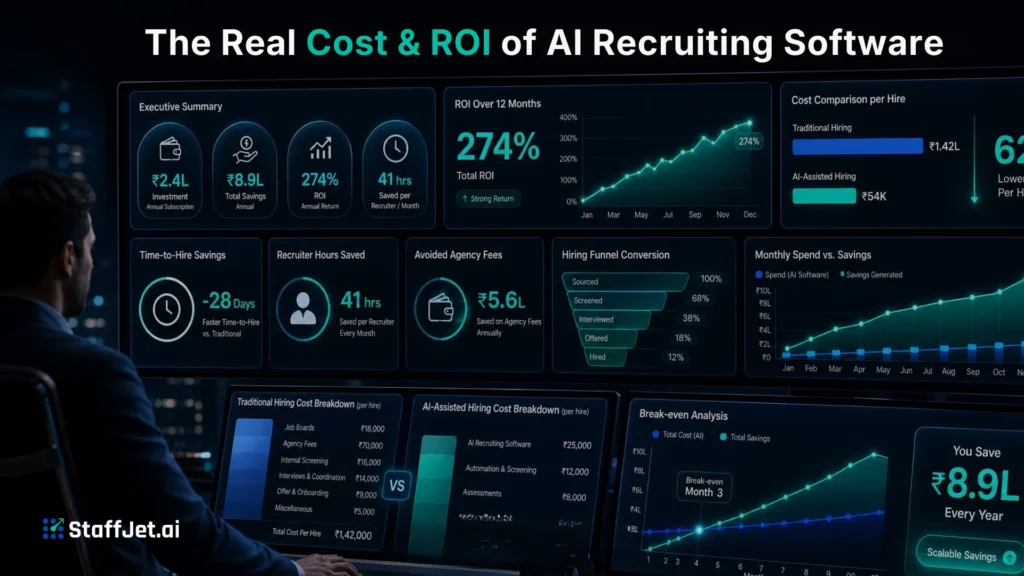
If a company spends ₹9,00,000 per year on AI recruiting software and saves ₹6,00,000 in recruiter productivity, ₹4,00,000 in reduced agency dependency, and ₹3,00,000 through faster role closure, total estimated benefit is ₹13,00,000.
Estimated ROI = ₹13,00,000 − ₹9,00,000 = ₹4,00,000 net annual value.
For ATS comparison, read AI Recruiting Software vs Traditional ATS
Which recruitment KPIs should businesses track to measure AI recruiting software ROI?
Businesses should track time-to-hire, cost-per-hire, screening time, interview-to-hire ratio, offer acceptance rate, recruiter productivity, and quality of hire.
Do not measure only how many resumes the system screened.
Track before and after numbers.
Important KPIs include:
- Time-to-hire
- Time-to-shortlist
- Cost per hire
- Recruiter hours per role
- Resume screening time
- Interview-to-hire ratio
- Candidate drop-off rate
- Offer acceptance rate
- Hiring manager shortlist approval rate
- Quality of hire
For example, if shortlisting drops from 10 days to 1 day, the hiring team can show a 9-day shortlisting improvement. If recruiter screening time drops from 25 hours to 8 hours, the team can show 17 hours saved per role.
This is how recruiting software ROI becomes visible to finance and leadership.
How long does it take to see ROI from AI recruiting software?
AI recruiting software ROI depends on hiring volume, recruiter adoption, implementation quality, workflow readiness, and how clearly the company tracks results.
Some benefits can show up quickly.
Resume screening, shortlisting, interview scheduling, and dashboard visibility can reduce manual work early. Long-term ROI usually comes from better hiring consistency, lower repetitive workload, and stronger decision quality.
A high-volume hiring team may see value faster because manual screening effort is higher. A low-volume team may take longer to justify the investment.
For example:
- Small team: ROI may take 6–12 months if hiring volume is low.
- Growing team: ROI may appear in 3–6 months if roles are recurring.
- High-volume team: ROI may appear sooner if the platform replaces heavy manual screening and agency dependency.
These are estimates. Real payback period depends on hiring volume, software cost, and baseline inefficiency.
For high-volume hiring context, read AI Recruiting Software for High-Volume Hiring (BPO, GCC, IT Services)
How can businesses maximize the return on AI recruiting software?
Businesses can maximize AI recruiting software ROI by automating repetitive tasks, standardizing workflows, training recruiters, integrating systems, and reviewing hiring metrics regularly.
Do not automate a broken hiring process.
Start with one high-volume or high-cost role. Define the current baseline first. Measure current time-to-shortlist, screening hours, interview volume, shortlist rejection rate, and cost per hire.
Then automate the stages with the highest friction:
- AI profile matching
- AI resume screening
- AUTO ASSESSMENT
- AUTO INTERVIEW
- Dashboard reporting
Recruiters should stay involved. AI should prepare better evidence. Humans should make final hiring decisions.
StaffJet, an AI recruitment platform, fits teams that want one connected workflow across screening, assessment, interview, and reporting.
For India-specific platform comparison, read Best AI Recruiting Software in India (2026)