AI Recruiting Software vs Traditional ATS: Which Is Better for Modern Hiring?
A traditional ATS can tell you who applied. It may not tell you who is worth interviewing first.
That gap matters. Hiring teams in India are under pressure to fill roles faster, reduce resume screening time, and improve candidate quality. When applications grow, storing resumes is not enough. Teams need help screening, scoring, comparing, and moving candidates forward.
That is why more HR leaders are comparing AI recruiting software vs traditional ATS tools. LinkedIn says AI is helping recruiters streamline repetitive work and focus more on strategic hiring tasks [LinkedIn, 2025]. SHRM also notes that AI can support recruiting automation while keeping human judgment central [SHRM, 2025].
StaffJet is an AI-powered recruiting platform built for this shift. For the full category context, read [Link: AI Recruiting Software: The Complete Guide (2026) → /ai-recruiting-software/].
What is the difference between AI recruiting software and a traditional ATS?
AI recruiting software improves hiring decisions through screening, scoring, assessments, interviews, and reports, while a traditional ATS mainly tracks applicants and hiring workflows.
An applicant tracking system stores candidate data, manages requisition management, tracks hiring stages, and supports communication.
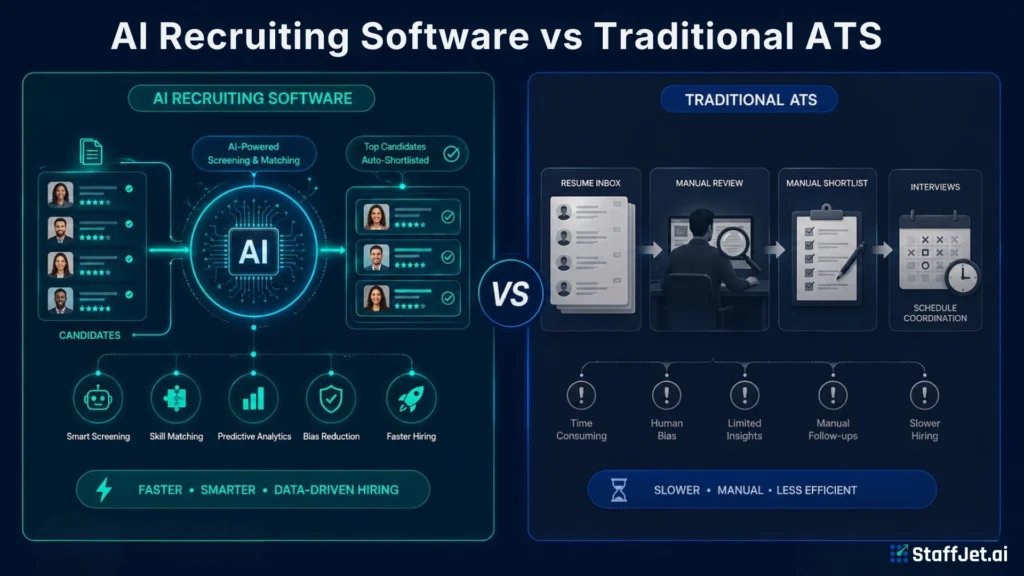
AI recruiting software adds intelligence on top of workflow automation. It can screen resumes, rank candidates, verify skills, and show hiring insights.
This is the core difference between ATS and AI recruiting software. One manages records. The other helps recruiters act on candidate evidence.
How does a traditional ATS work?
A traditional ATS works by collecting applications, storing resumes, tracking candidate stages, and helping recruiters manage hiring workflows.
Traditional ATS tools are useful for basic hiring operations.
They help recruiters post jobs, manage an applicant database, track candidates, send messages, and generate standard reports.
But most traditional ATS systems still depend heavily on recruiter effort. Recruiters must review resumes, compare candidates, schedule interviews, and prepare notes manually.
For teams with low hiring volume, this may be enough.
How does AI recruiting software improve the hiring process?
AI recruiting software improves hiring by automating resume screening, candidate ranking, skills assessments, interview support, and dashboard reporting.
This turns hiring from a storage process into a decision process.
As an AI recruiting platform, StaffJet supports AI profile matching, AI resume screening, AUTO ASSESSMENT, live AUTO INTERVIEW, and unified dashboard reporting.
This makes StaffJet AI recruiting software different from legacy recruitment systems that only track applications.
For a feature checklist, read AI Recruiting Software Features: A Buyer’s Checklist
AI Recruiting Software vs Traditional ATS: A Feature-by-Feature Comparison
AI recruiting software vs traditional ATS comparisons usually show the biggest difference in automation, candidate ranking, assessments, and decision visibility.
A traditional ATS handles resume storage, candidate status, requisition management, and reporting.
An AI hiring platform adds resume parsing, AI screening, candidate ranking, interview scheduling, skills verification, and candidate reports.
In ATS vs AI, the ATS is useful for workflow control. AI recruiting software is useful when teams need faster decisions and clearer evidence.
The best choice depends on hiring volume, role complexity, and recruiter workload.
Which hiring challenges can AI recruiting software solve that a traditional ATS cannot?
AI recruiting software can solve problems such as high resume volume, slow shortlisting, inconsistent screening, and scattered hiring evidence.
A traditional ATS may store all applicants, but it may not tell recruiters which candidate fits best.
AI recruiting software can rank profiles based on job fit. It can support consistent evaluation across similar roles. It can also reduce manual review.
The World Economic Forum says AI, big data, networks, and cybersecurity are among the fastest-growing skill areas for employers [World Economic Forum, 2025]. As skill needs change faster, manual resume review becomes harder.
When is a traditional ATS enough, and when should businesses upgrade to AI recruiting software?
A traditional ATS is enough for simple, low-volume hiring, while AI recruiting software is useful when speed, scale, and consistency become business priorities.
Small teams hiring occasionally may only need a traditional ATS.
Growing teams need more. High-volume hiring teams need faster resume screening. Enterprises need consistency across roles. Recruitment agencies need candidate ranking and reporting at scale.
If your recruiters spend most of their time screening resumes, the ATS may no longer be enough.
What should businesses consider before choosing AI recruiting software?
Businesses should check workflow coverage, recruiter control, reporting depth, adoption effort, and whether AI fits their hiring process before choosing software.
Do not buy AI because it looks modern.
Ask what the platform actually automates. Does it screen resumes? Does it score candidates? Does it support assessments? Does it create reports recruiters can review?
AI recruiting software like StaffJet should be evaluated on practical hiring outcomes, not only product demos.
For India-specific comparisons, read Best AI Recruiting Software in India (2026)
What business results can companies expect from AI recruiting software?
Companies can expect better speed, recruiter productivity, shortlist consistency, and hiring visibility when AI recruiting software is implemented correctly.
Any outcome depends on process quality, role clarity, recruiter adoption, and measurement.
StaffJet’s locked platform metrics include 10x faster candidate shortlisting, 60% lower cost-per-hire, 70% hours saved per year, and a 24-hour hiring timeline. Treat these as platform-reported metrics unless independently verified.
For budget planning, read The Real Cost & ROI of AI Recruiting Software
Key Takeaways
- A traditional ATS tracks applicants, while AI recruiting software supports screening, scoring, assessments, interviews, and reports.
- AI recruitment vs ATS is not only a tool comparison. It is a workflow maturity question.
- A traditional ATS may work for low-volume hiring.
- AI recruiting software is stronger for high-volume, fast-growth, and enterprise hiring teams.
- Recruiters still own judgment, candidate relationships, and final hiring decisions.
- Best AI recruiting software, StaffJet, should be judged by workflow coverage, recruiter control, reporting quality, and measurable hiring outcomes.