Unified Hiring Dashboards: Recruitment Data in One Place
Introduction
Hiring teams do not lose control only because they have too many candidates. They lose control because candidate data sits everywhere.
One resume is in email. One score is in a spreadsheet. Interview notes are in a chat thread. Assessment results are in another tool. By the time the hiring manager asks, “Who is the strongest candidate?”, the team is still collecting information.
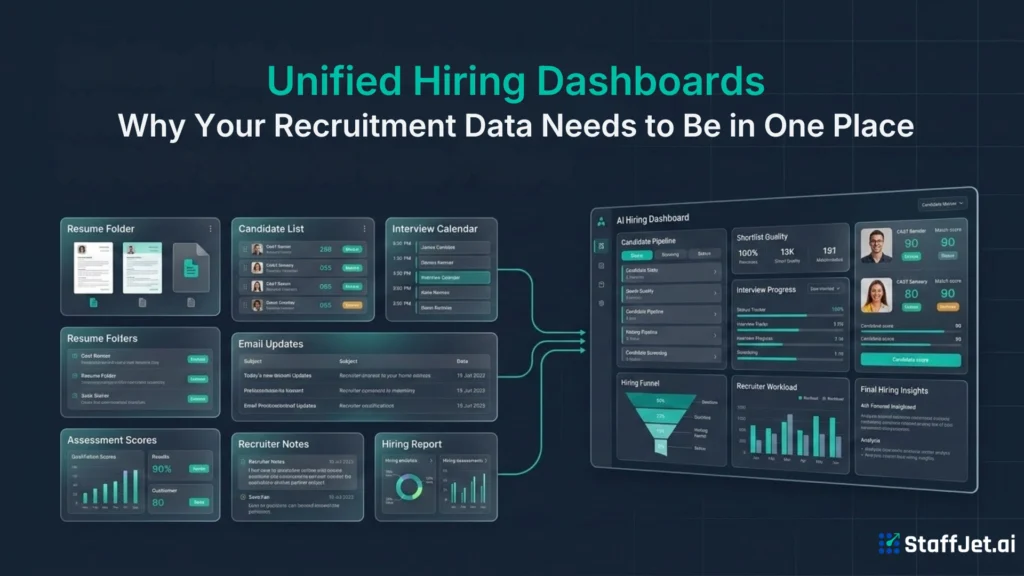
A unified hiring dashboard fixes this by bringing every candidate, stage, score, and report into one place. In ai hiring, the dashboard becomes the control room for faster and clearer decisions.
The unified dashboard is the command center for the entire AI recruitment process — see how it fits into the full workflow here: AI in the Recruitment Process
LinkedIn says AI is helping recruiters reduce repetitive work and focus more on strategic hiring tasks [LinkedIn, 2025]. SHRM also notes that AI can support recruiting by automating repetitive work while keeping human judgment central [SHRM, 2025].
What Is a Unified Hiring Dashboard?
A unified hiring dashboard is one view where recruiters can track candidates, hiring stages, scores, interview status, and reports across the recruitment process.
It is not just a storage screen. It is a decision view.
A strong dashboard shows where each candidate stands, what they have completed, how they performed, and what action is needed next.
For HR leaders, this improves visibility. For recruiters, it reduces manual tracking. For hiring managers, it gives one shared source of truth.
Why Recruitment Data Gets Scattered Across Hiring Teams
Recruitment data gets scattered because hiring teams use many channels, tools, and manual notes across the same role.
Applications may come from job boards, career pages, referrals, emails, or agency pipelines. Screening notes may sit with recruiters. Interview feedback may sit with hiring managers.
This creates confusion.
When data is fragmented, hiring decisions become slower. Recruiters need extra follow-ups. Hiring managers lack full context. Candidates may wait longer for updates.
Greenhouse’s 2025 workforce hiring research highlights how complex hiring journeys create friction for candidates and recruiters [Greenhouse, 2025].
How a Unified Hiring Dashboard Brings Recruitment Data in One Place
A unified hiring dashboard brings recruitment data together by connecting candidate profiles, screening scores, assessment results, interview progress, and reports in one workflow.
This helps teams stop switching between tools.
Instead of asking five people for updates, the recruiter can check one dashboard. Instead of sending separate files to hiring managers, the team can review one candidate view.
This improves speed and consistency.
For leadership, it also makes hiring performance easier to understand. Open roles, candidate progress, delays, and shortlist quality become more visible.
Step 1: Collect Candidate Data From All Sources
The first dashboard step is collecting candidate data from all application sources into one structured pipeline.
Candidates may apply through LinkedIn, Naukri, Indeed, a career page, referral, or direct email.
If these sources stay separate, recruiters spend time organizing data before they can evaluate candidates. That creates delay before shortlisting even starts.
A unified dashboard gives the hiring team one candidate pool. This makes early-stage review cleaner and reduces missed profiles.
The World Economic Forum says technology-related skill demand, including AI and big data, is rising across employers [World Economic Forum, 2025]. That makes organized candidate data more important.
Step 2: Track Every Candidate Across Hiring Stages
A unified hiring dashboard helps recruiters track every candidate across resume screening, assessments, interviews, and final review.
This is important because candidates move through different stages at different speeds.
One candidate may be waiting for an assessment. Another may have completed an interview. Another may need recruiter follow-up.
Without stage tracking, recruiters depend on memory, messages, or spreadsheets. That creates risk.
A clear dashboard shows status instantly. It helps teams know who needs action and who is ready for the next step.
Step 3: View Resume Scores, Assessments, and Interview Results Together
A unified dashboard improves hiring decisions by showing resume scores, assessments, and interview results together.
This helps recruiters judge candidates using multiple signals.
A resume may look strong, but assessment results may show gaps. A candidate may have average experience but strong skills performance. Interview notes may add context.
This is where dashboard data becomes useful.
When showing what shortlisting data looks like in the dashboard, teams can also review the full shortlisting process here: AI-Powered Candidate Shortlisting: 500 to 10
Step 4: Compare Candidates Side by Side
Side-by-side comparison helps hiring teams review candidates using the same information instead of scattered opinions.
This is useful when two or three candidates appear equally strong.
A dashboard can help compare role fit, resume score, skill result, interview stage, and final notes in one place.
Manual comparison is slower because recruiters must collect different files and feedback.
Side-by-side comparison does not remove judgment. It improves the quality of the conversation.
Step 5: Identify Hiring Bottlenecks Faster
A unified hiring dashboard helps teams identify where candidates are slowing down in the recruitment process.
Bottlenecks often hide in plain sight.
Candidates may be stuck waiting for screening. Assessments may be incomplete. Interviews may be scheduled too late. Hiring manager feedback may be pending.
A dashboard makes these delays visible.
This matters because time-to-hire is not only an HR metric. It affects project delivery, revenue roles, and team capacity.
Step 6: Generate Candidate Reports for Final Decisions
Candidate reports help hiring teams make final decisions using consolidated evidence instead of scattered notes.
A useful report should show resume fit, assessment performance, interview summary, strengths, gaps, and next-step recommendation.
This helps hiring managers move faster.
It also supports better documentation. When teams can see why a candidate moved forward, decisions become easier to explain.
For interview pipeline tracking, scheduled interviews and candidate progress should also appear in the dashboard. See the operational detail here: Automated Interview Scheduling
How Unified Dashboards Improve Recruiter Productivity
Unified dashboards improve recruiter productivity by reducing manual tracking, repeated follow-ups, and status update work.
Recruiters should not spend most of their day searching for candidate data.
They should spend time speaking with candidates, aligning hiring managers, and improving shortlist quality.
LinkedIn says AI is changing recruiting by automating time-consuming tasks and helping recruiters focus on higher-impact work [LinkedIn, 2025].
A dashboard supports that shift by making the process easier to manage.
How Hiring Managers Make Better Decisions With Shared Data
Hiring managers make better decisions when they can see the same candidate data that recruiters are using.
This reduces confusion.
Instead of asking, “Why was this candidate shortlisted?”, the hiring manager can see scores, assessment results, interview notes, and reports.
Shared data also improves alignment. Recruiters and hiring managers can discuss facts, not scattered impressions.
This is especially useful for technical roles, where skill evidence matters before final interviews.
Why Recruitment Dashboards Matter for High-Volume Hiring
Recruitment dashboards matter most in high-volume hiring because manual tracking breaks down when candidate volume increases.
A small hiring pipeline can survive in spreadsheets. A large pipeline cannot.
When teams handle hundreds of applicants, multiple open roles, and several hiring managers, scattered data becomes a serious risk.
A unified dashboard helps teams manage volume without losing visibility.
This supports faster shortlisting, fewer missed candidates, and clearer ownership of next steps.
Where Human Judgment Still Matters After Dashboard Insights
Human judgment still matters because dashboards show data, but recruiters and hiring managers must interpret the context.
A dashboard can show scores and status. It cannot fully judge motivation, career goals, compensation expectations, or culture fit.
Human recruiters still need to speak with candidates, understand intent, and manage relationships.
This is important in India, where notice periods, counteroffers, and drop-offs can affect hiring outcomes.
AI should improve visibility. Humans still make the decision.
Final Thoughts: From Scattered Data to Clear Hiring Decisions
The future of recruitment data is one shared view where hiring teams can act faster and decide with more confidence.
Hiring teams do not need more disconnected tools. They need one place to see candidate progress, scores, interviews, reports, and next actions.
A unified hiring dashboard supports this shift.
It works best when connected to AI profile matching, AI resume screening, AUTO ASSESSMENT, AUTO INTERVIEW, and dashboard reporting inside an end-to-end AI hiring intelligence platform.
For teams building a data-driven recruitment operation, the next step is a wider implementation roadmap: [Link: How to Build an AI-First Recruitment Strategy
Key Takeaways
- Recruitment data becomes hard to manage when it sits across emails, spreadsheets, job boards, and interview notes.
- A unified hiring dashboard brings candidate data, scores, stages, and reports into one place.
- Dashboards improve recruiter productivity by reducing manual tracking and repeated follow-ups.
- Hiring managers make better decisions when they can review shared candidate data.
- Human judgment still matters after dashboard insights because hiring requires context.