Seamless Integration: How AI Recruitment Tools Connect with Your Tech Stack
82% of organisations increased their HR technology investment in the last 12 months, yet only 28% reported measurable impact on business KPIs [PwC, 2024]. Meanwhile, the average HR information system is used by just 32% of employees [Gartner, 2022]. The gap between buying tools and getting value from them is not a budget problem. It is an integration problem. Most HR teams operate a fragmented stack of point solutions ,an ATS for tracking, a separate assessment platform for screening, yet another tool for interview scheduling ,none of which talk to each other. The result is duplicated effort, inconsistent candidate data, and recruiters spending up to 80% of their week on administrative tasks instead of actual hiring [Shortlistd Research, 2024]. Integration capability is one of the key criteria in our Best AI Recruitment Tool in 2026 comparison, and it deserves the same scrutiny in your evaluation process.
Why Does Tech Stack Integration Matter for AI Recruitment Tools Right Now?
Because India’s HR technology market is growing at 7.88% CAGR, and disconnected tools are the primary reason most organisations fail to extract value from that investment.
India’s HR technology market is projected to reach USD 2.3 billion by 2033, up from USD 1.2 billion in 2025 [People Matters / IMARC Group, 2025]. More tools enter the market each quarter. The average mid-sized company now relies on 8–12 separate HR systems [HR.com State of Today’s HR Tech Stack, 2024]. Each new tool promises efficiency, but without integration, each one also adds a data silo. Gartner reports that only 35% of HR leaders believe their current technology approach is helping them achieve business objectives [Gartner, 2024]. The problem is not the tools themselves. It is the space between them.
What Systems Should AI Recruitment Tools Integrate With?
The three critical integration points are your ATS, HRMS, and communication platforms ,without connectivity to these, any new tool creates more work than it eliminates.
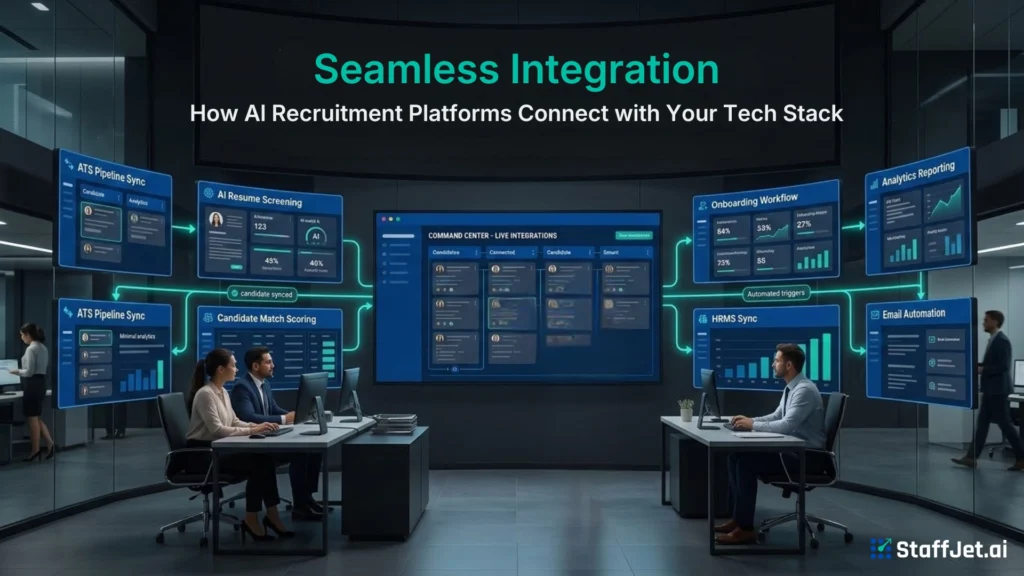
An Applicant Tracking System (ATS) is the backbone of most hiring operations ,70% of large companies and 75% of recruiters use one [SelectSoftware Reviews, 2025]. But an ATS alone does not constitute a modern hiring stack. Effective ai recruitment tools must connect bidirectionally with three categories of systems. First, your ATS or HRMS, where candidate records, offer approvals, and onboarding data live. Second, job boards and sourcing platforms, where applications originate. Third, communication tools ,email, calendar, and messaging platforms ,where scheduling and candidate engagement actually happen. Each integration point carries its own technical requirements: API availability, data format compatibility, authentication protocols, and sync frequency. For a detailed explanation of these system categories, our guide on AI Recruitment Platform vs. ATS vs CRM breaks down the distinct role each plays in your hiring workflow.
How Do Data Silos Between AI Recruitment Tools and Existing Systems Hurt Hiring Outcomes?
Disconnected systems force recruiters into manual data transfers, duplicate entries, and reconciliation work that wastes time and introduces errors at every hiring stage.
When an AI recruitment platform cannot exchange data with your ATS or HRMS, recruiters manually re-enter candidate information, re-upload assessment scores, and reconcile conflicting status updates across platforms. IDC Market Research estimates that siloed data costs companies 20–30% of their annual revenue through inefficiencies [IDC, 2024]. In recruitment specifically, the impact surfaces as slower time-to-hire, inconsistent candidate experience, and audit trail gaps that create compliance risk. Recruiters spend an estimated 8–13 hours per week on data-related administrative tasks ,updating spreadsheets, syncing systems, and tracking responses across platforms [Recruiter.com, 2024]. Every disconnected tool adds to that burden.
What Technical Dependencies Impact AI Recruitment Tool Implementation?
API quality, data mapping complexity, and vendor support are the three factors that most determine whether an integration succeeds or stalls.
Nearly 1 in 4 organisations report that new HR tech implementations fail to meet adoption expectations [Sapient Insights Group, via SHRM, 2025]. The most common causes are not technical sophistication gaps ,they are poor API documentation, incompatible data formats between systems, and insufficient vendor support during onboarding. When evaluating AI recruitment tools, request three things from every vendor: a live API documentation site, a data mapping specification for your specific ATS, and a defined implementation timeline with milestones. A tool that cannot provide these is unlikely to integrate cleanly regardless of what its marketing materials claim. Additionally, check whether the vendor offers webhook support for real-time event triggers and whether sync is bidirectional or limited to one-way data push.
How Does StaffJet Address Tech Stack Integration for AI Recruitment?
StaffJet operates as an end-to-end AI hiring intelligence platform with a unified dashboard, reducing the number of disconnected tools your team manages.
Rather than adding another point solution to your stack, StaffJet automates six stages of recruitment within a single platform: job posting, AI profile matching, AI resume screening, skills assessment, live AI interview (AUTO INTERVIEW, 20–30 minutes at a booked time slot), and dashboard reporting. The unified dashboard provides a single source of truth across all hiring stages, eliminating the data reconciliation burden that fragmented tools create. On the outcomes that matter most, StaffJet delivers 10x faster candidate shortlisting, 60% lower cost-per-hire, and 70% hours saved per year. Fewer handoffs between systems means fewer points of failure, and a simpler tech stack to manage overall.
What Checklist Should You Use Before Integrating an AI Recruitment Tool?
Apply this five-point evaluation framework to any vendor ,before signing a contract.
Map your existing stack: List every system involved in your hiring workflow ,ATS, HRMS, job boards, calendar, email ,and identify which ones the new tool must connect to.
Demand API documentation: Request live API docs and verify webhook support before purchasing. A vendor that cannot show you the integration layer likely cannot deliver it.
Test with your own data: Run a pilot with a representative candidate pool to confirm bidirectional sync, data accuracy, and recruiter experience.
Calculate total integration cost: Include vendor implementation fees, internal IT time, data migration, and training. Integration cost often exceeds the tool’s subscription price.
Define success metrics: Set measurable targets ,reduction in manual data entry hours, sync error rates, and time-to-hire improvement ,before going live.
Where Is AI Recruitment Integration Headed Next?
The future belongs to unified, API-first platforms that eliminate tool sprawl rather than add to it.
The HR technology landscape is consolidating around platforms that offer broad functionality with deep integration capabilities. SHRM’s 2025 CHRO Priorities report found that 90% of CHROs expect AI integration in the workplace to become more prevalent [SHRM, 2025]. For hiring leaders, this means the evaluation question is shifting from “Which tool has the best features?” to “Which tool reduces the complexity of our stack?” StaffJet continues developing its end-to-end platform with this trajectory in mind ,fewer tools, fewer handoffs, fewer integration points to maintain. For specific tool recommendations tailored to your team’s scale, our guide on How to Choose the Right AI Recruiting Software for Your Team Size provides a structured starting point.