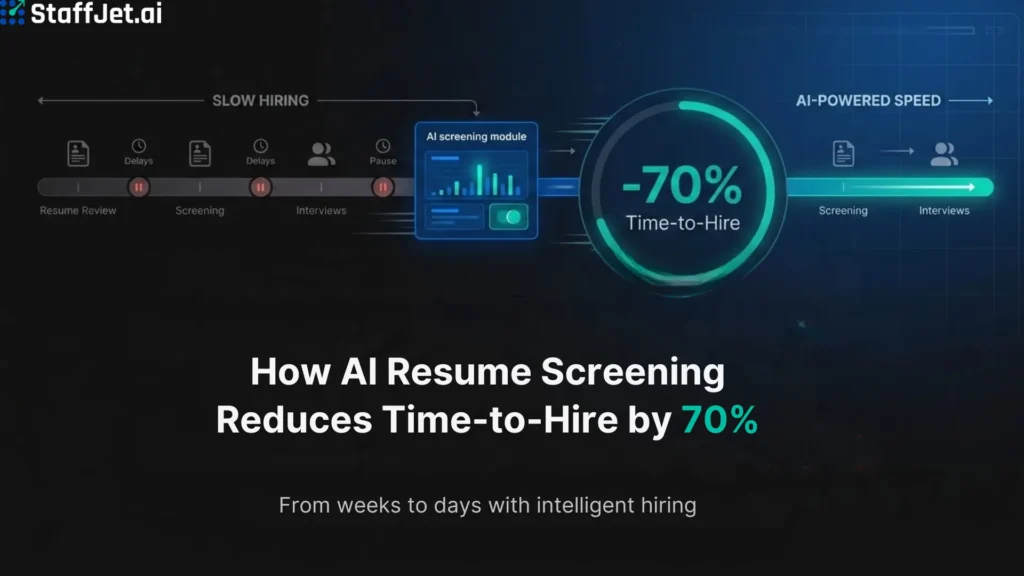
How AI Resume Screening Reduces Time-to-Hire by 70%
A mid-level role in India takes 45 to 50 days to fill on average [The Hire Arc, 2025]. During those seven weeks, your recruiter spends most of their time doing one thing: reading resumes. Not interviewing. Not closing offers. Just reading resumes. The cost of that delay compounds daily in lost productivity, overworked teams, and strong candidates who accept competing offers before your team reaches their application. For a deeper understanding of how this technology works and what it delivers for hiring teams, read our complete guide toAI resume screening.
Why Is AI Resume Screening a Business Priority for Indian Hiring Teams?
AI resume screening directly reduces the single largest time drain in hiring: manual resume review, which accounts for up to 70% of total recruitment time.
India’s hiring landscape is under pressure on multiple fronts. IT job demand reached 1.8 million roles in 2025, a 16% increase over the previous year [Quess Corp, 2025]. At the same time, 60% of companies globally reported longer hiring timelines in 2024 [GoodTime, 2025 Hiring Insights Report]. The mismatch is clear: more roles to fill, more applications arriving per posting, and the same manual processes struggling to keep pace. The average cost per hire in India now ranges between ₹1.5 lakh and ₹2 lakh [The Hire Arc, 2025], and every additional week a position stays open pushes that number higher through recruiter overtime, agency fees, and lost revenue from unfilled seats.

Where Does Manual Screening Fail, and How Does AI Resume Screening Fix It?
Manual screening breaks at scale: one posting can attract 200+ resumes, while human reviewers average only 6 to 8 seconds per initial scan.
When a job posting generates 150 or 200 applications, manual screening becomes the bottleneck that slows the entire pipeline. Research shows that candidate screening consumes up to 70% of a recruiter’s total hiring time [Evalufy, 2025]. Each resume must be opened, scanned, compared against role requirements, and either shortlisted or rejected. At scale, this creates a queue that takes days or weeks to clear. Meanwhile, top candidates are only available on the market for an average of 10 days before accepting another offer [SelectSoftwareReviews, 2026]. The math is straightforward: if your screening takes three weeks and your best candidate is gone in ten days, your process is losing before it starts. For a side-by-side comparison of how these approaches differ, read our analysis ofAI resume screening vs. manual screening.
What Does the Research Say About AI Resume Screening and Hiring Speed?
Organizations using AI in recruitment report filling roles up to 75% faster, with AI-enabled teams completing 66% more candidate screens per week.
The evidence is not anecdotal. According to SHRM’s 2025 Talent Trends Report, 43% of organizations now use AI for HR tasks, up from 26% in 2024, and 89% of HR professionals using AI in recruiting report measurable time savings [SHRM, 2025]. A 2025 survey of 380 recruiters found that AI-enabled teams complete 66% more candidate screens per week while spending 41% less time on documentation and administrative tasks [Pinpoint, 2025]. AI screening tools analyze resumes against job requirements in seconds, evaluating career trajectories, identifying transferable skills, and ranking candidates consistently. This is not about replacing recruiter judgment. It is about ensuring that recruiter judgment is applied to a shortlist of ten strong candidates rather than a pile of two hundred unsorted resumes.
How Does AI Resume Screening Improve Quality of Hire and Reduce Cost?
Speed and quality are linked: faster screening means recruiters evaluate more candidates thoroughly, reduce bias, and lower the overall cost per hire.
When screening is slow, corners get cut. Recruiters under pressure resort to gut-feel shortlists, inconsistent evaluation criteria, and rushed phone screens. Research on unconscious bias in hiring shows that manual resume review is particularly vulnerable to subjective judgments that undermine both fairness and accuracy [PMC/NIH, 2022]. AI screening applies the same evaluation criteria to every resume, eliminating the variability that creeps in when different recruiters review different applications at different times of day. The cost impact is direct. SHRM data shows that the total cost to hire can reach three to four times the position’s salary when hidden costs are included [SHRM, 2020]. Reducing time-to-hire from 45 days to under two weeks cuts recruiter hours, agency dependency, and the productivity gap of open positions simultaneously.
How Does StaffJet’s AI Resume Screening Accelerate Your Hiring Pipeline?
StaffJet automates screening, assessment, and first-round interviews on a single platform, enabling 10x faster shortlisting and a 24-hour hiring timeline.
StaffJet is an end-to-end AI hiring intelligence platform. Its AI resume screening engine evaluates incoming applications against role-specific criteria and produces ranked shortlists within minutes. AI profile matching then identifies the strongest candidates from across job boards, internal databases, and referral pools. After screening, candidates move directly into AUTO ASSESSMENT for skills evaluation and AUTO INTERVIEW, a structured 20 to 30 minute live AI interview conducted at a booked time slot. Every stage feeds data into a unified dashboard, giving hiring managers real-time visibility into pipeline health. The platform delivers 10x faster candidate shortlisting, 60% lower cost-per-hire, 70% hours saved per year, and a 24-hour hiring timeline from application to hire decision.
How Can Your Hiring Team Improve Screening Before Adopting AI Resume Screening?
Before investing in AI, teams can reduce screening time by defining structured evaluation criteria, standardizing review workflows, and setting a 48-hour shortlist deadline.
Here is a practical framework you can apply immediately:
Define must-have criteria before posting the role. Write down the three to five non-negotiable skills or experiences. Use these as a filter before reading any resume in full.
Standardize your review process. Every recruiter on the team should evaluate the same fields in the same order: relevant experience, skills match, role progression, and employment gaps. Structured evaluation reduces both time and inconsistency.
Set a 48-hour shortlist deadline. Commit to sending a shortlist to the hiring manager within two days of the application deadline. This forces prioritization and prevents the backlog from growing.
Track your screening metrics. Measure the number of resumes reviewed per hour, the application-to-shortlist ratio, and the time from application to first contact. These numbers will show you exactly where time is lost.
Evaluate your AI readiness. If your team screens more than 100 resumes per posting or your average time-to-hire exceeds 30 days, the manual approach is already costing more than automation would.
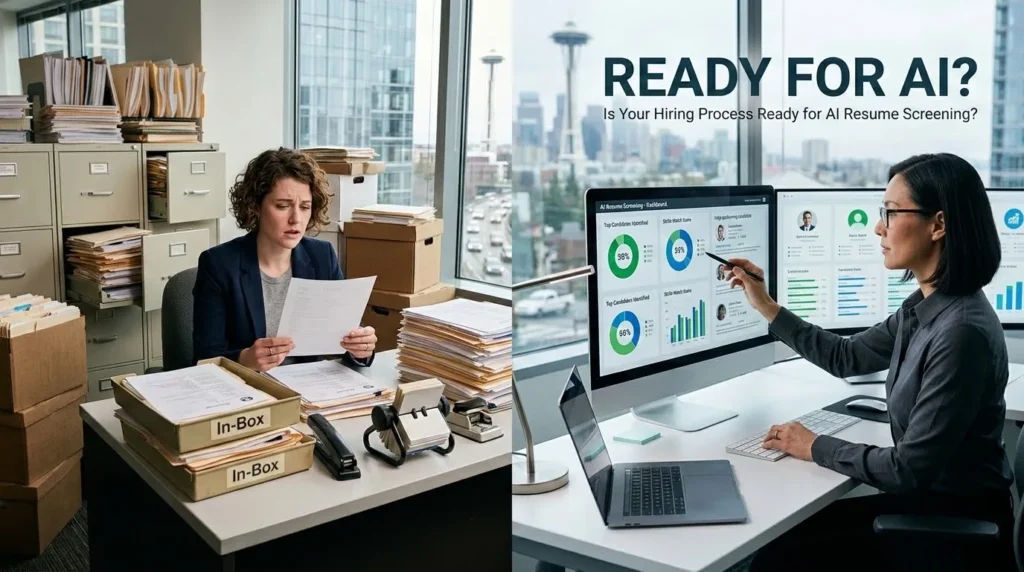
Is Your Hiring Process Ready for AI Resume Screening?
The transition to AI-driven hiring is accelerating: 87% of recruiting professionals globally are already exploring or using AI tools in their workflows.
The Indian hiring market is only growing more competitive. With IT job demand climbing 16% year over year [Quess Corp, 2025] and candidate expectations shifting toward faster, more transparent processes, teams that rely solely on manual screening will continue to lose time, money, and top talent. The data supports a clear conclusion: AI resume screening removes the most persistent bottleneck in the hiring pipeline, and the organizations that adopt it early are already seeing measurable gains in speed, cost, and quality. If your team is experiencing persistent delays, high candidate drop-off, or inconsistent shortlists, check whether these5 signs your resume screening process needs AI apply to your organization.
Key Takeaways
Manual resume screening consumes up to 70% of total recruitment time, creating the single largest hiring bottleneck.
Top candidates are available for an average of 10 days, while average time-to-fill in India is 45 to 50 days.
AI-enabled teams complete 66% more candidate screens per week and fill roles up to 75% faster.
StaffJet’s end-to-end AI hiring platform delivers 10x faster shortlisting, 60% lower cost-per-hire, and a 24-hour hiring timeline.
Even without AI, structured evaluation criteria and 48-hour shortlist deadlines can meaningfully reduce screening delays.