AI Recruitment Platform vs. ATS vs CRM: What Is the Difference?
India’s technology sector added an estimated 160,000 new roles in FY2025, and hiring teams are drowning under the weight of those openings. Global Capability Centres are expanding four times faster than traditional IT services [Zyoin, 2025], while the demand-supply gap for critical roles like machine learning engineers and data scientists sits between 60% and 73% [Zinnov, 2024]. Most HR leaders already use an Applicant Tracking System. Many have explored a recruitment CRM. A growing number are now evaluating an AI recruitment platform. Understanding these categories is the first step in evaluating tools , see our full comparison of the best AI recruitment platforms for 2026.
The average recruiter spends 10 to 15 hours reviewing resumes for a single hire [Zivaro, 2025], and screening quality degrades after the first 50 to 60 applications. A bad hire in India costs companies over ₹20 lakh in lost productivity, training costs, and client impact [Hindustan Times, 2018]. The tool you choose determines whether your team spends time on strategic decisions or mechanical filtering.
Why Does the AI Recruitment Platform vs. ATS vs. CRM Distinction Matter?
Choosing the wrong system means paying for software that tracks candidates but does not evaluate them. With a bad hire costing over ₹20 lakh and skill gaps affecting 57% of GCC leaders, the difference between tracking, nurturing, and intelligently hiring has direct financial consequences.
The global recruitment software market was valued at $3.1 billion in 2024, growing at 7.4% annually [Grand View Research, cited in Yena, 2026]. India’s ATS market alone reached $300 million in 2025 [IMARC Group, 2025], and 43% of organisations now use AI for at least one HR function [SHRM, 2025]. Yet much of that investment funds tools that digitise workflows rather than accelerate decisions. Understanding what each category delivers is the prerequisite to making that investment count.
What Does an ATS Do , and Where Does an AI Recruitment Platform Go Further?
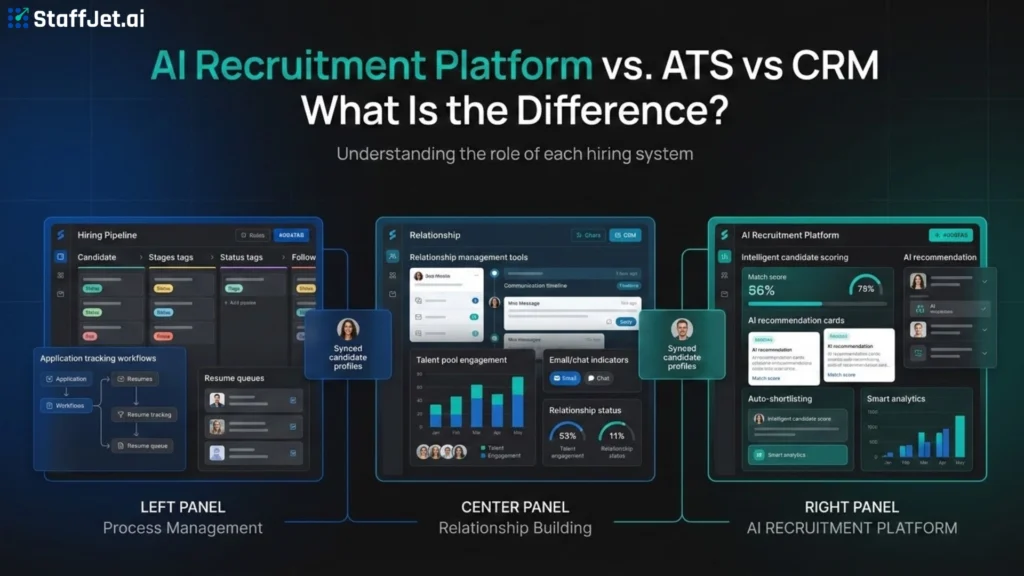
An ATS manages candidate workflows and compliance , it tells you where a candidate stands. An AI recruitment platform evaluates whether that candidate is worth hiring, automating screening, matching, and assessment.
An Applicant Tracking System was built to manage candidates who have already applied , job postings, application collection, interview scheduling, offer management, and compliance. Over 98% of Fortune 500 companies use one [Zeko AI, 2025], and 78% of users report improved hiring quality [ibid.]. But an ATS is fundamentally reactive: it organises what has already happened. Most companies with an ATS need tools that complement it rather than replace it. The real question is whether those additions address the actual bottleneck→ [Link: Seamless Integration: How AI Platforms Connect with Your Tech Stack the hours recruiters spend deciding who to advance.
An AI recruitment platform addresses that bottleneck directly. Instead of tracking applications, it evaluates them using AI resume screening to shortlist candidates, AI profile matching to connect roles with the right talent, and automated skills assessments to verify capabilities before a human enters the process. An ATS organises your hiring process. An AI recruitment platform accelerates the decisions within it.
Can a Recruitment CRM Replace an AI Recruitment Platform?
No. A CRM builds long-term candidate relationships and talent pipelines , it is designed for sourcing and engagement, not evaluation. An AI recruitment platform automates the assessment layer that sits between sourcing and hiring.
A Candidate Relationship Management system functions like a marketing engine for talent. It segments candidates, automates outreach, tracks engagement, and nurtures passive candidates [SmartRecruiters, 2026]. For high-volume hiring teams, a CRM keeps the talent pool warm and reduces future sourcing costs.
But a CRM cannot screen for technical fit, run standardised assessments, or conduct structured interviews. That is the layer an AI recruitment platform occupies. Where a CRM asks whether a person is interested, an AI recruitment platform asks whether that person is qualified and answers with data.
How Does an AI Recruitment Platform Compare When You Stack an ATS and CRM?
Combining an ATS and CRM creates a strong workflow for sourcing and tracking, but the evaluation stage remains manual. An AI recruitment platform owns that middle layer , automating resume screening, skills assessment, and interview intelligence.
This is the most common misconception in the Indian market. Companies invest in an ATS for process management, add a CRM for talent pipelining, and assume they have a modern hiring stack. But the centre of the funnel evaluation stays entirely manual. Recruiters still review 200 to 300 resumes per role [Zivaro, 2025], and interviewers still lack standardised evaluation criteria.
An AI recruitment platform differs because it automates the evaluation layer. It uses machine learning to parse and rank candidates, runs automated assessments, and conducts structured AI-driven interviews at booked time slots , producing comparable data for every candidate. Research found that AI-driven platforms significantly improve both hiring efficiency and candidate-fit prediction [Yahya & Ravi, 2025]. With an ATS and CRM, your technology helps recruiters work. With an AI recruitment platform, it does the work recruiters should not have to do.
How Does StaffJet’s AI Recruitment Platform Fit Into This Ecosystem?
StaffJet operates as an end-to-end AI hiring intelligence platform not an ATS add-on or a sourcing CRM automating job posting, AI profile matching, AI resume screening, skills assessment, live AI interviews, and dashboard reporting in a single workflow.
StaffJet’s AI resume screening processes applications in minutes rather than the 10 to 15 hours recruiters typically spend manually, delivering 10x faster candidate shortlisting. The AUTO INTERVIEW feature conducts structured 20 to 30-minute live AI interviews at booked time slots, generating consistent evaluation data. AI profile matching connects roles with relevant talent, while automated assessments validate competencies before the interview stage. Together, these capabilities contribute to 60% lower cost-per-hire, 70% hours saved per year, and a 24-hour hiring timeline from posting to interview completion. All metrics feed into a unified dashboard, replacing the fragmented reporting from stacked tools.
Which AI Recruitment Platform Architecture Should You Choose?
Inbound-heavy models benefit from an ATS paired with AI screening. Proactive sourcing teams need a CRM with AI matching. Companies hiring at scale or competing for scarce talent gain the most from an integrated AI recruitment platform covering evaluation, assessment, and interview automation.
Map your primary hiring challenge first. If high volumes make it hard to identify the right candidates, your bottleneck is evaluation; you need AI screening and matching. If finding candidates is the struggle, sourcing is the bottleneck and a CRM is the priority. If both, stacking separate tools adds complexity. An end-to-end AI recruitment platform that handles the full lifecycle is the more efficient architecture. For startups and IT services companies in India competing for the same talent pool, the integrated approach delivers the clearest ROI. If evaluating systems, use a structured scoring framework see our guide.
What Are the Key Takeaways When Comparing an AI Recruitment Platform, ATS, and CRM?
• An ATS tracks candidates through hiring stages but does not evaluate them. It is a system of record, not a system of intelligence.
• A CRM builds and nurtures talent pipelines over time but cannot assess candidate quality or fit.
• An AI recruitment platform automates the evaluation layer screening, matching, assessing, and interviewing that neither an ATS nor a CRM addresses.
• Stacking an ATS and CRM leaves the most time-consuming part of hiring candidate evaluation entirely manual.
• The right system architecture depends on whether your bottleneck is sourcing, evaluation, or both.