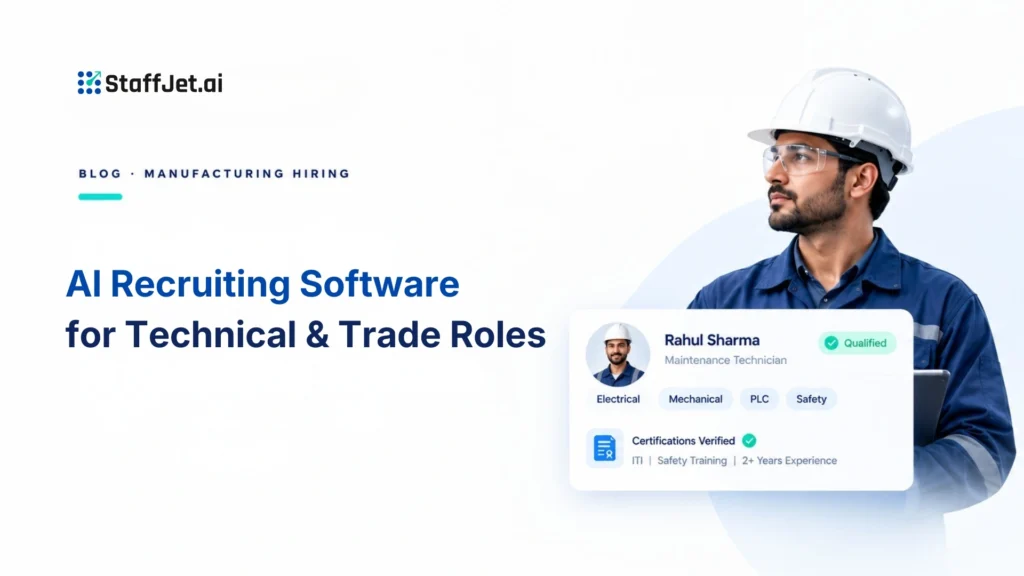
Closing the Skills Gap: AI Recruiting Software for Technical and Trade Roles
A factory may receive hundreds of applications for a maintenance technician position and still struggle to find someone who can diagnose equipment faults.
The problem is not always a shortage of applicants. Candidates may have related industrial experience, but their resumes do not clearly demonstrate the technical competencies required.
AI recruiting software for technical and trade roles helps manufacturers identify relevant experience, recognize transferable skills, and organize job-specific candidate assessments.
India’s registered manufacturing employment increased by 7.19% in FY2024–25, according to the Annual Survey of Industries 2024–25 [Ministry of Statistics and Programme Implementation, 2026].
This employment growth does not independently measure the shortage of skilled tradespeople. However, it reinforces the importance of effective recruitment and workforce planning.
Staffjet.ai is an AI-powered recruiting platform for manufacturing companies, helping HR teams screen applications, assess technical knowledge, and conduct structured interviews.
Manufacturers evaluating AI recruiting software for manufacturing should focus on whether the system identifies relevant skills without excluding potentially qualified candidates.
Key Takeaways
- The manufacturing skills gap involves capability, not just applicant availability. Recruiters must distinguish general work experience from job-specific technical competence.
- AI can identify relevant and transferable experience. Consistent screening criteria help recruiters consider candidates whose previous job titles differ from the vacancy.
- Technical assessments provide stronger evidence than resume keywords. Practical knowledge, troubleshooting ability, and equipment familiarity require role-specific evaluation.
- Recruitment technology cannot replace workforce training. Apprenticeships, technical education, and supervised experience remain necessary.
- Manufacturers should measure qualified candidate availability. Skill-match rates, assessment results, and time-to-fill provide more useful information than application volume alone.
What Is the Skills Gap in Manufacturing Recruitment?
The manufacturing skills gap occurs when available candidates do not possess, or cannot demonstrate, the competencies employers require for specific technical jobs.
A plant may need CNC programming knowledge, electrical troubleshooting experience, or industrial welding skills.
Candidates with general manufacturing experience may not meet every requirement.
The World Economic Forum’s Future of Jobs Report 2025 identifies skills gaps as a major business transformation barrier for 63% of surveyed employers globally [World Economic Forum, 2025].
This is a global finding, not an India-specific manufacturing shortage rate.
Why Is the Skills Gap Difficult for Technical and Trade Recruitment?
Technical and trade positions often require equipment-specific knowledge, practical experience, and qualifications that cannot be confirmed through resumes alone.
A mechanical technician may have maintenance experience but limited exposure to the machinery used at a particular plant.
Similarly, an electrician may understand general electrical systems without experience in industrial fault diagnosis.
Recruiters must separate essential skills from experience that candidates can develop through training.
Which Technical Roles Are Most Affected by the Manufacturing Skills Gap?
Roles requiring specialized machinery, maintenance knowledge, safety awareness, or technical precision can be difficult to fill when suitable candidates are unavailable.
| Manufacturing role | Skills to evaluate |
| CNC operator | Machine setup, programming, drawings |
| Welder | Welding methods, material knowledge |
| Industrial electrician | Electrical troubleshooting |
| Maintenance technician | Fault diagnosis, preventive maintenance |
| Machinist | Measurement, machining procedures |
| Quality technician | Inspection methods, specifications |
These are examples of role requirements, not a verified ranking of occupational shortages.
How Can AI Recruiting Software Help Address the Skills Gap?
AI recruiting software can compare candidate experience with documented job requirements, identify relevant profiles, and support structured technical assessments.
The process should begin with accurate job requirements.
An AI recruiting platform can help organize candidate information, but recruiters must verify qualifications and practical competence.
Automated recommendations should not replace final hiring decisions.
Step 1: How Should Manufacturers Define Skills Gap Requirements?
Recruiters should identify essential technical competencies before evaluating candidates. Each requirement should relate directly to the tasks performed in the position.
The U.S. Office of Personnel Management’s job analysis guidance recommends identifying job tasks and the competencies necessary to perform them [OPM, n.d.].
For manufacturing recruitment, plant managers should help define equipment knowledge, troubleshooting requirements, and mandatory qualifications.
Avoid adding unnecessary experience requirements that exclude otherwise suitable applicants.
Step 2: How Can AI Identify Candidates With Relevant Trade Skills?
AI resume screening helps organize applications by documented experience, qualifications, and technical responsibilities. It allows recruiters to prioritize profiles requiring further evaluation.
For example, applications may describe welding processes, electrical maintenance, machine operation, or quality inspection.
Staffjet.ai AI recruiting software for manufacturing helps talent acquisition teams shortlist candidates for production, maintenance, engineering, and plant operations roles.
Relevant resume information should support initial screening, not determine final competency.
Step 3: How Can AI Recognize Transferable Skills in Technical Recruitment?
Transferable skills are competencies developed in one job that may also be useful in another technical role. Recruiters should evaluate these skills against current job requirements.
Consider a maintenance technician experienced in industrial pumps who applies for a role involving related mechanical equipment.
Troubleshooting and preventive maintenance knowledge may be relevant, although equipment-specific training could still be necessary.
A job-related assessment should establish whether that experience transfers.
Step 4: How Can Skills Assessments Improve Trade Recruitment?
Role-specific assessments help manufacturers evaluate technical understanding before selecting candidates for practical demonstrations or final interviews.
Assessment topics may include:
- Engineering drawing interpretation
- Electrical fault identification
- Welding procedure knowledge
- Equipment troubleshooting
- Quality inspection methods
The U.S. Office of Personnel Management’s work sample guidance explains how job-related tasks can provide direct evidence of relevant competencies [OPM, n.d.].
Digital assessments should complement practical testing where equipment operation matters.
Step 5: How Can Manufacturers Match Candidates With Skill Requirements?
Candidate matching should compare demonstrated and documented competencies against mandatory and preferred requirements separately.
A suitable evaluation framework includes:
| Evaluation category | Evidence required |
| Technical experience | Relevant previous responsibilities |
| Equipment knowledge | Machine familiarity |
| Qualifications | Applicable certificates |
| Practical competence | Assessment or demonstration |
| Training needs | Missing but developable skills |
Manufacturers adopting skills-based hiring in manufacturing should avoid relying only on job titles or years of experience.
How Can AI Support Hiring for Hard-to-Fill Technical Roles?
AI-supported screening can help recruiters identify relevant applicants more consistently, including candidates whose experience may be overlooked during manual resume review.
For specialized maintenance or machining positions, technical requirements should be documented before screening begins.
As an AI recruiting platform for manufacturing, Staffjet.ai supports candidate matching, skills assessments, structured interviews, and centralized hiring reports.
The availability of qualified workers still determines whether vacancies can be filled.
Can AI Identify Candidates Who Need Additional Training?
Candidate assessments can reveal gaps between demonstrated knowledge and the requirements of a role. Employers must decide whether those gaps can be addressed through training.
A candidate may understand general machining principles but need instruction on specific equipment.
Recruiters should distinguish trainable skills from qualifications required before joining.
AI assessments provide supporting information; they do not independently establish complete training needs.
Why Do Apprenticeships Matter When Closing the Skills Gap?
Recruitment can identify available talent, but apprenticeships and vocational training help develop competencies that the existing workforce may lack.
India’s Ministry of Skill Development and Entrepreneurship describes training initiatives through Industrial Training Institutes and apprenticeship programs in its Aligning Skill Development with Industry Requirements update [Ministry of Skill Development and Entrepreneurship, 2025].
Manufacturers should work with training partners when essential skills are consistently unavailable.
AI cannot independently create job-ready technical workers.
How Should Manufacturers Verify Trade Certifications and Safety Competence?
Employers should confirm mandatory qualifications through appropriate sources and separately evaluate job-related safety knowledge and practical ability.
A candidate may hold a technical certificate without demonstrating current competence in a specific task.
For manufacturers verifying certifications and safety compliance in hiring, official credential checks and supervised practical evaluation should remain separate responsibilities.
AI resume screening cannot establish certificate authenticity.
Where Does Staffjet.ai Fit in Closing the Manufacturing Skills Gap?
Staffjet.ai supports candidate screening, profile matching, technical assessments, structured interviews, and hiring reports within an end-to-end AI hiring intelligence workflow.
Staffjet.ai, an AI recruitment platform for manufacturing companies, helps plant HR managers streamline bulk screening and evaluate candidates against role-specific requirements.
Its confirmed capabilities include AI resume screening, AUTO ASSESSMENT, and AUTO INTERVIEW.
AUTO INTERVIEW conducts a scheduled, live AI interview lasting 20–30 minutes at a booked time slot.
Staffjet.ai reports 10x faster candidate shortlisting. This is a vendor-reported result, not an independently verified manufacturing benchmark.
What Metrics Should Manufacturers Track When Addressing the Skills Gap?
Manufacturers should evaluate whether recruitment identifies more suitable candidates and reduces delays without weakening technical assessment standards.
| Metric | What it measures |
| Qualified candidate availability | Suitable applicants for each role |
| Skill-match rate | Candidates meeting defined requirements |
| Assessment pass rate | Candidates meeting evaluation standards |
| Time-to-fill | Vacancy opening to position filled |
| Training needs | Skills requiring development |
These measures help distinguish recruitment inefficiency from genuine workforce shortages.
What Should Manufacturers Check Before Adopting AI Recruiting Software?
Manufacturers should evaluate job relevance, assessment quality, recruiter oversight, reporting, and implementation requirements before selecting AI recruitment software.
Use this checklist:
- Define essential competencies for each technical role.
- Identify skills that can be developed through training.
- Test AI screening on previously reviewed applications.
- Assess whether relevant candidates are incorrectly excluded.
- Include practical evaluations where required.
- Confirm mandatory certification checks.
- Review assessment results with plant managers.
- Compare shortlist quality and recruitment costs.
A controlled pilot can help determine whether AI improves recruitment decisions.
How Should Manufacturers Plan for the Future of Technical Skills Recruitment?
Manufacturers should combine competency-based recruitment with vocational training, apprenticeships, and long-term workforce planning.
AI can help identify relevant experience and improve candidate evaluation, but it cannot eliminate genuine skill shortages.
AI recruiting software like Staffjet.ai can support this process by connecting screening, assessments, interviews, and reporting.
The objective is to identify qualified candidates more effectively while developing the technical workforce needed for future production.