How Manufacturers Use AI to Verify Certifications and Safety Compliance During Hiring
A candidate applies for an electrical maintenance role with several technical qualifications listed on their resume. But who confirms whether those credentials are valid, current, and relevant to the equipment they will maintain?
AI certification verification in manufacturing hiring can support document review and qualification screening, but employers must still confirm credentials through appropriate sources.
India’s registered manufacturing employment grew by 7.19% in FY2024–25, according to the Annual Survey of Industries 2024–25 [Ministry of Statistics and Programme Implementation, 2026].
As manufacturing employment grows, qualification checks remain important for technical recruitment and workplace safety.
Staffjet.ai is an AI-powered recruiting platform for manufacturing companies, helping HR teams automate resume screening, candidate assessments, and interviews for plant and factory roles.
Manufacturers evaluating AI recruiting software for manufacturing should distinguish automated candidate screening from official certification verification.
Key Takeaways
- Certification information on a resume is not proof of validity. Employers must confirm essential qualifications through reliable issuing authorities or approved procedures.
- AI can support preliminary qualification screening. It can help identify stated credentials and missing information, but automated document authentication requires separate verified capabilities.
- Safety knowledge and practical competence are different. Candidates may understand safety procedures without demonstrating safe equipment operation.
- Certification requirements vary by job and location. Manufacturers should define applicable qualifications before screening candidates.
- Human verification remains essential. Compliance decisions require documented checks, appropriate assessments, and accountable reviewers.
What Is AI Certification Verification in Manufacturing Hiring?
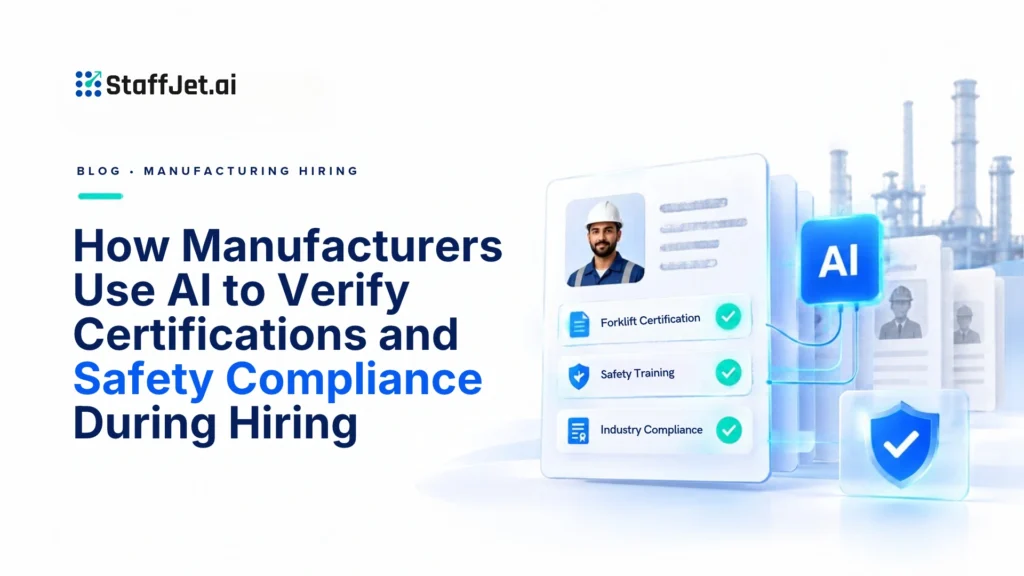
Certification verification means confirming that a candidate holds the qualifications required for a manufacturing position. AI-supported screening can help organize stated qualifications, but validity must be confirmed through an appropriate verification process.
Employers may need to review technical certificates, training records, licenses, or other role-specific documents.
The requirements depend on the position, equipment, applicable law, and work location.
Why Is Certification and Safety Verification Important in Manufacturing Hiring?
Manufacturers must establish whether candidates meet mandatory qualifications and understand relevant workplace safety requirements before assigning technical responsibilities.
The Government of India’s Directorate General Occupational Safety and Health provides technical support for occupational safety and health in factories [DGOSH, 2026].
Recruitment checks should reflect applicable legal requirements and the actual work involved.
A listed qualification should not be accepted without necessary verification.
What Challenges Affect Manual Certification Verification in Manufacturing Hiring?
Manual checks can become difficult when recruiters handle different document formats, issuing bodies, qualification requirements, and large applicant volumes.
| Verification challenge | Potential recruitment problem |
| Incomplete documents | Additional candidate follow-up |
| Different certificate formats | Difficult information comparison |
| Unclear issuing authority | Additional verification work |
| Missing expiry information | Unresolved qualification status |
| Multiple technical roles | Different verification requirements |
These are potential administrative challenges, not measured industry-wide failure rates.
How Can AI Support Certification and Safety Verification During Hiring?
AI-supported recruitment can identify stated qualifications and organize candidate information for review. Document authentication, expiry validation, and official issuer checks must be performed through separately verified processes.
A suitable verification workflow includes:
- Identifying required credentials
- Collecting supporting documents
- Reviewing qualification details
- Confirming validity
- Assessing job-related knowledge
- Recording final decisions
Recruiters should retain responsibility for exceptions and unresolved information.
Step 1: How Should Manufacturers Define Certification Requirements Before AI Screening?
HR and safety teams should establish mandatory qualifications, relevant training, and job-specific competencies before screening applications.
| Manufacturing role | Possible verification focus |
| Electrician | Applicable electrical qualifications |
| Welder | Relevant process qualifications |
| Forklift operator | Required training and authorization |
| Maintenance technician | Technical qualifications and safety knowledge |
| Machine operator | Equipment-specific training |
These are examples, not universal legal requirements. Local regulations and employer responsibilities must determine mandatory checks.
Step 2: How Should Employers Collect Certifications for Manufacturing Hiring?
Recruiters should request relevant qualification documents and record missing information before moving candidates into final selection.
The process should identify the document type, issuing organization, candidate name, and applicable qualification details.
Employers should collect only information necessary for recruitment and handle records according to applicable privacy requirements.
Step 3: How Can AI Assist With Certification Information Extraction?
Document-reading AI tools can potentially extract certificate names, dates, and issuing organizations, but this requires a specific verified capability.
An extracted value is not proof that the original document is authentic.
Staffjet.ai’s confirmed AI resume screening can identify qualifications stated in candidate profiles. Automated certificate extraction or authentication has not been established as a Staffjet.ai feature.
Step 4: How Should Manufacturers Check Certification Validity and Expiry?
Recruiters should review qualification details against the requirements of the position and check whether supporting documents remain valid where expiry applies.
A certificate may be genuine but unsuitable for a particular task.
Missing dates or inconsistent information should trigger further review, not an automatic conclusion of fraud.
Employers must use appropriate verification methods.
Step 5: How Can Manufacturing Employers Confirm Credentials With Issuers?
Official verification requires confirmation through the relevant issuing authority, authorized register, or another recognized process where available.
The employer should document the verification source and result.
AI-generated matching scores cannot establish authenticity.
This distinction is especially important when recruiting for roles involving regulated qualifications or safety-critical responsibilities.
Step 6: How Can AI Assess Workplace Safety Knowledge During Hiring?
Structured assessments can evaluate whether candidates understand job-related safety procedures, hazards, and appropriate responses to unsafe conditions.
Assessment topics may include:
- Equipment isolation procedures
- Emergency response
- Personal protective equipment
- Hazard reporting
- Safe operating instructions
The U.S. Office of Personnel Management’s structured interview guidance supports using consistent questions linked to job competencies [OPM, n.d.].
This is general assessment guidance, not an Indian safety certification standard.
Step 7: How Should AI Screening Flag Qualification Gaps for HR Review?
Candidate screening should identify missing or unclear qualifications for further investigation rather than treating every information gap as proof of non-compliance.
Staffjet.ai AI recruiting software for manufacturing helps talent acquisition teams shortlist candidates for production, maintenance, engineering, and plant operations roles.
Its profile matching and resume screening can support initial evaluation against documented job requirements.
HR teams must separately confirm mandatory credentials and qualification status.
Step 8: How Should Manufacturers Maintain Certification Verification Records?
Employers should document required qualifications, verification findings, unresolved issues, and final hiring decisions using a consistent internal process.
A verification record may include:
| Record | Purpose |
| Qualification required | Establish role requirement |
| Document reviewed | Identify supporting evidence |
| Verification result | Record confirmation status |
| Reviewer | Establish accountability |
| Final decision | Document hiring outcome |
A unified recruitment dashboard can support candidate reporting, but a dedicated certification audit system should not be assumed.
Which Manufacturing Roles Need Safety and Certification Verification?
Verification needs depend on the work performed, the equipment involved, and applicable legal or organizational requirements.
Roles involving electrical work, welding, material-handling equipment, maintenance, or hazardous processes may require particular qualifications or training.
Recruiters should work with plant safety and technical teams to establish role-specific requirements.
How Does AI Reduce Manual Work in Manufacturing Credential Screening?
AI can reduce repetitive candidate information review and help recruiters prioritize profiles requiring additional qualification checks.
For organizations adopting skills-based hiring in manufacturing, screening should connect documented qualifications with evidence of job-related ability.
AI resume screening can support this initial process.
Actual time savings should be measured rather than assumed.
How Does Certification Verification Differ From Safety Competency Assessment?
Certification verification confirms a documented qualification. Competency assessment evaluates whether someone can demonstrate the knowledge or ability required for a task.
These checks answer different questions.
The U.S. Office of Personnel Management’s work sample guidance explains how realistic work tasks can provide evidence of relevant job performance [OPM, n.d.].
For safety-critical manufacturing activities, supervised practical evaluation may still be necessary.
How Can Verified Credentials Support Manufacturing Hiring Decisions?
Verified qualifications provide evidence that required credential conditions have been met. They do not independently establish complete job readiness or guarantee safe future performance.
Manufacturers should combine credential checks with relevant technical assessments.
This is particularly useful when closing the skills gap in technical and trade hiring.
Training and supervision remain important after recruitment.
What Are the Limitations of AI Certification Verification?
AI cannot independently guarantee document authenticity, legal compliance, or safe equipment operation. Employers remain responsible for appropriate verification and hiring decisions.
Potential limitations include:
- Incorrect document interpretation
- Missing credential information
- Unverified issuing sources
- Outdated qualification requirements
- Assessments that do not reflect actual work
Human review is essential when errors may affect safety or eligibility.
Where Does Staffjet.ai Fit in Manufacturing Compliance Hiring?
Staffjet.ai supports candidate screening, skills assessments, structured interviews, and recruitment reporting. Official credential authentication and statutory compliance checks remain separate employer responsibilities.
As an AI recruiting platform for manufacturing, Staffjet.ai supports candidate matching, skills assessments, structured interviews, and centralized hiring reports.
AUTO ASSESSMENT can help evaluate job-related knowledge, while AUTO INTERVIEW provides a scheduled, live AI interview lasting 20–30 minutes at a booked time slot.
Staffjet.ai, an AI recruitment platform for manufacturing companies, helps HR managers organize candidate evaluations against role-specific requirements.
These capabilities do not replace issuing-authority verification or hands-on safety assessment.
What Should HR Teams Check Before Using AI for Certification Screening?
Manufacturers should assess job relevance, verification responsibilities, candidate data handling, technical evaluation quality, and recruiter oversight before introducing AI-supported screening.
Use this checklist:
- Identify legally required credentials by role.
- Confirm issuing-authority verification procedures.
- Define how missing documents are handled.
- Use relevant safety knowledge assessments.
- Require practical testing where necessary.
- Establish reviewer responsibilities.
- Document final qualification decisions.
- Confirm software capabilities before purchasing.
A pilot can help identify screening errors before wider implementation.
How Should Manufacturers Approach Future Certification and Safety Verification?
Manufacturing hiring should combine efficient candidate screening with verified qualifications and practical evidence of competence.
AI can assist with organizing information and evaluating knowledge, but it cannot replace accountability for safety-critical decisions.
Staffjet.ai offers an end-to-end AI hiring intelligence workflow that manufacturers can evaluate as part of a broader recruitment and verification process.