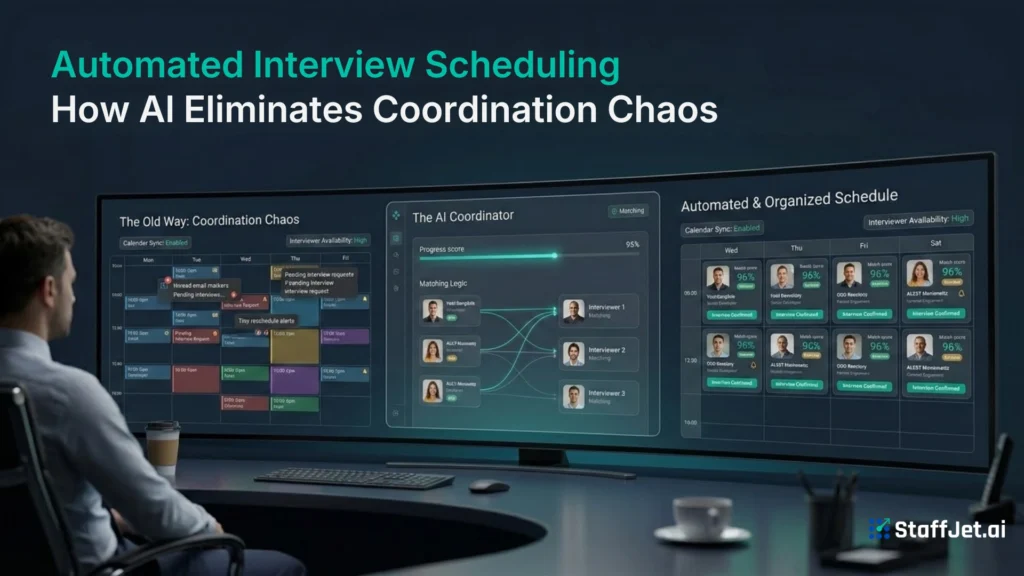
Automated Interview Scheduling: How AI Eliminates Coordination Chaos
Interview delays do not always happen because candidates are unavailable. Many happen because recruiters, hiring managers, and candidates cannot align calendars fast enough.
Automated interview scheduling removes this coordination drag. It helps shortlisted candidates book available slots, sends interview invites, syncs calendars, and keeps the process moving.
Interview scheduling is Step 3 in our full guide to AI in the recruitment process: AI in the Recruitment Process
AI scheduling becomes powerful only once you have a qualified shortlist. Here is how AI gets you there first: AI-Powered Candidate Shortlisting: 500 to 10
LinkedIn reports that AI is helping recruiters streamline repetitive tasks and spend more time on strategic hiring work [LinkedIn, 2025]. SHRM also says AI can improve recruiting by automating repetitive tasks while keeping human judgment central [SHRM, 2025].
What Is Automated Interview Scheduling?
Automated interview scheduling uses AI and calendar workflows to schedule interviews without repeated manual follow-ups between recruiters, candidates, and interviewers.
It replaces back-and-forth emails with a structured booking flow. Recruiters share available slots. Candidates choose a suitable time. Calendar invites and reminders are sent automatically.
For hiring teams, the benefit is simple. Less coordination. Faster movement from shortlist to interview.
Why Manual Interview Scheduling Creates Hiring Delays
Manual interview scheduling creates delays because every interview depends on multiple people replying, confirming, and rescheduling on time.
A recruiter may need to check the hiring manager’s availability, ask the candidate for options, manage conflicts, and send reminders. If one person replies late, the whole process slows.
This is a productivity issue. Recruiters should spend time engaging candidates and aligning stakeholders, not chasing calendars.
Greenhouse’s 2025 hiring research shows candidates are affected by slow and complex hiring journeys, especially when application and interview processes feel difficult [Greenhouse, 2025].
How AI Eliminates Interview Coordination Chaos
AI eliminates coordination chaos by turning interview scheduling into a guided workflow instead of a manual email chain.
The system checks availability, sends invitations, lets candidates select slots, updates calendars, and triggers reminders.
This reduces small delays that add up across many roles. For high-volume hiring, this matters even more. Ten open roles can quickly turn into hundreds of scheduling messages.
Automated scheduling does not remove recruiter involvement. It removes repetitive coordination.
Step 1: Candidate Shortlist Is Created Automatically
Interview scheduling works best when the shortlist is already structured and qualified.
The process starts after resume screening, candidate matching, skills assessment, or another evaluation step. Only relevant candidates should move to interviews.
This protects hiring manager time. It also improves candidate experience because people are not invited into interviews without a clear reason.
An end-to-end AI hiring intelligence platform can connect shortlisting and interview scheduling in one workflow, rather than keeping both stages separate.
Step 2: Interview Invitations Are Sent Without Manual Follow-Up
Automated interview scheduling sends interview invitations without recruiters writing the same follow-up emails again and again.
Once a candidate reaches the interview stage, the system can send an invite with available slots and required instructions.
This reduces recruiter admin time. It also reduces candidate waiting time.
SHRM notes that AI can help HR teams focus on high-value human-centered work by automating repetitive recruiting processes [SHRM, 2025]. Interview invitations are one of those repeatable tasks.
Step 3: Candidates Choose Available Time Slots
Candidates choose from available time slots, which reduces back-and-forth and gives them more control over scheduling.
This is important for candidate experience.
Many candidates are already working. They may need early morning, evening, or specific time windows. A self-selection flow makes the process easier.
Candidate experience matters because hiring is competitive. Slow responses and rigid scheduling can increase drop-off, especially for strong candidates with other opportunities.
Step 4: Calendars Sync Automatically
Calendar sync helps ensure interview slots are confirmed across recruiters, candidates, and hiring managers without duplicate manual updates.
Once a candidate books a slot, the calendar event should update for everyone involved.
This prevents double booking. It also keeps hiring teams aligned.
For distributed teams, calendar sync is useful because interviews may include people from different cities or time zones. Manual coordination becomes harder as the number of stakeholders grows.
Step 5: AI Sends Interview Reminders
Automated reminders reduce the risk of missed interviews by keeping candidates and interviewers informed before the scheduled time.
Reminders may include time, meeting link, role details, and preparation instructions.
This step looks small, but it protects hiring momentum. A missed interview means rescheduling, extra follow-up, and possible candidate drop-off.
If no-show reduction is discussed, it should be measured internally by each hiring team because public benchmarks vary by industry, role, and geography. Without verified internal data, no-show improvement should be treated as an estimate.
Step 6: Recruiters Track Scheduled Interviews in One Dashboard
A dashboard helps recruiters track scheduled interviews, pending confirmations, completed interviews, and next actions in one place.
This matters when a team is handling many candidates across many roles.
Without a dashboard, recruiters may track interviews in emails, calendars, spreadsheets, and chat threads. That creates poor visibility.
A unified dashboard helps hiring managers see progress without asking for constant updates. For more on this, see Unified Hiring Dashboards
How Automated Scheduling Improves Candidate Experience
Automated scheduling improves candidate experience by making the interview process faster, clearer, and easier to complete.
Candidates do not want to wait days for a time slot. They want clarity.
A smooth booking flow tells them that the employer is organized. It also respects their time.
Greenhouse’s 2025 workforce research highlights that candidate experience remains a major hiring concern as applicants face more complex hiring processes [Greenhouse, 2025].
How AI Scheduling Reduces No-Shows
AI scheduling can reduce no-shows by sending reminders, confirming availability, and making interview details easy to access.
The key is consistency.
Manual reminders depend on recruiter bandwidth. Automated reminders are triggered by the workflow.
No-show reduction should be tracked role by role. A high-volume sales role may behave differently from a senior engineering role. Teams should measure scheduled interviews, attended interviews, reschedules, and drop-offs.
Why Automated Scheduling Helps Recruiters Save Time
Automated scheduling saves recruiter time by removing repeated coordination work from the interview process.
Recruiters often spend hours each week checking calendars, sending reminders, and rescheduling calls. This is necessary work, but it is not the best use of recruiter skill.
LinkedIn says AI is changing recruiting by automating time-consuming work and helping recruiters focus on higher-impact tasks [LinkedIn, 2025].
The real gain is focus. Recruiters can spend more time on candidate conversations, offer management, and hiring manager alignment.
Where Human Recruiters Still Matter in the Interview Process
Human recruiters still matter because scheduling is only one part of interview success.
Recruiters must prepare candidates, explain the role, manage expectations, brief hiring managers, and keep top candidates engaged.
AI can book the meeting. It cannot build trust with the candidate.
This is especially important in India, where notice periods, counteroffers, and candidate drop-off can affect hiring outcomes. Human follow-up still matters.
Final Thoughts: From Calendar Chaos to Faster Hiring
The future of interview scheduling is simple: fewer emails, faster confirmations, and better visibility for every stakeholder.
Automated scheduling helps hiring teams remove a common bottleneck between shortlist and interview.
It works best when connected to the full recruitment workflow: AI profile matching, AI resume screening, AUTO ASSESSMENT, AUTO INTERVIEW, and dashboard reporting.
For teams using ai powered interviews, scheduling is not just an admin step. It is the bridge between qualified shortlists and structured evaluation.
A practical starting point is one role. Measure time from shortlist to scheduled interview, reschedule rate, candidate response time, and interviewer attendance.
Key Takeaways
- Automated interview scheduling removes repeated calendar coordination from hiring.
- It works best after a qualified shortlist is already created.
- Candidates benefit because they can choose available time slots faster.
- Recruiters benefit because they spend less time chasing confirmations.
- Dashboards help teams track scheduled interviews and next actions.
- Human recruiters still matter for preparation, communication, and candidate engagement.