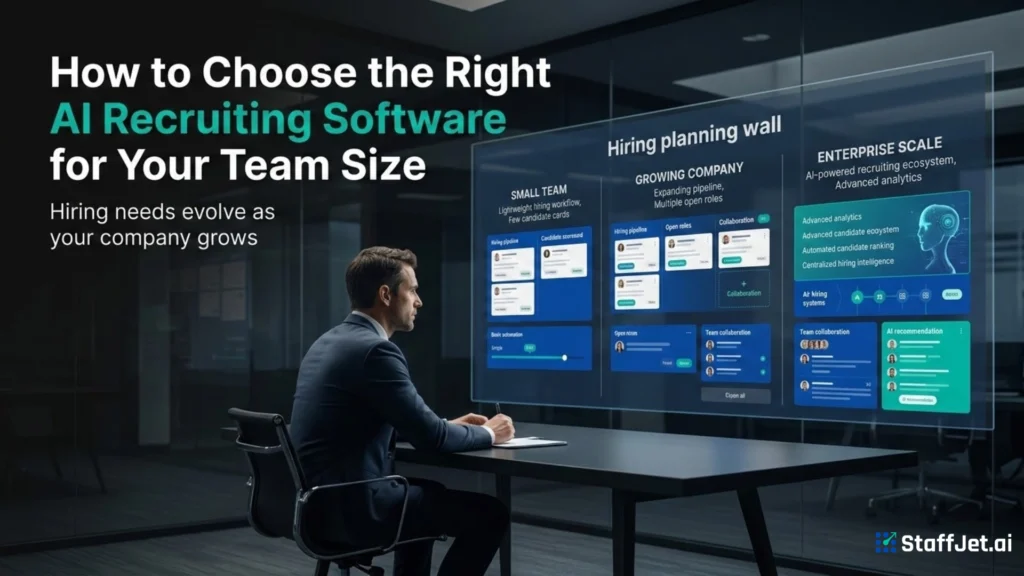
How to Choose the Right AI Recruiting Software for Your Team Size
A 2024 KPMG survey found that 63% of Indian startups lack structured HR processes, yet these same companies are expected to ramp up hiring by 20 to 30 percent in 2025 as funding recovers [JustHR, 2025; LinkedIn, 2025]. That mismatch is not just an operational inconvenience. It means founders and HR leads are making high-stakes hiring decisions with spreadsheets, email threads, and gut instinct — while competing against well-funded enterprises using purpose-built ai recruiting software. Once you know your team size needs, see which tools we recommend in our full 2026 comparison.
The MSME sector alone employs 31.66 crore people across India and contributes 30.1% of GDP [India SME Forum, 2025]. Whether you are a 15-person startup or a 2,000-person IT services firm, the tool you choose to manage hiring directly affects how fast you grow and how much it costs. The question is not whether to adopt AI recruiting software. It is which tool matches the realities of your team.
Why Does Team Size Matter When Choosing AI Recruiting Software?
Team size determines hiring volume, recruiter capacity, and budget — the three variables that dictate which features actually deliver ROI. A tool built for enterprise hiring will overwhelm a startup; a lightweight tool will buckle under enterprise demand.
The average recruiter closes 7.3 hires per quarter globally [Ashby, 2026]. A solo founder hiring 10 people a year has fundamentally different requirements than a 50-person company hiring 100. For small teams, the bottleneck is often finding candidates and screening them efficiently without a dedicated recruiter. For larger organisations, the challenge shifts to standardising evaluation across hundreds of hires and maintaining compliance. These are different problems, and they require different tools.
What Should Small Teams (Under 50 Employees) Prioritise in AI Recruiting Software?
Small teams need simplicity, speed, and affordability not feature overload. Prioritise automated screening, easy setup, and tools that work without a dedicated recruiter managing them.
Sixty-six percent of small business owners say attracting the right talent will be difficult in the next six months [Pin, citing NEXT Insurance survey]. At this stage, there is often no full-time recruiter. The founder, an operations manager, or a generalist HR person handles hiring alongside every other responsibility. The priority is reducing the hours spent on manual screening. Look for tools with AI resume screening that can shortlist candidates in minutes, not days. Entry-level HR and recruitment tools typically range from $2 to $8 per employee per month [HarmonyHR, 2025], making them accessible even for budget-conscious startups.
How Should Growing Teams (50–500 Employees) Evaluate AI Recruiting Software?
Growing teams need configurable workflows, standardised assessments, and reporting dashboards that scale with headcount without requiring enterprise-level budgets or dedicated implementation teams.
This is the most critical and most dangerous stage for software selection. Teams of 50 to 500 people typically hire 2 to 5 people per month, which is enough volume that manual processes break down, but not enough to justify a six-figure enterprise contract. The priority shifts from finding candidates to evaluating them consistently. AI-driven skills assessments and structured interview tools become essential. At the 75th percentile, recruiters handle 25 to 30 hires per year [LinkedIn Recruiter Productivity data, 2025], meaning a team of two recruiters can manage 50 to 60 annual hires — but only if the screening and evaluation layers are automated. Use this evaluation framework to score each tool against your specific requirements.
What Do Large Enterprises Need From AI Recruiting Software?
Enterprises need compliance-ready, deeply integrated platforms that handle high-volume hiring across multiple locations with audit trails, role-based permissions, and standardised evaluation at scale.
Companies with 500 or more employees often hire across geographies, job families, and seniority levels simultaneously. The average cost per hire in corporate India ranges from ₹30,000 to ₹1.5 lakh depending on the role [Economic Times, 2025], and even small efficiency gains compound across hundreds of hires. The priority is standardisation and control. Enterprise platforms must integrate with existing HRIS and ATS systems, support multi-level approval workflows, and provide explainable AI ranking to satisfy audit requirements [Everworker, 2026]. The ability to generate company-wide hiring dashboards broken down by department, role type, and time-to-fill is non-negotiable.
Where Does StaffJet Fit as an AI Recruiting Software Across Team Sizes?
StaffJet is an end-to-end AI hiring intelligence platform that scales across team sizes automating screening, assessment, and interviewing in a single workflow, whether you are hiring 10 people or 1,000.
StaffJet’s AI resume screening processes applications in minutes rather than the hours recruiters typically spend manually, delivering 10x faster candidate shortlisting. The AUTO INTERVIEW feature conducts structured 20 to 30-minute live AI interviews at booked time slots, generating consistent evaluation data regardless of team size. AI profile matching connects roles with relevant talent, while automated skills assessments validate competencies before the interview stage. Together, these capabilities contribute to 60% lower cost-per-hire, 70% hours saved per year, and a 24-hour hiring timeline from posting to interview completion. All metrics feed into a unified dashboard, giving small teams the visibility that was once available only to large enterprises.
What Budget Considerations Apply When Choosing AI Recruiting Software?
Calculate ROI as cost-per-hire impact, not just subscription cost. Factor in recruiter time saved, quality-of-hire improvements, and the cost of vacancies left open while you screen manually.
Mid-market HR platforms typically cost $8 to $30 per employee per month, while enterprise HCM suites range from $30 to $100 or more [HarmonyHR, 2025]. But the subscription fee is only one variable. If manual screening costs your team 15 hours per hire and your average cost per hire is ₹80,000 [SheWorks, 2026], a tool that cuts screening time by 70% pays for itself within the first few hires. For a detailed breakdown by vendor and company size, see our pricing guide. [Link: AI Recruitment Tools Pricing Guide
The real cost is not the software you buy, it is the software you do not buy while your team drowns in resumes.
What Are the Key Takeaways for Choosing AI Recruiting Software by Team Size?
• Match tool complexity to hiring volume, not company revenue. A 30-person startup hiring aggressively needs more automation than a 200-person company with low turnover.
• Small teams (under 50): prioritise AI resume screening and ease of setup. Every hour a founder spends on manual screening is an hour not spent on the business.
• Growing teams (50–500): invest in standardised assessments, structured interviews, and reporting. This is where manual processes break down fastest.
• Enterprises (500+): demand compliance features, HRIS integration, and audit trails. High-volume hiring without standardisation creates legal and quality risk.
• Budget by cost-per-hire impact. A tool that saves 10 recruiter hours per hire and improves quality-of-hire delivers measurable ROI regardless of subscription cost.
What Questions Should You Ask Before Selecting AI Recruiting Software?
We are a 20-person startup. Can we afford AI recruiting software?
Yes. Entry-level tools start as low as $2–$8 per employee per month [HarmonyHR, 2025]. At that price point, the question is not affordability. it is whether you can afford the cost of not automating screening. Calculate how many hours your team currently spends on resume review per hire.
What happens if we outgrow the tool we choose?
Evaluate scalability during selection, not after purchase. Ask vendors specifically about volume limits, pricing at the next tier, and whether core features like assessments and interviews scale with headcount. The most common mistake is choosing a tool that handles today’s volume but cannot accommodate 3x growth.
How do we justify this investment to our leadership team?
Frame it in business outcomes. Present your current cost-per-hire, average time-to-fill, and recruiter hours per hire. Show how automation reduces each metric. If your company hires 50 people a year and a tool saves even ₹15,000 per hire, that is ₹7.5 lakh in annual savings — a number leadership can act on.