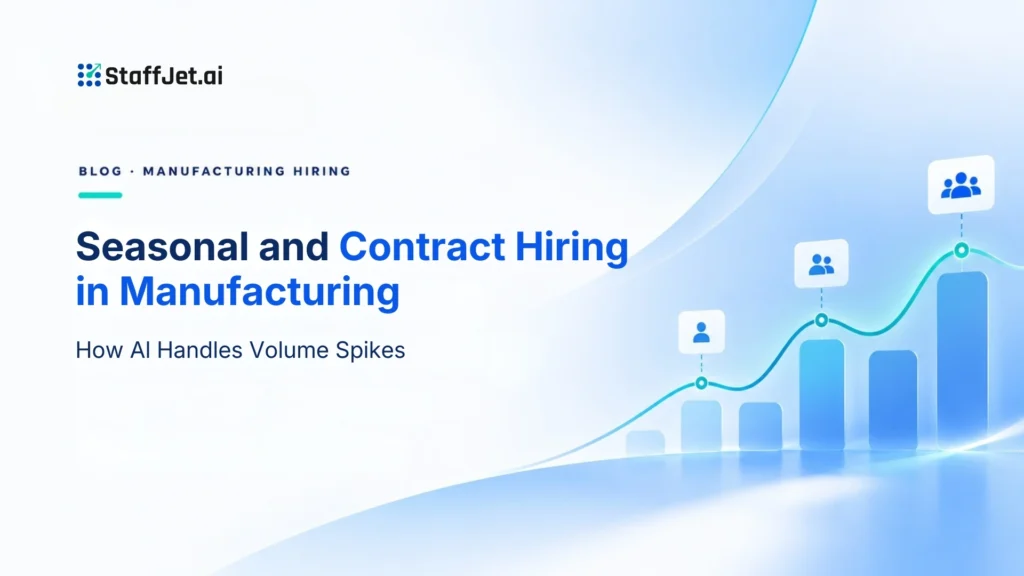
Seasonal and Contract Hiring in Manufacturing: How AI Handles Volume Spikes
A manufacturing plant may have enough workers for regular production but suddenly need additional operators, assembly workers, and warehouse staff when orders increase.
Seasonal hiring creates additional pressure because these workers must often be recruited within a fixed production deadline.
HR teams must review applications, coordinate staffing agencies, verify skills, confirm shifts, and track joining dates. Manual processing can become difficult when several vacancies open simultaneously.
India’s registered manufacturing employment increased by 7.19% in FY2024–25, according to the Annual Survey of Industries 2024–25 [Ministry of Statistics and Programme Implementation, 2026].
This indicates manufacturing employment growth, although it does not measure seasonal recruitment demand.
Staffjet.ai is an AI-powered recruiting platform for manufacturing companies, helping HR teams automate resume screening, candidate assessments, and interviews for plant and factory roles.
Manufacturers evaluating AI recruiting software for manufacturing should consider how automation performs when application volumes increase unexpectedly.
Key Takeaways
- Seasonal recruitment requires advance planning. Factories must estimate workforce requirements before production demand increases.
- AI can reduce repetitive screening during recruitment spikes. It helps HR teams identify relevant applicants without manually comparing every resume.
- Contract worker suitability depends on more than technical experience. Shift availability, plant location, contract duration, and joining readiness matter.
- Centralized candidate reporting improves recruitment visibility. HR teams can track shortlists, assessments, interviews, and pending decisions.
- Joining rates determine whether recruitment targets are achieved. Fast shortlisting has limited value when selected workers do not report for duty.
What Is Seasonal and Contract Hiring in Manufacturing?
Seasonal and contract hiring involves recruiting workers for temporary production requirements, defined projects, or fixed-duration assignments. Demand may increase during festivals, large orders, maintenance projects, or production expansions.
Seasonal employment usually responds to recurring demand patterns.
Contract recruitment may support project-specific or temporary staffing needs.
Both require clear job requirements, employment terms, and joining deadlines.
Why Does Seasonal Hiring Create Sudden Recruitment Volume Spikes?
Factories experience hiring spikes when production requirements increase faster than their existing workforce capacity. Additional workers may be required for shifts, assembly lines, packaging, or warehouse operations.
Common triggers include:
- Festive-season production
- Large customer orders
- Temporary production expansion
- New project requirements
- Additional operating shifts
Workforce demand should be estimated using production plans rather than assumed from previous recruitment volumes.
What Challenges Affect Seasonal and Contract Hiring?
HR teams must manage large applicant volumes, worker availability, agency coordination, technical verification, and joining deadlines within a short period.
| Recruitment challenge | Potential impact |
| High application volume | Increased screening workload |
| Multiple staffing agencies | Fragmented candidate information |
| Shift requirements | Availability mismatches |
| Technical verification | Delayed shortlisting |
| Joining uncertainty | Unfilled positions |
SHRM’s 2025 Talent Trends research found that 41% of surveyed U.S. organizations reported candidates disengaging during the interview process [SHRM, 2025].
This is not a manufacturing-specific joining or no-show rate.
How Does AI Recruiting Software Manage Seasonal Hiring Spikes?
AI recruiting software helps manufacturers organize applications, screen candidates against requirements, support assessments, and consolidate recruitment reports during high-volume hiring periods.
The aim is to reduce repetitive review while maintaining appropriate candidate evaluation.
SHRM’s 2025 research on AI in recruitment found that 89% of surveyed HR professionals using AI for recruitment reported time savings or improved efficiency [SHRM, 2025].
Actual factory recruitment outcomes still require measurement.
Step 1: How Should Manufacturers Forecast Seasonal Hiring Requirements?
Manufacturers should estimate temporary workforce needs using production schedules, current staffing, expected absenteeism, and required shift coverage.
Corporate HR and plant operations should agree on vacancy numbers and joining deadlines before recruitment begins.
Forecasting remains a workforce-planning responsibility. AI screening does not independently predict staffing demand unless a verified forecasting capability is available.
Step 2: How Should Factories Define Contract Recruitment Requirements?
Each temporary vacancy should include the role, technical requirements, plant location, shift arrangements, contract duration, and expected joining date.
| Role | Key requirements |
| Production operator | Equipment familiarity, shift availability |
| Assembly worker | Process knowledge, joining readiness |
| Warehouse associate | Material handling, location |
| Maintenance technician | Technical troubleshooting, qualifications |
Clear requirements reduce unnecessary screening and prevent misunderstandings about employment terms.
Step 3: How Can Seasonal Hiring Applications Be Collected Efficiently?
Recruiters should consolidate applications from approved job boards, staffing agencies, employee referrals, and direct submissions into a consistent review process.
Different recruitment sources may provide information in different formats.
HR teams should establish common candidate records and check for duplicate applications.
External recruitment-source integrations must be verified with the software provider.
Step 4: How Does AI Resume Screening Support Seasonal Hiring?
AI resume screening compares applications against defined job requirements and helps recruiters prioritize relevant profiles during large recruitment drives.
This can reduce repetitive comparisons, particularly when multiple vacancies share similar requirements.
Staffjet.ai AI recruiting software for manufacturing helps talent acquisition teams shortlist candidates for production, maintenance, engineering, and plant operations roles.
Recruiters should still verify essential experience and qualifications.
Step 5: How Can AI Match Contract Workers With Shifts and Availability?
Recruiters should evaluate technical suitability separately from shift availability, location preferences, contract duration, and joining readiness.
Relevant questions include:
- Can the candidate work the required shift?
- Is the plant location acceptable?
- Can the candidate join before production starts?
- Does the contract duration meet their expectations?
A technically qualified candidate may still be unavailable for the assignment.
Responses should be confirmed directly.
Step 6: How Can Seasonal Hiring Include Technical Skills Assessments?
Role-specific assessments help manufacturers evaluate job-related knowledge before involving plant managers in final selection.
The World Economic Forum’s Future of Jobs Report 2025 identifies skills gaps as a major business transformation barrier for 63% of surveyed employers globally [World Economic Forum, 2025].
For factories, assessments should focus on relevant operating procedures, quality requirements, or maintenance knowledge.
Practical demonstrations may still be necessary.
Step 7: How Can AI Interviews Support Contract Recruitment?
Structured AI interviews help collect comparable candidate responses during recruitment drives. Scheduling and candidate communication must still be managed carefully.
Staffjet.ai’s AUTO INTERVIEW conducts scheduled, live AI interviews lasting 20–30 minutes at a booked time slot.
An AI interview platform can support consistent initial evaluation where this capability is available.
Automated reminders and self-service rescheduling should not be assumed without vendor confirmation.
Step 8: How Can a Dashboard Track Seasonal Hiring Progress?
Centralized reporting helps recruiters monitor screening, assessments, interviews, pending decisions, and hiring progress across temporary vacancies.
As an AI recruiting platform for manufacturing, Staffjet.ai supports candidate matching, skills assessments, structured interviews, and centralized hiring reports.
A recruitment dashboard gives HR managers a common view of candidate progress.
Actual joining status still requires accurate updates from recruitment and plant teams.
How Can Seasonal Hiring Work Across Different Contracts and Plants?
Manufacturers should maintain consistent reporting while preserving differences in contract duration, shift arrangements, location, and technical requirements.
A temporary packaging role may require different experience from a maintenance assignment.
For organizations scaling blue-collar hiring across factories, centralized information helps coordinate recruitment without applying identical criteria to every vacancy.
How Does AI Reduce Manual Work During Seasonal Recruitment?
AI can reduce repetitive resume comparisons and organize candidate evaluations, allowing recruiters to concentrate on communication, verification, and joining coordination.
The benefit depends on application volume and the quality of screening criteria.
Staffjet.ai reports 70% annual recruiter hours saved. This is a vendor-reported figure, not an independently verified outcome for seasonal factory recruitment.
How Can Faster Seasonal Hiring Support Production Deadlines?
Faster candidate evaluation can help factories prepare staffing before production demand increases, provided qualified workers are available and can join on time.
Recruitment speed alone cannot guarantee production readiness.
Factories should compare vacancy coverage and actual joining dates against production schedules.
Operational benefits must be validated using plant-specific data.
How Can AI Support Contract Recruitment Through Staffing Agencies?
AI-supported candidate records can help internal recruiters review applications received from different staffing partners using common requirements.
Manufacturers should agree on candidate information, submission formats, assessment criteria, and feedback responsibilities.
Agency communication and contractual obligations remain operational responsibilities.
Do not assume automated agency integrations exist without verification.
What Metrics Should Manufacturers Track During Seasonal Hiring?
Factories should measure recruitment speed, candidate progression, and actual workforce joining against production deadlines.
| Metric | What it measures |
| Time-to-shortlist | Application to qualified shortlist |
| Applications screened | Screening workload |
| Qualified candidate rate | Suitable applicants reviewed |
| Interview attendance | Attended versus scheduled interviews |
| Offer acceptance | Accepted versus issued offers |
| Joining rate | Workers reporting for duty |
| Deadline coverage | Vacancies filled before production begins |
Joining rate and deadline coverage provide stronger operational evidence than application counts alone.
Where Does Staffjet.ai Fit in Seasonal Manufacturing Recruitment?
Staffjet.ai connects profile matching, AI resume screening, AUTO ASSESSMENT, scheduled AUTO INTERVIEW, and unified reporting in an end-to-end hiring intelligence workflow.
Staffjet.ai, an AI recruitment platform for manufacturing companies, helps plant HR managers organize bulk candidate evaluation against role-specific requirements.
The platform supports recruitment efficiency but does not independently manage contracts, statutory compliance, or workforce onboarding.
What Problems Cannot Be Solved by AI in Seasonal Hiring?
AI cannot guarantee worker availability, resolve wage disagreements, enforce employment contracts, complete statutory obligations, or ensure employee retention.
Manufacturers must separately manage:
- Compensation and contract terms
- Applicable labour-law compliance
- Worker onboarding
- Workplace training
- Shift arrangements
- Retention and attendance
These responsibilities require appropriate HR, operational, and legal oversight.
How Should Manufacturers Prepare for Future Seasonal Hiring Spikes?
Manufacturers should combine recruitment automation with workforce forecasts, clear job requirements, established staffing partners, and reliable joining data.
A practical readiness checklist includes:
- Estimate temporary staffing demand.
- Confirm role and contract requirements.
- Standardize screening criteria.
- Verify technical assessment needs.
- Assign interview and approval responsibilities.
- Track offer acceptance and joining.
- Compare recruitment results after peak production.
For recurring demand, building a talent pipeline for recurring manufacturing hiring can support better advance planning.