AI Resume Screening vs. Manual Screening: A Side-by-Side Comparison
India received the highest hiring demand globally in 2025, yet 80% of employers in the country reported difficulty finding the right talent [ManpowerGroup, 2025]. Over nine crore job applications were submitted on a single platform that same year, a 29% increase from the previous [Apna, 2025]. The volume is staggering. The bottleneck is no longer attracting candidates. It is processing them.
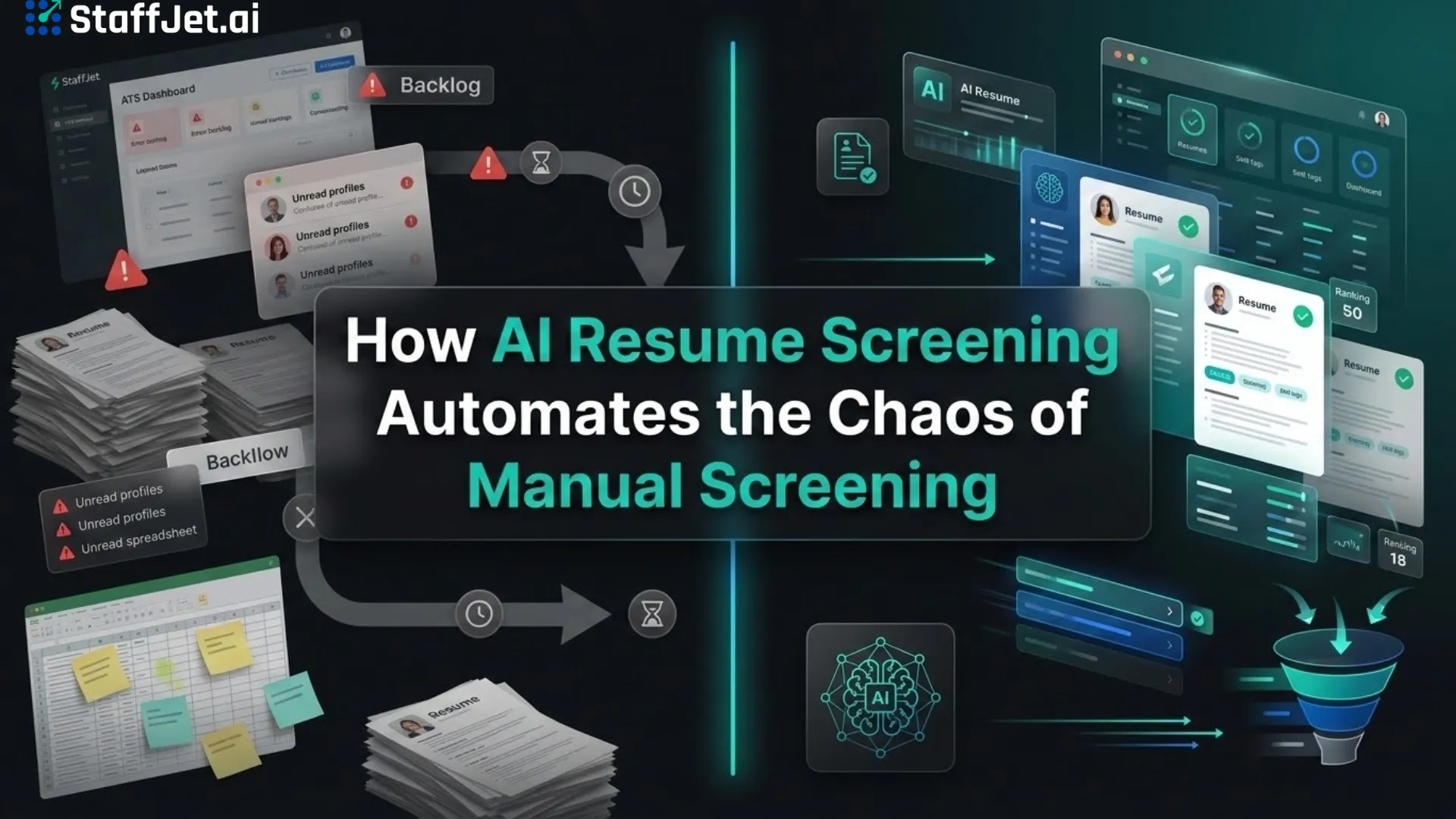
Most recruiting teams still rely on manual resume review, where a recruiter spends an average of just six seconds on each resume before making a fit-or-no-fit decision [TheLadders, 2012]. At that speed, errors are not possible. They are guaranteed. This comparison is part of ourThe Complete Guide to AI Resume Screening. It breaks down the real differences between AI-driven and manual screening so you can decide which approach fits your hiring reality.
Why Is AI Resume Screening Replacing Manual Review Globally?
AI-driven screening processes applications consistently and at scale, which is why 43% of organizations now use AI for HR tasks, up from 26% in 2024 [SHRM, 2025].
The pressure to hire faster is not new, but the tools available have changed. SHRM’s 2025 survey found that 69% of businesses still struggle to fill full-time roles, and 89% of HR professionals using AI in recruiting report measurable time savings [SHRM, 2025; LinkedIn, 2025]. For teams reviewing hundreds of resumes per role, the shift from manual to AI-driven evaluation is no longer theoretical. It is a competitive necessity.
Globally, organizations are adopting resume screening automation to handle volume without sacrificing quality. The question is no longer whether AI can help, but whether your team can afford to keep screening manually while competitors shortlist candidates in minutes.
The table below summarizes key differences across six factors.
| Factor | Manual Screening | AI Resume Screening |
| Time per 100 CVs | 12-18 hours | 10-15 minutes |
| Error rate | ~22% (fatigue-driven) | Significantly lower |
| Consistency | Variable across reviewers | Identical every time |
| Bias risk | Unconscious human bias | Algorithmic (auditable) |
| Scalability | Breaks down above 50 CVs | Scales without added headcount |
| Cost visibility | Hidden (recruiter time) | Transparent (software cost) |
How Does AI Resume Screening Compare to Manual Review on Speed?
AI screens 100 resumes in under 15 minutes versus 12 to 18 hours manually, a 90% or greater reduction in screening time [Marxel, 2026].
Speed is where the gap between AI and manual screening is widest. A recruiter conducting manual review spends 30 to 90 seconds on an initial CV scan, followed by three to five minutes on promising candidates [Marxel, 2026]. For a role with 200 applications, that adds up to 20 to 30 hours of work. AI systems process the same volume in under 20 minutes, with human review of recommendations taking roughly 30 to 60 additional minutes [Marxel, 2026].
For organizations measuring time-to-hire as a key performance indicator, this difference matters. AI-driven platforms like StaffJet deliver a 24-hour hiring timeline from application to decision, supported by 10x faster candidate shortlisting. These are achievable benchmarks for teams that automate their front-end screening.
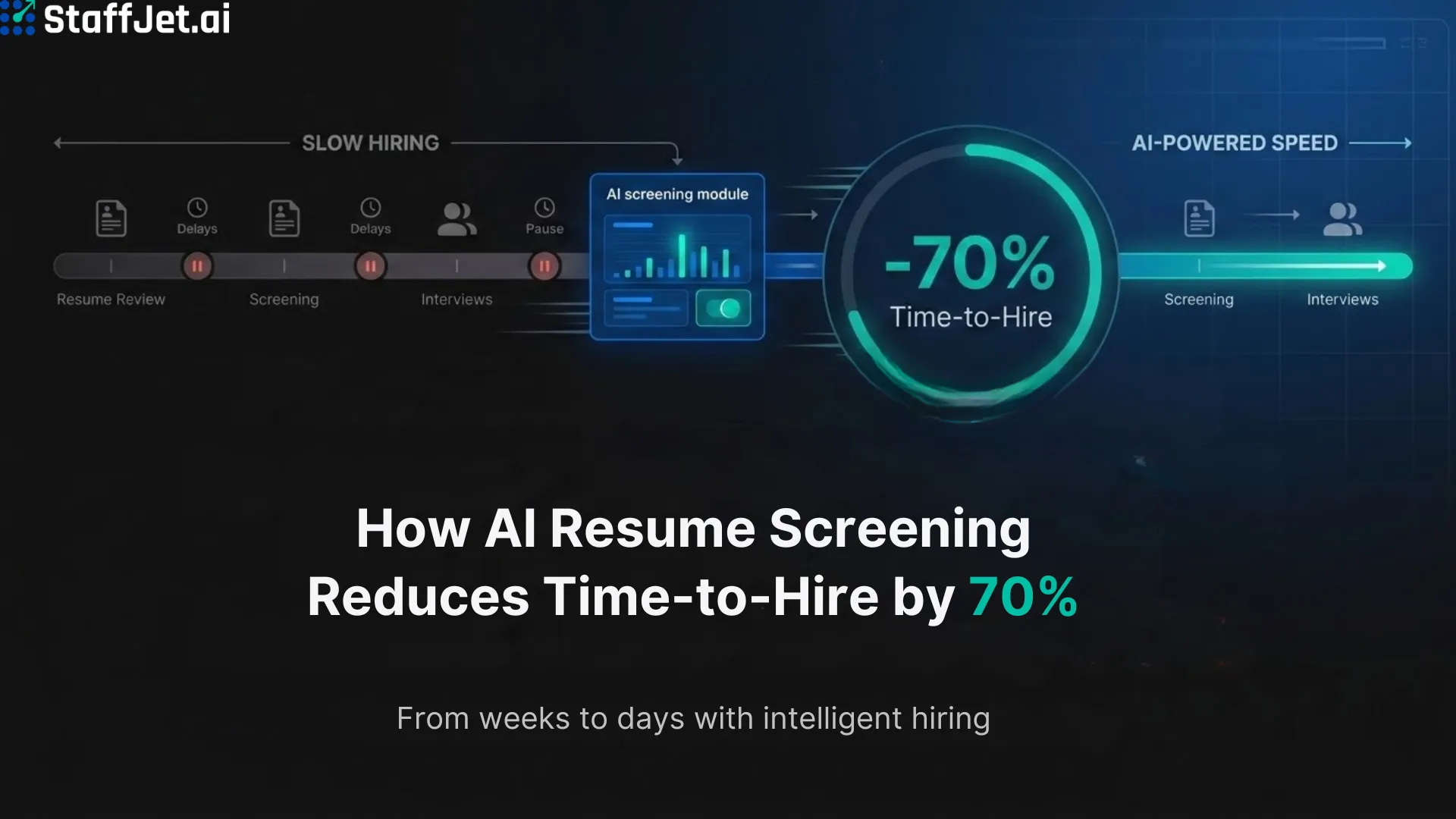
For a deeper look at the time-to-hire impact, readHow AI Resume Screening Reduces Time-to-Hire by 70%.

Does AI Resume Screening Deliver More Accurate and Consistent Results?
Manual screening carries an estimated 22% error rate due to fatigue, while AI applies identical criteria to every candidate, reducing errors significantly [Arahi, 2026].
Consistency is a hidden cost of manual hiring. Research shows that human reviewers apply different standards at different times of day. The 100th resume receives less attention than the 10th. Morning reviews tend to be more generous than afternoon ones [Marxel, 2026]. These are predictable consequences of cognitive fatigue and volume pressure.
This does not mean AI is perfect. It means AI is consistent, which is the foundation of fair and defensible hiring decisions. To understand the technical mechanics behind this, readHow Match Score Algorithms Work.
Can AI Resume Screening Help Reduce Hiring Bias?
AI can reduce certain forms of bias by focusing on job-relevant data, but it requires careful design and regular audits to avoid replicating historical biases.
Manual screening is susceptible to unconscious bias at multiple points. Name-based discrimination, affinity bias, and the halo effect all influence human decisions, often without the recruiter’s awareness [PMC, 2022]. A 2019 study by the National Bureau of Economic Research found that algorithmic recruitment tools could reduce racial bias in hiring decisions [NBER, 2019].
However, AI systems are not bias-free. If a model is trained on historical hiring data that reflects biased patterns, it will reproduce those patterns [University of Washington, 2025]. The advantage of AI is not the absence of bias. It is the ability to audit, measure, and correct bias more transparently than human decision-making allows. Teams should implement regular bias audits and ensure their criteria prioritize skills over demographic signals.
Where Does StaffJet Fit in Your AI Resume Screening Strategy?
StaffJet’s end-to-end AI hiring platform combines automated screening, AUTO ASSESSMENT, and live AI interviews into a single workflow, delivering 60% lower cost-per-hire.
StaffJet is not just an ATS. It is an end-to-end AI hiring intelligence platform that automates six stages of recruitment, from job posting through AI profile matching, AI resume screening, skills assessment, live AI interviews (AUTO INTERVIEW, conducted as a 20- to 30-minute booked session), and unified dashboard reporting.
For teams evaluating AI versus manual screening, StaffJet eliminates the need to choose between speed and quality. Its screening engine processes applications against role-specific criteria, while AUTO ASSESSMENT validates candidate skills before a human recruiter reviews a profile. The result is 70% hours saved per year on screening and assessment, freeing recruiters to focus on high-value candidate engagement.
What Should Your Team Do Before Switching to AI Resume Screening?
Map your current screening process, define measurable success criteria, and run a parallel comparison before fully committing to an AI-driven approach.
This approach gives you data, not assumptions, to guide your decision.
1. Audit your current process: Document how long your team spends on screening per role, what criteria they use, and where inconsistencies appear.
2. Define evaluation criteria: Write clear, skills-based requirements for each role type. AI is only as good as the rules it follows.
3. Run a parallel test: Process the same batch of applications through both manual and AI workflows. Compare shortlists, time spent, and candidate quality.
4. Measure the gap: Track differences in speed, consistency, and shortlist accuracy over at least two hiring cycles.
5. Scale gradually: Start with high-volume roles where manual review is the biggest bottleneck, then expand to other positions.
The comparison between AI and manual screening is not about replacing recruiters. It is about giving them better tools. Manual review still has strengths in evaluating career narratives and cultural context. But for speed, consistency, and scalability, AI delivers measurable advantages that manual processes cannot match.
As hiring volumes continue to rise globally, the teams that thrive will be those that combine human judgment with AI-powered efficiency. StaffJet’s platform is built for that future, and the data increasingly supports making the transition now rather than later.
Key Takeaways
• Manual screening takes 12 to 18 hours per 100 CVs; AI takes under 15 minutes [Marxel, 2026].
• Manual review carries an estimated 22% error rate from fatigue; AI applies consistent criteria [Arahi, 2026].
• AI can reduce certain biases but requires regular auditing to avoid replicating historical patterns.
• StaffJet’s end-to-end platform delivers 60% lower cost-per-hire through integrated screening, assessment, and interviews.
• Run parallel tests before fully transitioning to validate results for your specific hiring context.