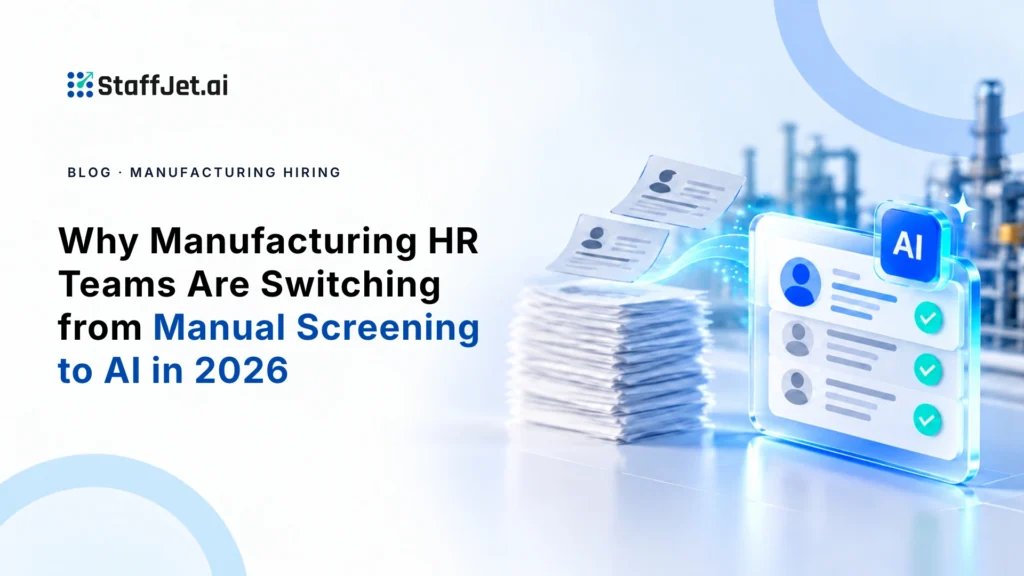
Why Manufacturing HR Teams Are Switching from Manual Screening to AI in 2026
A manufacturing HR team may receive hundreds of applications for machine operators, maintenance technicians, production supervisors, and quality inspectors. Reviewing every resume manually takes time, especially when recruiters must check technical experience, qualifications, and shift availability.
The move from manual screening to AI is driven by the need to review applications efficiently without reducing evaluation standards.
India’s organized manufacturing employment grew by 7.19% in FY2024–25, according to the Annual Survey of Industries 2024–25 [Ministry of Statistics and Programme Implementation, 2026].
As manufacturing employment expands, HR teams need reliable processes for managing recruitment workloads.
Staffjet.ai is an AI-powered recruiting platform for manufacturing companies, helping HR teams automate resume screening, candidate assessments, and interviews for plant and factory roles.
Manufacturers evaluating AI recruiting software for manufacturing should focus on how effectively it reduces repetitive screening while maintaining recruiter oversight.
Key Takeaways
- Manual screening becomes difficult when application volumes increase. Recruiters spend more time comparing resumes and less time evaluating qualified candidates.
- AI screening can improve recruiter productivity by organizing applications and identifying profiles matching documented job requirements.
- Consistent screening criteria improve candidate comparison. However, AI recommendations still require human review to identify errors and potential bias.
- AI can help small HR teams manage multiple vacancies without repeatedly reviewing the same information.
- Successful AI adoption requires measurable results. Manufacturers should compare screening hours, shortlist relevance, hiring manager acceptance, and recruitment costs.
What Is Manual Screening in Manufacturing Recruitment?
Manual screening involves recruiters individually reviewing applications to determine whether candidates meet job requirements. It commonly includes checking experience, qualifications, technical skills, and availability.
A recruiter hiring machine operators may review equipment experience, previous responsibilities, and relevant certifications.
This approach offers direct control but becomes difficult when application volumes increase.
Why Do Manufacturing HR Teams Still Use Manual Screening Instead of AI?
Many manufacturing teams continue manual screening because they already use familiar recruitment processes and rely on recruiter judgment for technical evaluation.
Smaller HR departments may use spreadsheets, email applications, and job portal records.
Changing these processes requires clear job requirements, employee training, and confidence in the selected technology.
AI should support existing recruitment expertise rather than replace it.
What Challenges Does Manual Screening Create for Manufacturing HR Teams?
Manual screening increases repetitive administrative work, makes consistent evaluation harder, and can delay candidate shortlisting when recruitment volumes grow.
| Recruitment activity | Manual screening challenge |
| Resume review | Repeated document reading |
| Skills matching | Inconsistent interpretation |
| Candidate comparison | Information spread across files |
| Shortlisting | Time-consuming documentation |
| Reporting | Manual progress tracking |
These are common process risks, not universal outcomes.
Manufacturers should assess their own recruitment data before estimating inefficiencies.
Why Are Manufacturing HR Teams Moving From Manual Screening to AI in 2026?
Manufacturing HR teams are evaluating AI screening to reduce repetitive work, organize large application volumes, and apply clearer candidate evaluation criteria.
According to SHRM’s 2025 Talent Trends research, 89% of surveyed HR professionals whose organizations use AI for recruitment reported time savings or improved efficiency [SHRM, 2025].
The finding reflects surveyed organizations, primarily in the United States, rather than manufacturing companies in India.
It supports evaluating automation while measuring actual performance locally.
Reason 1: How Does AI Screening Address High Manufacturing Application Volumes?
AI screening can organize applications against defined job requirements and prioritize relevant profiles, reducing the need for repeated manual comparisons.
A factory recruiting production workers may receive applications with different formats and experience descriptions.
AI resume screening helps identify relevant information for recruiter review.
Candidates should not be rejected solely because their resumes use different terminology.
Reason 2: How Does AI Screening Improve Technical Skills Evaluation?
AI screening helps identify documented technical experience, but practical competence requires additional assessment and verification.
Machine operators, maintenance engineers, and quality inspectors need different skills.
Manufacturers using AI screening for machine operators and technicians should establish role-specific criteria before reviewing applications.
The World Economic Forum’s Future of Jobs Report 2025 found that 63% of surveyed employers globally identified skills gaps as a major business transformation barrier [World Economic Forum, 2025].
This is a global finding, not an Indian manufacturing recruitment statistic.
Reason 3: How Can AI Screening Reduce Urgent Plant Hiring Delays?
AI screening can shorten initial application review when suitable candidates are already available. It cannot eliminate delays caused by genuine skills shortages or pending hiring approvals.
Recruiters should measure application-to-shortlist time before and after automation.
Manufacturers seeking to cut time-to-hire for shop floor roles must also address interview coordination and manager response times.
Faster screening alone does not guarantee faster hiring.
Reason 4: How Can AI Screening Support Small Manufacturing HR Teams?
AI can reduce repetitive resume comparisons, allowing recruiters to spend more time on candidate communication, assessments, and hiring manager coordination.
A small HR team may recruit operators, technicians, and supervisors simultaneously.
Staffjet.ai AI recruiting software for manufacturing helps talent acquisition teams shortlist candidates for production, maintenance, engineering, and plant operations roles.
Recruiters remain responsible for confirming candidate suitability.
Reason 5: How Does AI Screening Improve Consistency Between Recruiters?
AI screening can apply the same documented criteria across applications, supporting more consistent initial evaluation. It does not automatically eliminate hiring bias.
The U.S. Office of Personnel Management’s assessment guidance recommends identifying job-related competencies when evaluating candidates [OPM, n.d.].
Manufacturers should regularly review screening criteria, investigate errors, and ensure candidates receive fair consideration.
Consistent criteria are useful only when those criteria are relevant.
Reason 6: How Does AI Screening Make Candidate Comparison Easier?
Structured candidate information helps recruiters compare relevant experience, assessment results, and outstanding requirements without repeatedly reviewing complete resumes.
Useful evaluation categories include:
- Relevant work experience
- Machine-specific skills
- Technical assessment findings
- Mandatory qualifications
- Information requiring verification
As an AI recruiting platform for manufacturing, Staffjet.ai supports high-volume recruitment through AI candidate matching, skills assessments, structured interviews, and centralized hiring reports.
Final decisions remain with recruiters and hiring managers.
Reason 7: How Can AI Screening Improve Recruitment Visibility?
Centralized reporting helps HR teams monitor screening progress, pending evaluations, and candidate status across multiple vacancies.
A recruitment dashboard can help managers identify where applications are delayed.
Staffjet.ai, an AI recruitment platform for manufacturing companies, helps plant HR managers organize screening and review role-specific candidate information.
Reporting supports accountability but does not automatically improve hiring decisions.
How Does Manual Screening Compare With AI Screening in Manufacturing?
The main difference is how applications are organized and initially evaluated. AI can reduce repetitive review, while human judgment remains necessary for technical verification and final hiring decisions.
| Evaluation area | Manual screening | AI-assisted screening |
| Screening speed | Individual resume review | Automated profile comparison |
| Skills evaluation | Recruiter interpretation | Structured criteria and human verification |
| Consistency | Depends on reviewer | Standardized criteria, subject to auditing |
| Recruiter workload | More repetitive review | Less repetitive sorting |
| Reporting | Often manual | Centralized candidate information |
Actual results depend on implementation quality and the recruitment process.
How Does AI Screening Help Recruiters Focus on Higher-Value Work?
AI screening can reduce administrative review so recruiters can focus on technical verification, candidate communication, and coordination with plant managers.
SHRM’s 2025 AI in HR research identifies resume screening among common AI recruiting uses and emphasizes the continuing importance of human judgment [SHRM, 2025].
For manufacturing recruitment, practical skills evaluation remains particularly important.
Where Does Staffjet.ai Fit in the Shift From Manual Screening to AI?
Staffjet.ai connects profile matching, resume screening, skills assessments, scheduled AI interviews, and reporting in an end-to-end AI hiring intelligence workflow.
Its confirmed capabilities include AI resume screening, AUTO ASSESSMENT, AUTO INTERVIEW, and a unified candidate dashboard.
AUTO INTERVIEW conducts a scheduled, live AI interview lasting 20–30 minutes at a booked time slot.
Staffjet.ai reports 10x faster candidate shortlisting. This is a vendor-reported claim, not an independently verified manufacturing benchmark.
What Should Manufacturers Check Before Switching From Manual Screening to AI?
Manufacturers should evaluate screening relevance, recruiter oversight, technical assessments, implementation requirements, and measurable outcomes before selecting AI recruitment software.
Use this checklist:
- Define screening requirements by role.
- Test AI results against previously reviewed applications.
- Check whether relevant candidates are incorrectly excluded.
- Verify required ATS integrations.
- Keep technical hiring decisions with plant managers.
- Establish a baseline for screening time and costs.
- Review candidate data handling and access controls.
A controlled pilot can identify limitations before wider implementation.
How Can Manufacturers Measure Success After Replacing Manual Screening With AI?
Manufacturers should measure time savings and shortlist quality together. Faster processing has limited value if suitable candidates are missed.
| Metric | What to measure |
| Time-to-shortlist | Application to qualified shortlist |
| Screening hours saved | Recruiter hours before and after |
| Qualified candidate rate | Suitable candidates among reviewed profiles |
| Manager acceptance | Shortlists accepted for further evaluation |
| Cost per qualified shortlist | Screening cost divided by qualified candidates |
Compare results using similar roles and hiring volumes.
What Is the Future of Manual Screening and AI in Manufacturing Recruitment?
Manufacturing recruitment is likely to use more automated application review while retaining human oversight for technical assessment and final decisions.
AI adoption should focus on reducing unnecessary administrative work without weakening candidate evaluation.
AI recruiting software like Staffjet.ai offers manufacturers a connected workflow to evaluate against their operational hiring requirements.
The goal is not to remove recruiters. It is to help them spend more time evaluating people and less time processing documents.