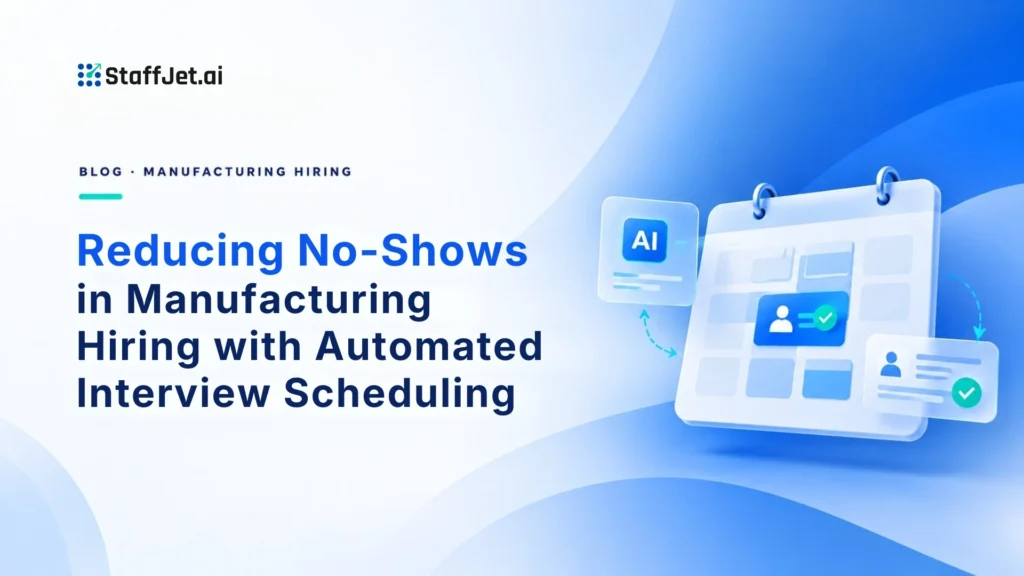
Reducing No-Shows in Manufacturing Hiring with Automated Interview Scheduling
A factory HR team schedules interviews for machine operators, production workers, and maintenance technicians. The plant manager reserves time, but several candidates never arrive.
These missed interviews waste recruiter time, create scheduling problems, and delay urgent hiring decisions.
Automated interview scheduling can address avoidable coordination problems through clear booking instructions, confirmations, reminders, and rescheduling options.
SHRM’s 2025 Talent Trends research found that 41% of surveyed U.S. organizations experienced candidates ghosting during interviews [SHRM, 2025]. This measures organizations reporting ghosting, not the percentage of interviews missed, and is not specific to Indian manufacturing.
Staffjet.ai is an AI-powered recruiting platform for manufacturing companies, supporting structured candidate screening, assessments, and scheduled interviews for plant recruitment.
Manufacturers exploring AI recruiting software for manufacturing should assess how their recruitment workflow manages candidate communication and interview attendance.
Key Takeaways
- Interview no-shows create additional recruitment work. Missed appointments require rescheduling and delay candidate evaluation.
- Clear interview booking and confirmations can reduce uncertainty. Candidates need accurate information about timing, location, interview format, and expectations.
- Reminders and rescheduling options can address avoidable attendance problems. Their effectiveness should be measured rather than assumed.
- Shift-based recruitment requires flexible interview arrangements. Factories should consider workers’ existing shift schedules and travel requirements.
- Attendance rates should be measured alongside hiring outcomes. Confirmations alone do not prove that more candidates complete interviews or accept offers.
What Are Interview No-Shows in Manufacturing Recruitment Scheduling?
An interview no-show occurs when a candidate does not attend a scheduled interview without cancelling or arranging another appointment beforehand.
Manufacturing recruitment may involve operators, technicians, production associates, and shift supervisors.
Each missed appointment affects a scheduled recruitment activity. Recruiters should distinguish genuine no-shows from cancellations communicated in advance.
Why Do Candidates Miss Manufacturing Interviews Despite Interview Scheduling?
Candidates may miss interviews because of work schedules, transport difficulties, unclear instructions, competing offers, or changes in employment plans.
Possible reasons include:
- Rotating shifts or unexpected overtime
- Long travel distances
- Salary or location concerns
- Conflicting interview appointments
- Unclear communication
The iHire State of Online Recruiting 2025 reported that 50.7% of surveyed employers were frustrated by candidate ghosting, including failure to respond or attend interviews [iHire, 2025].
The finding describes broader employer experiences, not manufacturing-specific causes.
How Do Interview No-Shows Affect Manufacturing Recruitment Scheduling?
Missed interviews increase coordination work, leave planned evaluation slots unused, and can extend recruitment timelines.
| Hiring activity | Potential effect |
| Recruiter coordination | Additional follow-up |
| Plant manager interviews | Unused interview time |
| Candidate evaluation | Delayed assessment |
| Hiring decisions | Longer vacancy periods |
The operational impact depends on staffing needs and whether suitable alternative candidates are available.
Factories should measure missed appointments before estimating their recruitment costs.
How Does Automated Interview Scheduling Help Reduce No-Shows?
Automated scheduling can organize interview bookings, communicate appointment details, and support confirmation or rescheduling workflows. These functions may reduce avoidable confusion and coordination delays.
A useful process includes candidate slot selection, invitation delivery, confirmation, reminders, and attendance tracking.
However, organizations should verify which functions are available in the selected software.
Automation improves administration; it does not guarantee attendance.
Step 1: How Can Interview Scheduling Match Candidate Availability?
Recruiters should offer interview times that candidates can realistically attend, particularly when applicants already work rotating shifts.
A worker completing a night shift may not be available for a morning interview.
HR teams should identify suitable time windows before confirming appointments.
Where flexible scheduling is possible, candidates should receive clear information about available slots.
Step 2: How Should Automated Interview Scheduling Send Invitations?
Interview invitations should clearly communicate the appointment date, time, format, location or joining instructions, and contact details.
A useful invitation contains:
- Role and interview purpose
- Confirmed appointment time
- Interview location or access instructions
- Expected duration
- Contact for scheduling problems
Recruiters should check message delivery and ensure candidates understand the instructions.
Step 3: How Can Interview Scheduling Confirm Candidate Attendance?
Candidate confirmation helps recruiters distinguish accepted interview appointments from invitations that have not received a response.
Confirmation should be simple and accessible.
HR teams can ask candidates to accept the scheduled appointment or contact the recruiter about a conflict.
Unconfirmed interviews may require follow-up, but confirmation does not guarantee attendance.
Step 4: How Can Automated Interview Reminders Reduce No-Shows?
Reminders can help candidates remember appointments and review practical interview information. Their effectiveness depends on timing, delivery, and candidate circumstances.
A randomized trial published in the British Journal of General Practice found higher appointment attendance among patients receiving mobile reminders than among those receiving no reminders [Leong et al., 2006].
This research concerns healthcare appointments, not recruitment. It supports testing reminders but cannot establish a manufacturing interview improvement rate.
Step 5: How Can Interview Scheduling Simplify Rescheduling?
A clear rescheduling process allows candidates to report conflicts before their appointment instead of simply missing the interview.
Recruiters should explain how candidates can request a different time.
Where software supports self-service rescheduling, employers should verify how changes reach the hiring team.
Track rescheduled interviews separately from missed interviews to avoid misleading attendance reports.
Step 6: How Can Interview Scheduling Keep Plant Managers Updated?
Recruiters and plant managers need accurate information about confirmed interviews, cancellations, completed evaluations, and pending decisions.
Centralized reporting can reduce repeated status requests.
Staffjet.ai AI recruiting software for manufacturing helps recruitment teams organize screening, candidate assessments, structured interviews, and hiring information.
However, dedicated automated reminder and rescheduling capabilities must be confirmed separately.
Step 7: How Can Interview Scheduling Data Reduce Future No-Shows?
Recruitment teams should review attendance patterns by role, shift, location, and scheduling interval to identify recurring problems.
Useful comparisons include:
- Confirmed versus unconfirmed interviews
- Interviews attended by shift type
- Appointments rescheduled
- Candidates who cancelled in advance
- Time between invitation and interview
These comparisons may reveal where scheduling changes deserve testing.
How Does Automated Interview Scheduling Support Shift-Based Recruitment?
Shift-based hiring requires interview arrangements that consider candidates’ existing work schedules, travel time, and availability.
A production worker may be unavailable during standard office hours.
Factories should avoid assuming that every candidate can attend a fixed daytime interview.
Flexible time slots and clear advance communication can make participation more practical.
How Do Reminders and Confirmations Support Interview Attendance?
Confirmations establish whether candidates intend to attend, while reminders reinforce appointment details before the scheduled time. Both should be evaluated through actual attendance results.
A confirmation process can identify scheduling conflicts early.
A reminder can provide directions, joining instructions, or recruiter contact details.
Neither solves salary mismatches, competing offers, or lack of candidate interest.
How Can AI Recruiting Software Manage Bulk Interview Scheduling?
AI-supported hiring workflows can organize screening results and interview information across multiple roles. Dedicated scheduling automation depends on the software’s confirmed functionality.
As an AI recruiting platform for manufacturing, Staffjet.ai supports candidate matching, skills assessments, scheduled structured interviews, and centralized reporting.
Its AUTO INTERVIEW is a live AI interview lasting 20–30 minutes at a booked time slot.
Manufacturers should verify calendar management, reminders, and rescheduling separately before selecting software.
Why Do No-Shows Continue After Interview Scheduling Is Automated?
Automation cannot eliminate attendance problems caused by unsuitable job conditions, personal constraints, competing opportunities, or changes in candidate interest.
Employers should communicate essential job information early, including:
- Plant location
- Shift arrangements
- Compensation expectations
- Interview format
- Joining requirements
Clear communication helps candidates decide whether the role remains suitable before scheduling.
Where Does Staffjet.ai Fit in Manufacturing Interview Coordination?
Staffjet.ai connects AI profile matching, resume screening, skills assessments, scheduled AUTO INTERVIEW, and unified reporting within an end-to-end hiring intelligence workflow.
Staffjet.ai, an AI recruitment platform for manufacturing companies, helps plant HR teams maintain organized candidate evaluations across recruitment stages.
Its confirmed features support structured interview delivery and reporting. They should not be confused with unverified automatic reminder, calendar-booking, or self-service rescheduling capabilities.
What Metrics Should Manufacturers Track for Interview Scheduling?
Manufacturers should measure confirmations, attendance, cancellations, rescheduling, and interview completion time to understand recruitment coordination performance.
| Metric | Calculation |
| Attendance rate | Attended ÷ scheduled interviews |
| Confirmation rate | Confirmed ÷ invitations delivered |
| No-show rate | Unannounced missed ÷ scheduled interviews |
| Rescheduling rate | Rescheduled ÷ scheduled interviews |
| Scheduling turnaround | Invitation to completed interview |
Keep cancellations and rescheduled interviews identifiable so teams can interpret rates consistently.
How Can Manufacturers Improve Interview Scheduling Without New Software?
Factories can improve interview attendance by standardizing invitations, checking candidate availability, communicating clearly, and reviewing missed appointments.
Use this checklist:
- Confirm candidate availability before booking.
- Share complete interview instructions.
- Request appointment confirmation.
- Establish a reminder process.
- Provide a clear rescheduling contact.
- Record cancellations and no-shows separately.
- Review attendance by role and shift.
These practices provide a starting point for reducing shop floor hiring time with AI, while improving the existing scheduling process.
How Will Automated Interview Scheduling Change Manufacturing Hiring?
Effective interview scheduling will depend on clear communication, flexible appointment arrangements, reliable attendance data, and coordination between candidates and recruiters.
AI can support structured recruitment, but scheduling automation must be evaluated against actual candidate needs.
Staffjet.ai provides an end-to-end hiring intelligence workflow that manufacturers can assess alongside their communication and scheduling requirements.