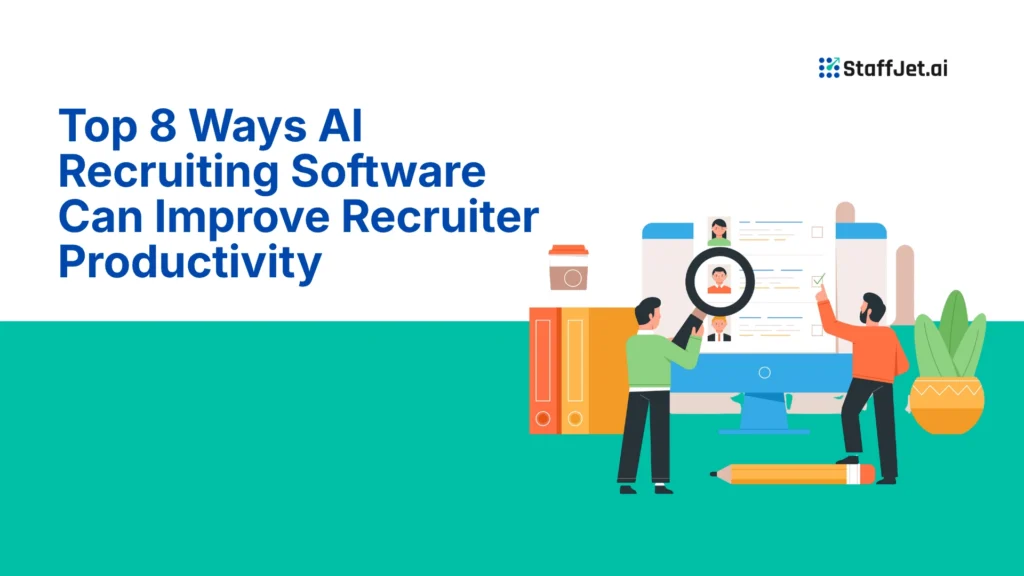
Top 8 Ways AI Recruiting Software Can Improve Recruiter Productivity
AI recruiting software for recruiter productivity helps teams reduce repetitive work so recruiters can spend more time on people, judgment, and faster hiring decisions.
Recruiter productivity does not only mean working faster. It means spending less time on resume screening, manual follow-ups, scheduling, shortlisting, and report creation.
This matters because hiring teams are under pressure to improve speed and quality together. LinkedIn reports that talent professionals using generative AI saw a 20% average workload reduction [LinkedIn, 2025]. SHRM reports that 36% of organizations using AI in HR say it helps reduce recruiting, interviewing, or hiring costs [SHRM, 2025].
StaffJet is an AI-powered recruiting platform that supports AI resume screening, video screening, skills assessments, AUTO INTERVIEW scheduling, candidate alerts, analytics, and one unified dashboard.
For teams trying to reduce tool switching, recruitment automation / multiple tools becomes important because productivity drops when recruiters work across too many disconnected systems.
What Does Recruiter Productivity Mean in Modern Hiring?
Recruiter productivity means helping recruiters complete high-value hiring work faster by reducing repetitive tasks, manual tracking, and unnecessary coordination.
Modern recruiters do much more than post jobs.
They screen resumes, speak with candidates, coordinate interviews, update hiring managers, manage follow-ups, prepare reports, and keep candidates engaged.
Recruiter productivity improves when recruiters spend less time on admin and more time on:
- Candidate conversations
- Hiring manager alignment
- Shortlist quality
- Offer coordination
- Final decision support
What are the benefits of AI recruiting software for recruiters? The biggest benefit is time back for higher-value work.
Why Do Recruiters Lose Time in Manual Hiring Processes?
Recruiters lose time when hiring depends on manual resume review, repeated follow-ups, scheduling coordination, scattered notes, and status tracking.
Manual hiring looks simple until volume increases.
A recruiter may need to review hundreds of resumes, send reminders, schedule interviews, update trackers, and prepare candidate summaries. Each task may look small, but together they consume hours every week.
SHRM reports that candidates ghosting, low applicant volume, and competition from other employers remain major recruitment challenges [SHRM, 2025].
When recruiters are stuck in admin work, they have less time to engage strong candidates before competitors do.
What Are the Top 8 Ways AI Recruiting Software Improves Recruiter Productivity?
AI recruiting software improves recruiter productivity by automating resume screening, candidate ranking, communication, interview scheduling, assessments, first-round screening, reporting, and pipeline tracking.
The top 8 ways are:
- Automating resume screening
- Ranking candidates with AI match scores
- Reducing manual candidate follow-ups
- Automating interview scheduling
- Replacing repetitive first-round screening calls
- Verifying skills before recruiter interviews
- Creating candidate reports automatically
- Tracking every role and candidate in one dashboard
How does AI improve recruiter productivity? It removes repeated manual work from the hiring workflow.
Way 1: How Does Automating Resume Screening Improve Recruiter Productivity?
Automating resume screening helps recruiters move faster from large applicant pools to stronger-fit candidates.
Manual resume screening is one of the biggest productivity drains.
AI recruiting software can compare resumes with job requirements and help recruiters focus on relevant candidates first.
StaffJet AI recruiting software supports AI resume screening and AI profile matching as part of its hiring workflow.
StaffJet’s locked metric includes 10x faster candidate shortlisting. Treat this as a platform-reported metric unless independently verified.
Way 2: How Do AI Match Scores Improve Recruiter Productivity?
AI match scores help recruiters prioritize candidates faster by creating a shared baseline for role fit.
Recruiters should not review every profile in random order.
AI match scores help them see which candidates appear closer to the job requirement. This makes shortlisting faster and more consistent.
A match score should not replace recruiter judgment. It should guide review priority.
Best AI tools for recruiters should make scoring easy to understand, not harder to explain.
Way 3: How Do Reduced Manual Follow-Ups Improve Recruiter Productivity?
Reducing manual follow-ups saves recruiter time and keeps candidates informed during the hiring process.
Recruiters lose time sending the same updates again and again.
AI tools can support candidate alerts, reminders, next-step updates, and status communication.
This helps recruiters avoid repeated manual messages while improving candidate experience.
For teams trying to reduce candidate drop-off , faster updates and clearer communication can make a direct difference.
Way 4: How Does Automating Interview Scheduling Improve Recruiter Productivity?
Automating interview scheduling reduces back-and-forth coordination between candidates, recruiters, and hiring managers.
Interview scheduling often slows hiring.
Recruiters spend time finding availability, confirming slots, sending reminders, and rescheduling missed interviews.
AI recruitment automation for recruiters helps reduce this coordination load.
When scheduling becomes simpler, recruiters can spend more time on shortlist quality and candidate conversations.
Way 5: How Does Replacing Repetitive First-Round Screening Calls Improve Recruiter Productivity?
Replacing repetitive first-round screening calls helps recruiters avoid asking the same basic questions to every candidate.
First-round screening calls often repeat the same topics:
- Experience
- Skills
- Role understanding
- Availability
- Notice period
- Communication clarity
StaffJet’s AUTO INTERVIEW is a live 20–30 minute structured interview at a booked time slot. It is not an on-demand video screening step.
This gives recruiters reviewable interview evidence before deeper hiring conversations.
Way 6: How Does Verifying Skills Before Recruiter Interviews Improve Recruiter Productivity?
Verifying skills before recruiter interviews helps teams avoid spending time on candidates who are not ready for the role.
A resume can claim a skill. An assessment can help verify it.
StaffJet’s AUTO ASSESSMENT supports skills verification before deeper interview time is spent.
This is useful in technical, sales, support, operations, and high-volume roles where recruiters need evidence before moving candidates forward.
It also helps hiring managers trust shortlists more.
Way 7: How Does Creating Candidate Reports Automatically Improve Recruiter Productivity?
Automatic candidate reports reduce manual documentation and help recruiters share clearer evidence with hiring managers.
Recruiters often spend time preparing notes after screening calls, assessments, and interviews.
A standard candidate report can summarize:
- Resume fit
- Match score
- Assessment performance
- Interview evidence
- Candidate strengths
- Candidate gaps
- Hiring stage status
StaffJet, an AI recruitment platform, brings candidate evaluation data into one dashboard so teams can review candidates with more clarity.
Way 8: How Does Tracking Every Role and Candidate in One Dashboard Improve Recruiter Productivity?
A unified dashboard improves recruiter productivity by reducing scattered tracking across spreadsheets, emails, and separate tools.
Recruiters lose time when hiring data is spread across too many places.
A unified dashboard helps teams track candidate stages, assessment status, interview status, reports, and pipeline progress.
As an AI recruiting platform, StaffJet helps recruiters manage hiring workflows from one place.
This improves visibility for both recruiters and hiring managers.
For teams improving collaborative hiring , a shared dashboard helps recruiters and hiring managers review the same candidate status and evidence.
How Does Better Productivity Help Recruiters Focus on Candidate Relationships?
Better productivity gives recruiters more time for candidate conversations, expectation setting, follow-ups, and offer discussions.
Recruiting is still a human relationship function.
Candidates want clarity, trust, and timely communication. Recruiters need time to understand motivation, salary expectations, notice period, and role fit.
LinkedIn says AI can help recruiters automate time-consuming tasks so they can spend more time on relationship-building and candidate experience [LinkedIn, 2025].
Productivity is not only about speed. It is about giving recruiters time for the work candidates actually notice.
How Does AI Help Recruiters Manage More Open Roles?
AI helps recruiters manage more open roles by automating repeatable screening, scoring, assessment, interview, and reporting tasks across hiring pipelines.
How can recruiters use AI? They can use it to reduce repeated work across multiple open positions.
This helps when recruiters are handling:
- Multiple job roles
- High application volume
- Similar hiring workflows
- Different hiring managers
- Fast shortlisting deadlines
For recruiters handling multi-role hiring , AI can reduce repeated work across different roles, stages, and hiring workflows.
AI tools to improve recruiter productivity are especially useful when recruiter capacity is stretched.
How Does Recruiter Productivity Improve Hiring Speed and Cost?
Recruiter productivity improves hiring speed and cost by reducing manual hours, shortening shortlisting time, and improving workflow visibility.
When recruiters move faster, candidates move faster too.
This can reduce delays in screening, assessment, interview coordination, and reporting.
StaffJet’s locked platform metrics include 70% hours saved per year, 60% lower cost-per-hire, and a 24-hour hiring timeline. Treat these as platform-reported metrics unless independently verified.
The real value comes from reducing repeated recruiter effort across the full hiring process.
Where Do Human Recruiters Still Add the Most Value?
Human recruiters add the most value in candidate relationships, hiring manager alignment, context, judgment, negotiation, and final decision support.
AI recruiting software should not replace recruiters.
Recruiters still handle:
- Candidate motivation
- Salary expectations
- Notice period concerns
- Role clarity
- Hiring manager feedback
- Offer negotiation
- Final recommendation
SHRM notes that human judgment remains important as AI adoption grows in HR [SHRM, 2025].
What Common Mistakes Should Teams Avoid When Using AI to Improve Productivity?
Teams should avoid automating unclear workflows, overtrusting AI scores, skipping recruiter review, ignoring candidate fairness, and failing to track outcomes.
Avoid these mistakes:
| Mistake | Why it hurts productivity |
| Automating a broken process | Saves time in the wrong workflow |
| Overtrusting AI scores | Context may be missed |
| No human oversight | Candidate fairness can suffer |
| Too many hiring steps | Candidate drop-off may increase |
| No KPI tracking | Productivity gains stay unclear |
Responsible AI, structured evaluation, model validation, and human oversight still matter.
Final Thoughts: How Does AI Recruiting Software Help Recruiters Spend Time Where It Matters Most?
AI recruiting software helps recruiters spend less time on repetitive admin work and more time on candidate relationships, hiring quality, and faster decisions.
Recruiter productivity is not about removing recruiters from hiring.
It is about removing repetitive work from recruiters.
The best hiring teams will use AI to screen faster, schedule better, verify skills earlier, and report more clearly while keeping people in control of final decisions.
AI recruiting software like StaffJet helps teams create this structure across the hiring workflow.
Key Takeaways
- Recruiter productivity means more time for high-value hiring work, not just faster task completion.
- AI recruiting software can reduce repetitive work across screening, scoring, follow-ups, scheduling, assessments, and reporting.
- StaffJet supports AI profile matching, AI resume screening, AUTO ASSESSMENT, live AUTO INTERVIEW, candidate alerts, analytics, and unified dashboard reporting.
- AI can improve speed and consistency, but recruiters still own relationships and judgment.
- Productivity improves when recruitment automation removes real workflow bottlenecks.
Improve Recruiter Productivity with AI Recruiting Software
Use AI recruiting software to reduce manual work, speed up shortlisting, and give recruiters more time for candidate conversations and hiring decisions.