How AI Recruiting Software Standardizes Candidate Evaluation Across Hiring Teams
AI recruiting software for candidate evaluation helps hiring teams judge candidates with the same role-based criteria instead of different personal opinions.
Candidate evaluation becomes inconsistent when many recruiters, hiring managers, or departments are involved. One interviewer may focus on communication, another on experience, and another on gut feeling.
LinkedIn reports 20% average workload reduction among talent professionals using generative AI [LinkedIn, 2025]. For quality, SHRM says 24% of organizations using AI in HR improved their ability to identify top candidates [SHRM, 2025].
StaffJet is an AI-powered recruiting platform that supports AI resume screening, skills assessments, structured AI interviews, and unified candidate reports.
For a deeper view of skills-based hiring , companies should connect role criteria, assessments, and interview evidence before final decisions.
What Does Standardized Candidate Evaluation Mean?
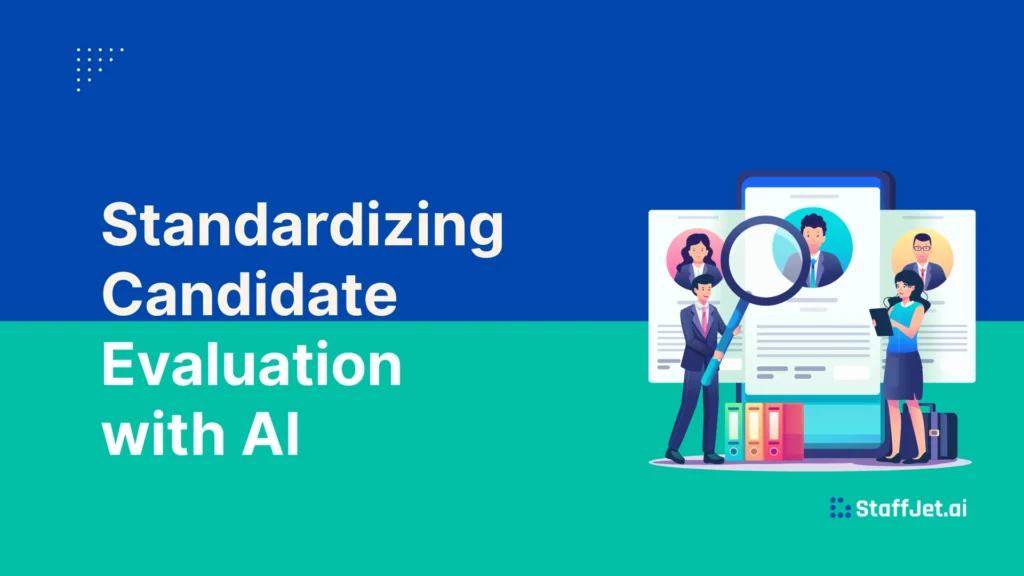
Standardized candidate evaluation means every candidate is reviewed against the same role-based criteria, screening method, assessment process, interview structure, and report format.
Standardization does not mean every role uses the same test. It means every candidate for the same role is evaluated using the same evidence.
Why Candidate Evaluation Becomes Inconsistent Across Hiring Teams
Candidate evaluation becomes inconsistent when different people use different screening habits, interview questions, scoring methods, and decision standards.
Inconsistency usually appears when hiring teams grow. Common causes include different recruiter screening styles, hiring manager expectations, no shared role criteria, unstructured interviews, no scoring baseline, scattered notes, and weak reporting.
Why Manual Evaluation Creates Different Hiring Standards
Manual evaluation creates different hiring standards because people naturally judge resumes, interviews, communication, and experience differently.
Recruiters and hiring managers need judgment. But without structure, judgment can become inconsistent. The EEOC has warned that employers using hiring technology should ensure tools do not create unlawful adverse impact [EEOC, 2023].
How AI Recruiting Software Standardizes Candidate Evaluation
AI recruiting software standardizes candidate evaluation by giving every candidate the same role-based screening criteria, structured questions, assessment methods, scoring system, and report format.
How does AI standardize candidate evaluation? It creates a repeatable hiring process through role-based screening, resume screening, match scores, structured questions, skills assessments, live interviews, reports, and dashboard comparison.
Step 1: Define Role-Based Evaluation Criteria
Role-based criteria help hiring teams agree on what matters before candidates are screened or interviewed.
Start with the work, not the resume. A developer may need coding and debugging. A sales executive may need communication. A support role may need clarity. A data analyst may need SQL.
Step 2: Screen Every Resume Against the Same Job Requirements
AI resume screening helps every resume get reviewed against the same job requirements instead of different recruiter assumptions.
Manual screening can change from person to person. AI resume screening standardizes the first filter by checking required skills, experience, fit, and gaps.
StaffJet AI recruiting software supports AI profile matching and AI resume screening as part of its hiring workflow.
Step 3: Use AI Match Scores to Create a Common Evaluation Baseline
AI match scores give recruiters and hiring managers a shared starting point for candidate comparison.
A match score should not be the final hiring decision. It should be a baseline that helps recruiters prioritize candidates, compare similar profiles, reduce guesswork, and support shortlist review.
Step 4: Ask Candidates Structured Screening Questions
Structured screening questions help hiring teams collect comparable responses from every candidate.
Unstructured screening creates uneven evidence. Structured questions help teams check role understanding, relevant experience, communication clarity, problem-solving approach, availability, and motivation.
This supports fairer candidate evaluation because each candidate gets a similar chance to show fit.
Step 5: Verify Skills With the Same Assessment Framework
Using the same assessment framework helps hiring teams verify candidate skills with consistent scoring and clearer evidence.
AI powered candidate assessment software is useful when assessments are role-relevant. Engineering roles may need coding. Sales roles may need pitching. Support roles may need response quality. Data roles may need SQL.
StaffJet’s AUTO ASSESSMENT supports skills verification before deeper interview time is spent.
Step 6: Run Structured Interviews With Consistent Criteria
Structured interviews help hiring teams compare candidates using the same evaluation areas, not interviewer preference.
Structured interviews reduce variation. They help teams evaluate technical depth, role knowledge, communication, problem-solving, decision-making, and candidate readiness.
StaffJet’s AUTO INTERVIEW is a live 20–30 minute structured interview at a booked time slot. It supports deeper evaluation while keeping final decisions with recruiters and hiring managers.
Step 7: Create Standard Candidate Reports for Team Review
Standard candidate reports help hiring teams review the same type of evidence for every candidate.
A good candidate report should include match score, resume screening summary, assessment performance, interview summary, candidate strengths, candidate gaps, hiring stage status, and overall evaluation evidence.
StaffJet, an AI recruitment platform, brings candidate evaluation data into unified reports so teams can review candidates with more clarity.
Step 8: Compare Candidates Side by Side in One Dashboard
Side-by-side dashboard comparison helps hiring teams make faster and more consistent decisions across candidates.
AI recruitment software for hiring teams is strongest when recruiters and hiring managers see the same evidence.
For better alignment across decision-makers, read collaborative hiring
How Standardized Evaluation Helps Recruiters and Hiring Managers Align
Standardized evaluation helps recruiters and hiring managers align because both teams review the same criteria, scores, assessments, interviews, and reports.
Standardization aligns role needs, shortlist reasons, assessment proof, interview findings, and candidate gaps.
For teams measuring recruiter productivity , standardized evaluation should reduce repeated review work and improve shortlist clarity.
How AI Reduces Bias in Candidate Evaluation
AI can help reduce some hiring bias by applying consistent screening criteria and structured evaluation, but it cannot automatically remove bias.
How can companies reduce hiring bias? They should standardize criteria, review outcomes, audit tools, and keep human oversight in final decisions. NIST recommends AI risk management through governance, measurement, monitoring, and continuous improvement [NIST, 2023].
Why Standardized Evaluation Matters for Multi-Role and High-Volume Hiring
Standardized evaluation matters in multi-role and high-volume hiring because teams must compare many candidates without losing quality, fairness, or visibility.
High-volume teams need structured evaluation across roles, recruiters, departments, locations, and applicant pools.
For teams managing multi-role hiring , standardized evaluation helps keep criteria, assessments, and reports consistent across different roles.
StaffJet’s locked metrics include 10x faster shortlisting, 60% lower cost-per-hire, 70% hours saved, and a 24-hour hiring timeline. Treat these as platform-reported unless independently verified.
Where Human Judgment Still Matters in Standardized Hiring
Human judgment still matters because AI can organize evidence, but recruiters and hiring managers understand context, motivation, compensation fit, and final suitability.
AI recruiting software should support decisions, not replace decision-makers. Recruiters still handle candidate conversations, salary expectations, notice period, role clarity, feedback, offers, and final recommendations. SHRM notes that human judgment remains essential as AI adoption grows in HR [SHRM, 2025].
Common Mistakes to Avoid When Standardizing Candidate Evaluation
Common mistakes include using vague criteria, overtrusting AI scores, skipping assessments, ignoring recruiter feedback, and failing to review hiring outcomes.
Avoid vague role criteria, the same process for every role, overtrusting AI scores, no assessment stage, scattered feedback, and no KPI review. These mistakes make screening inconsistent, leave skills unverified, weaken alignment, and repeat problems.
Responsible AI, model validation, and human oversight remain important.
Final Thoughts: Better Hiring Decisions Need Consistent Evidence
Better hiring decisions need consistent evidence across resumes, assessments, interviews, reports, and hiring team reviews.
Every candidate should be reviewed against the right criteria and evidence.
AI recruiting software like StaffJet helps teams create this structure while keeping final hiring decisions with people. Best AI recruiting software, StaffJet, should be evaluated on workflow coverage, recruiter control, and reporting clarity.
Key Takeaways
- Standardized candidate evaluation means candidates are compared using the same role-based evidence.
- AI recruiting software standardizes screening, scoring, assessments, interviews, and reports.
- StaffJet supports AI profile matching, AI resume screening, AUTO ASSESSMENT, live AUTO INTERVIEW, and unified dashboard reporting.
- AI can improve consistency, but it does not automatically remove bias.
- Recruiters and hiring managers still control final judgment.
- Consistent evidence helps teams make faster and clearer hiring decisions.