AI Recruiting Software for Multi-Role Hiring: How to Manage Different Hiring Workflows at Scale
AI recruiting software for multi role hiring helps companies manage different roles without forcing every candidate through the same process.
Hiring for one role is difficult. Hiring for five roles at the same time creates a bigger problem.
A developer, sales executive, support agent, data analyst, and plant supervisor cannot be evaluated in the exact same way. Each role needs different screening criteria, assessments, interview questions, and decision signals.
This matters as hiring becomes more complex. LinkedIn says AI helps recruiters streamline repetitive tasks and focus on strategic hiring work [LinkedIn, 2025]. SHRM reports that 36% of organizations using AI in HR say it helps reduce recruiting, interviewing, or hiring costs [SHRM, 2025].
StaffJet is an AI-powered recruiting platform built for this flexible hiring flow. Teams can choose which hiring stages to enable or skip based on the role, applicant volume, and urgency.
For better team coordination, read [Link: collaborative hiring → /ai-recruiting-software-collaborative-hiring/].
What Is Multi-Role Hiring?
Multi-role hiring means recruiting for different job types at the same time, with different skills, screening needs, assessments, interviews, and decision criteria.
Multi-role hiring is common in IT services, GCCs, BPOs, manufacturing, staffing firms, and enterprises.
Each team may hire for developers, QA engineers, cloud engineers, support agents, trainers, plant supervisors, finance roles, HR roles, or sales roles together.
The problem starts when every role is pushed through one generic workflow.
Why Does Multi-Role Hiring Become Difficult at Scale?
Multi-role hiring becomes difficult at scale because recruiters must manage different roles, large applicant volumes, hiring managers, and evaluation methods together.
At scale, hiring becomes messy.
Recruiters need to manage different job descriptions, skill requirements, hiring managers, assessments, interview stages, candidate communication, shortlist reporting, and hiring deadlines.
When this happens manually, teams often depend on spreadsheets, emails, and disconnected tools.
The StaffJet research brief notes that many hiring teams struggle with fragmented hiring tools and manual coordination across systems [StaffJet Research Brief, 2026].
Why Can’t One Hiring Workflow Fit Every Role?
One hiring workflow cannot fit every role because different jobs need different proof of fit.
A single process creates weak evaluation.
Developers need coding ability, debugging, and technical depth. Sales executives need communication, persuasion, and follow-up discipline. Support agents need clarity, patience, and problem-solving. Data analysts need SQL, reporting logic, and business understanding. Plant supervisors need process discipline and team coordination.
The same test, questions, and scoring method cannot work for every role.
This is why hiring software must support flexible workflows, not one fixed process.
How Does AI Recruiting Software Help Manage Different Hiring Workflows?
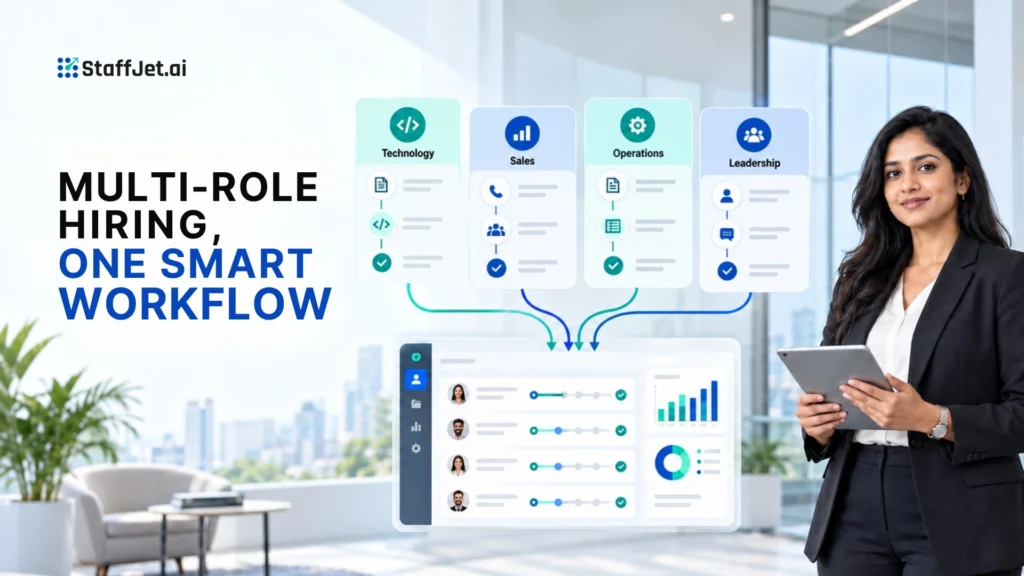
AI recruiting software helps hiring teams create different evaluation paths for different roles while keeping screening, assessments, interviews, reports, and candidate tracking connected.
AI recruiting software helps by making the workflow role-specific.
It can support AI profile matching, AI resume screening, role-specific assessments, video screening, live AUTO INTERVIEW, candidate ranking, and unified dashboard reporting.
As an AI recruiting platform, StaffJet helps teams manage different workflows without losing visibility across roles.
Step 1: How Do You Group Roles by Hiring Need and Evaluation Type?
The first step in multi-role hiring is grouping roles based on how they should be evaluated.
Do not create a separate hiring process from scratch for every job.
Group roles by evaluation type:
- Technical roles: resume screening, skills assessment, structured interview
- Communication roles: resume screening, video screening, interview
- Operations roles: resume screening, scenario assessment, interview
- Leadership roles: profile matching, structured interview, deeper human review
- High-volume roles: bulk screening, automated assessment, dashboard tracking
This keeps the process organized without becoming generic.
Step 2: How Do You Define Different Criteria for Each Role?
Each role should have its own evaluation criteria based on job requirements, not one shared checklist.
Different roles need different signals.
Developers need technical depth. Sales teams need communication and follow-up ability. Support teams need patience and clarity. Data teams need analytical thinking. Plant supervisors need process discipline.
AI hiring software for multiple job roles works best when each role has clear criteria before screening starts.
Step 3: How Does AI Resume Screening Work Based on Role Requirements?
AI resume screening helps recruiters compare candidates against the correct role requirements instead of reviewing every resume manually.
Manual resume screening becomes difficult when roles increase.
AI resume screening can help recruiters match resumes to job descriptions, filter weak-fit profiles, rank candidates by role relevance, prioritize stronger applicants, and reduce manual shortlisting.
StaffJet AI recruiting software supports AI profile matching and AI resume screening as part of its hiring workflow.
Step 4: How Do You Add Role-Specific Assessments Where Needed?
Role-specific assessments help verify whether candidates can perform the actual work required for the job.
Not every role needs the same assessment.
A developer may need a coding or debugging test. A data analyst may need an SQL task. A sales role may need an objection-handling scenario. A support role may need a customer response simulation. An operations role may need a process task.
StaffJet’s AUTO ASSESSMENT helps teams verify skills before deeper interview time is spent.
Step 5: How Can Video Screening Support Communication-Based Roles?
Video screening helps evaluate communication, clarity, confidence, and role understanding for roles where speaking quality matters.
Video screening is useful for sales roles, customer support roles, client-facing roles, recruitment agency roles, and team lead roles.
It helps recruiters review how candidates explain their experience and respond to role-related questions.
Video screening should support evaluation. It should not replace recruiter judgment.
Step 6: How Do Structured AI Interviews Support Deeper Evaluation?
Structured AI interviews help teams compare candidates using consistent, role-relevant questions and reviewable interview evidence.
Unstructured interviews create variation.
One interviewer may focus on confidence. Another may focus on experience. Another may rely on instinct.
StaffJet’s AUTO INTERVIEW is a live 20–30 minute structured interview at a booked time slot. It supports deeper evaluation while keeping final hiring decisions with the human team.
Structured evaluation helps reduce inconsistency across departments.
Step 7: How Can Teams Track Every Role and Candidate in One Dashboard?
A unified dashboard helps recruiters track every role, candidate, stage, score, assessment, interview, and report in one place.
Multi-role hiring becomes difficult when data is scattered.
A dashboard helps teams see open roles, candidate stages, assessment status, interview status, reports, and where each candidate is stuck.
StaffJet, an AI recruitment platform, brings candidate evaluation data into one unified dashboard.
For teams trying to manage [Link: recruitment workflows in one platform → /ai-recruiting-software-replace-multiple-recruitment-tools/], dashboard visibility becomes critical.
Step 8: How Do You Compare Workflow Performance Across Roles?
Teams should compare workflow performance across roles to see which hiring paths are fast, slow, or creating candidate drop-off.
Multi-role hiring needs measurement.
Track time-to-shortlist by role, time-to-hire by role, assessment completion rate, interview completion rate, hiring manager shortlist approval, candidate drop-off, and quality of hire.
StaffJet’s locked platform metrics include 10x faster candidate shortlisting, 60% lower cost-per-hire, 70% hours saved per year, and a 24-hour hiring timeline. Treat these as platform-reported metrics unless independently verified.
What Hiring Workflows Can Be Customized by Role?
Hiring workflows can be customized by role through screening rules, assessments, video screening, interview stages, reports, and dashboard views.
A software developer may need resume screening, assessment, AUTO INTERVIEW, and dashboard report.
A sales executive may need resume screening, video screening, AUTO INTERVIEW, and dashboard report.
A support agent may need resume screening, video screening, assessment, and dashboard report.
A data analyst may need resume screening, data task, AUTO INTERVIEW, and dashboard report.
A senior manager may need profile matching, structured interview, and deeper human review.
This keeps hiring structured without making every role identical.
How Does Multi-Role Hiring Improve Recruiter Productivity?
Multi-role hiring improves recruiter productivity when repeated screening, assessment coordination, interview scheduling, and reporting are automated.
Recruiters lose time when every role needs manual setup.
Recruitment automation helps reduce repeated work across resume review, candidate ranking, assessment assignment, interview scheduling, status tracking, and hiring manager reporting.
For teams measuring [Link: recruiter productivity → /ai-recruiting-software-improve-recruiter-productivity/], multi-role workflows should reduce repeated setup and manual tracking across roles.
LinkedIn reports that talent professionals using generative AI saw a 20% average workload reduction [LinkedIn, 2025].
How Does AI Standardize Evaluation Without Making It Generic?
AI can standardize the hiring structure while still allowing each role to have different criteria, assessments, and interview questions.
Standardized does not mean identical.
It means every candidate is evaluated fairly against the right criteria for that role.
AI recruitment workflows for multiple roles can use common stages, role-specific criteria, different assessments, structured scoring, human review, and comparable reports.
For deeper context on [Link: standardized candidate evaluation → /ai-recruiting-software-standardizes-candidate-evaluation/], teams should separate shared hiring standards from role-specific evaluation criteria.
This helps support candidate fairness while avoiding one-size-fits-all hiring.
Why Does Multi-Role Hiring Matter for High-Volume Teams?
Multi-role hiring matters for high volume hiring because teams must manage many candidates, roles, departments, and workflows without losing speed or quality.
High volume hiring often happens in IT services, BPOs, GCCs, staffing firms, and enterprises.
The World Economic Forum says the skills gap is the biggest barrier to business transformation, with nearly 40% of job skills expected to change by 2030 [World Economic Forum, 2025].
When skill needs change fast, companies need recruitment software for high volume hiring that can adapt role by role.
Where Do Recruiters Still Matter in Multi-Role Hiring?
Recruiters still matter because they understand role context, candidate motivation, compensation fit, hiring manager expectations, and final judgment.
AI can help with screening, matching, assessments, interviews, and reporting.
Recruiters still handle candidate conversations, salary expectations, notice periods, role clarity, hiring manager alignment, offer discussions, and final decision support.
AI recruiting software like StaffJet works best when it supports recruiters instead of replacing them.
What Common Mistakes Should Teams Avoid When Managing Multiple Hiring Workflows?
Common mistakes include using one workflow for every role, skipping criteria definition, overusing assessments, ignoring recruiter feedback, and not tracking performance.
Avoid one workflow for every role, vague role criteria, too many assessment steps, no dashboard tracking, ignoring recruiters, and no KPI review.
These mistakes make evaluation generic, increase candidate drop-off, reduce visibility, weaken adoption, and repeat hiring problems across roles.
Human oversight, responsible AI, and structured evaluation still matter.
Final Thoughts: Why Does Multi-Role Hiring Need Flexible Automation, Not One Fixed Process?
Multi-role hiring needs flexible automation because different roles require different evidence, but teams still need one connected system to manage hiring at scale.
Modern hiring is no longer one pipeline.
A growing company may hire engineers, salespeople, support agents, finance teams, and managers together. Each role needs its own evaluation path.
AI recruiting software can help teams manage this complexity without creating fragmented processes.
Best AI recruiting software, StaffJet, should be evaluated on workflow flexibility, recruiter control, dashboard visibility, and measurable hiring outcomes.
Key Takeaways
- Multi-role hiring means managing different roles with different evaluation needs.
- AI recruiting software for multi role hiring helps teams create role-specific workflows while keeping hiring connected.
- StaffJet supports AI profile matching, AI resume screening, AUTO ASSESSMENT, live AUTO INTERVIEW, and unified dashboard reporting.
- Recruitment automation improves recruiter productivity by reducing repeated manual work.
- Flexible workflows help standardize evaluation without making every role generic.
- Recruiters still control context, candidate relationships, and final hiring decisions.