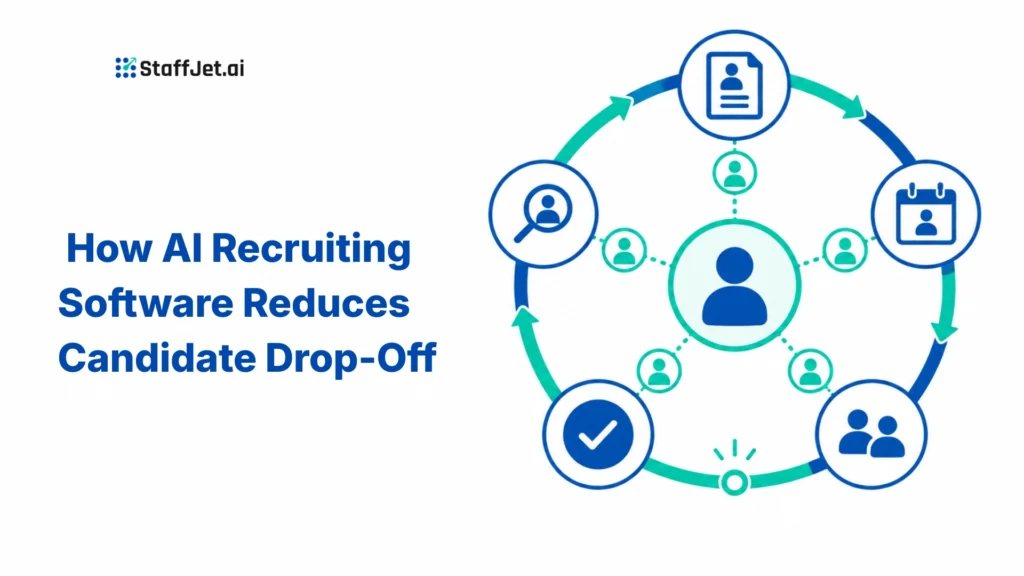
How AI Recruiting Software Helps Reduce Candidate Drop-Off During Recruitment
AI recruiting software to reduce candidate drop off matters because good candidates do not wait forever.
They apply, wait, follow up, and move on. Sometimes they accept another offer before the company finishes screening. Sometimes they stop responding because the process feels slow, unclear, or repetitive.
This is now a serious hiring problem. CareerPlug’s 2025 Candidate Experience Report found that 26% of job seekers declined an offer because of a poor candidate experience in 2024 [CareerPlug, 2025]. Bullhorn’s 2025 Talent Trends report found that three-quarters of candidates stopped working with a recruiter because the process was too long or communication was not enough [Bullhorn, 2025].
Candidate drop off is not only a candidate problem. It is a business leakage problem.
For a deeper view of [Link: candidate experience → /ai-recruiting-software-candidate-experience/], hiring teams need to look at speed, updates, interview friction, and recruiter capacity together.
StaffJet is an AI-powered recruiting platform that supports automated resume screening, video screening, skills assessments, interview scheduling, candidate alerts, and dashboard tracking in one flow.
What Is Candidate Drop-Off in Recruitment?
Candidate drop off means candidates leave or stop responding during the hiring process before a final decision is made.
Candidate drop off can happen at any stage:
| Stage | What drop-off looks like |
| After applying | Candidate never replies to recruiter outreach |
| Before screening | Candidate loses interest during long waiting time |
| Before assessment | Candidate skips the test |
| Before interview | Candidate does not book or attend the slot |
| After offer | Candidate declines or accepts another company |
The main reason is simple: candidates judge the company by the hiring process.The main reason is simple: candidates judge the company by the hiring process.
Why Do Candidates Drop Off During the Hiring Process?
Candidates drop off when the hiring process is slow, unclear, repetitive, difficult to complete, or poorly communicated.
Most candidate drop off happens because of friction.
Common reasons include:
- No update after applying
- Long gap before screening
- Too many manual steps
- Repeated questions across rounds
- Confusing assessment instructions
- Interview scheduling delays
- No clear timeline
- Better offer from another company
Greenhouse reported that 61% of job seekers had been ghosted after a job interview in its 2024 State of Job Hunting research [Greenhouse, 2024].
If candidates feel ignored, they disengage.
Why Slow Hiring Increases Candidate Drop-Off
Slow hiring increases candidate drop off because strong candidates usually have more options and may accept another offer before your team reaches them.
Slow hiring hurts three things at once:
| Hiring delay | Business impact |
| Late screening | Strong candidates move elsewhere |
| Slow interviews | Candidates lose interest |
| Poor updates | Employer trust drops |
| Long decision cycles | Offer acceptance becomes harder |
Omni’s 2026 Candidate Experience Report found that 49% of respondents would withdraw from a hiring process that takes too long [Omni RMS, 2026].
This is why reducing time-to-hire is not only about internal efficiency. It directly affects candidate engagement.
How AI Recruiting Software Helps Reduce Candidate Drop-Off
AI recruiting software reduces candidate drop off by shortening response time, removing scheduling delays, sending timely updates, making screening easier, and helping recruiters act faster on qualified candidates.
AI recruiting software helps by improving the flow.
It supports:
- Faster resume screening
- Candidate ranking
- Automated candidate communication
- Structured assessments
- Interview scheduling support
- Candidate alerts
- Dashboard tracking
- Recruiter prioritization
LinkedIn reports that AI helps recruiters automate time-consuming tasks so they can spend more time building relationships and improving candidate experience [LinkedIn, 2025].
Reason 1: AI Screens Candidates Faster
AI recruiting software reduces waiting time by screening applications faster and helping recruiters identify stronger-fit candidates earlier.
Manual screening creates delay.
AI recruiting software can help recruiters move from hundreds of resumes to a smaller shortlist faster.
StaffJet AI recruiting software supports AI resume screening and AI profile matching. StaffJet’s platform materials state that it can screen 500 resumes in under 2 minutes. Treat this as a platform-reported metric unless independently verified [StaffJet, 2026].
Faster screening means candidates do not stay stuck at the first stage.
Reason 2: Automated Communication Keeps Candidates Updated
Automated communication reduces candidate drop off by keeping candidates informed about their next step, status, and interview progress.
Silence creates doubt.
Candidates are more likely to disengage when they do not know what is happening.
AI tools for candidate engagement can support:
- Application confirmation
- Screening updates
- Assessment instructions
- Interview reminders
- Status notifications
- Next-step alerts
Bullhorn’s 2025 report found that long processes and poor communication were major reasons candidates stopped working with recruiters [Bullhorn, 2025].
Reason 3: Video Screening Reduces Scheduling Friction
Video screening reduces scheduling friction by allowing earlier candidate evaluation without long back-and-forth coordination.
First-round calls often slow hiring.
Recruiters need time. Candidates need time. Calendars do not match. By the time a call is booked, the candidate may already be in another process.
AI powered candidate engagement works better when candidates move quickly from application to screening.
Video screening helps recruiters review communication, confidence, and role understanding earlier. It should support evaluation, not replace final human judgment.
Reason 4: Skills Assessments Make the Process More Structured
Skills assessments reduce candidate drop off by making expectations clearer and helping candidates understand what they are being evaluated on.
A confusing hiring process makes candidates leave.
Structured assessments improve clarity because candidates know what skill is being tested.
| Without structure | With structured assessment |
| Unclear evaluation | Clear skill requirement |
| Repeated questions | Defined test stage |
| Subjective screening | Comparable performance |
| Slow feedback | Faster review |
StaffJet’s AUTO ASSESSMENT supports skills verification before deeper interview time is spent.
Reason 5: Interview Scheduling Becomes Faster and Easier
AI recruiting software reduces interview delays by helping candidates move to booked interview slots faster.
Interview scheduling is one of the biggest hidden delays in hiring.
Recruiters often lose time on:
- Finding availability
- Sending reminders
- Rescheduling missed calls
- Updating hiring managers
- Tracking who has confirmed
StaffJet’s AUTO INTERVIEW is a live 20–30 minute structured interview at a booked time slot. It is not an on-demand video screening step.
Clear scheduling reduces confusion and helps prevent delayed responses.
Reason 6: Recruiters Can Prioritize High-Fit Candidates Quickly
AI recruiting software helps recruiters prioritize high-fit candidates quickly so strong applicants do not wait too long for action.
Candidate engagement improves when recruiters act faster on the right people.
AI profile matching can help identify candidates whose skills and experience align closely with the role.
As an AI recruiting platform, StaffJet helps recruiters focus attention on stronger-fit candidates earlier in the workflow.
This improves recruiter productivity because recruiters spend less time sorting low-fit applications and more time engaging serious candidates.
For more context on [Link: recruiter productivity → /ai-recruiting-software-improve-recruiter-productivity/], teams should measure how much time is spent on screening, follow-ups, and scheduling.
Reason 7: Dashboards Help Teams Spot Where Candidates Are Dropping Off
Dashboards help hiring teams see where candidates are stuck, delayed, or leaving the process.
Candidate drop off is hard to fix if teams cannot see where it happens.
A unified dashboard can show:
| Drop-off signal | What the team should check |
| Candidates not completing assessments | Are tests too long or unclear? |
| Candidates not booking interviews | Are slots limited or delayed? |
| Candidates not responding | Are updates too slow? |
| Candidates rejected late | Are screening criteria unclear? |
StaffJet, an AI recruitment platform, brings candidate stage data into one dashboard so teams can track movement and take action earlier.
How Faster Shortlisting Improves Candidate Experience
Faster shortlisting improves candidate experience because candidates receive movement, clarity, and feedback sooner.
Candidates want a process that respects their time.
When shortlisting is slow, they may assume the company is not interested.
When shortlisting is faster, recruiters can:
- Contact strong candidates earlier
- Share next steps faster
- Reduce unnecessary waiting
- Keep candidates warm
- Improve trust in the hiring process
StaffJet’s locked platform metrics include 10x faster candidate shortlisting and a 24-hour hiring timeline. Treat these as platform-reported metrics unless independently verified [StaffJet, 2026].
How AI Helps Reduce No-Shows and Delayed Responses
AI helps reduce no-shows and delayed responses by improving reminders, status updates, scheduling clarity, and recruiter follow-up discipline.
No-shows are often a symptom of weak engagement.
Candidates may skip interviews when:
- They forgot the slot
- They accepted another offer
- They were not reminded
- They lost interest
- They did not understand the process
Recruitment automation can reduce these issues by keeping reminders, alerts, and next steps consistent.
Can AI reduce recruitment drop off? Yes, when it improves speed, clarity, and communication. But it should still be supported by recruiter follow-up.
Where Recruiters Still Matter in Candidate Engagement
Recruiters still matter because candidates want human context, trust, answers, and personal communication during important hiring decisions.
AI can automate repetitive steps.
Recruiters still need to handle:
- Candidate motivation
- Salary expectations
- Notice period concerns
- Offer conversations
- Role clarity
- Employer brand
- Relationship building
SHRM notes that human judgment remains critical as AI becomes more common in HR [SHRM, 2025].
AI recruitment software for candidate retention works best when automation supports human engagement.
Common Mistakes That Still Cause Candidate Drop-Off
Candidate drop off continues when companies automate steps without fixing process delays, unclear communication, or poor candidate experience.
Avoid these mistakes:
| Mistake | Why it causes drop-off |
| Too many hiring rounds | Candidates lose patience |
| No clear timeline | Candidates feel ignored |
| Long assessments | Candidates abandon the process |
| Late recruiter response | Strong candidates move on |
| Poor interview coordination | No-shows increase |
| No human touch | Trust drops |
How does AI improve candidate engagement? It helps when automation removes friction. It does not help when companies simply add more steps.
Final Thoughts: Faster Hiring Keeps Better Candidates Engaged
The future of recruitment belongs to companies that move quickly, communicate clearly, and respect candidate time.
Candidate drop off is not random.
It usually happens when the hiring process is too slow, unclear, or hard to complete.
AI recruiting software can help by speeding up screening, improving communication, simplifying scheduling, and giving recruiters better visibility.
Best AI recruiting software, StaffJet, should be evaluated on whether it helps teams move qualified candidates forward without losing human judgment.
Key Takeaways
- Candidate drop off happens when hiring is slow, unclear, repetitive, or poorly communicated.
- AI recruiting software can reduce candidate drop off by speeding up screening, updates, assessments, interviews, and dashboard tracking.
- StaffJet supports AI profile matching, AI resume screening, AUTO ASSESSMENT, live AUTO INTERVIEW, candidate alerts, and unified dashboard reporting.
- Faster shortlisting improves candidate engagement because strong candidates do not wait as long.
- Recruiters still matter for relationship building, offer conversations, and final hiring judgment.