AI Recruiting Software for Candidate Sourcing: How AI Finds Better-Fit Talent Faster
Finding candidates is not the same as finding the right candidates.
Indian employers continue to face strong hiring demand while struggling to find skilled talent. ManpowerGroup’s Q2 2026 survey reported a 68% Net Employment Outlook for India. Its 2025 talent shortage research also found that 80% of Indian employers had difficulty finding skilled talent. [ManpowerGroup, 2026; ManpowerGroup, 2025] (ManpowerGroup)
This makes candidate sourcing a key part of hiring speed and quality. Recruiters need to find relevant people faster and spend less time reviewing profiles that do not match the role.
This is where skills-based hiring can help. It focuses the search on the skills needed for the job instead of relying only on job titles or broad profile matches.
What is AI recruiting software for candidate sourcing?
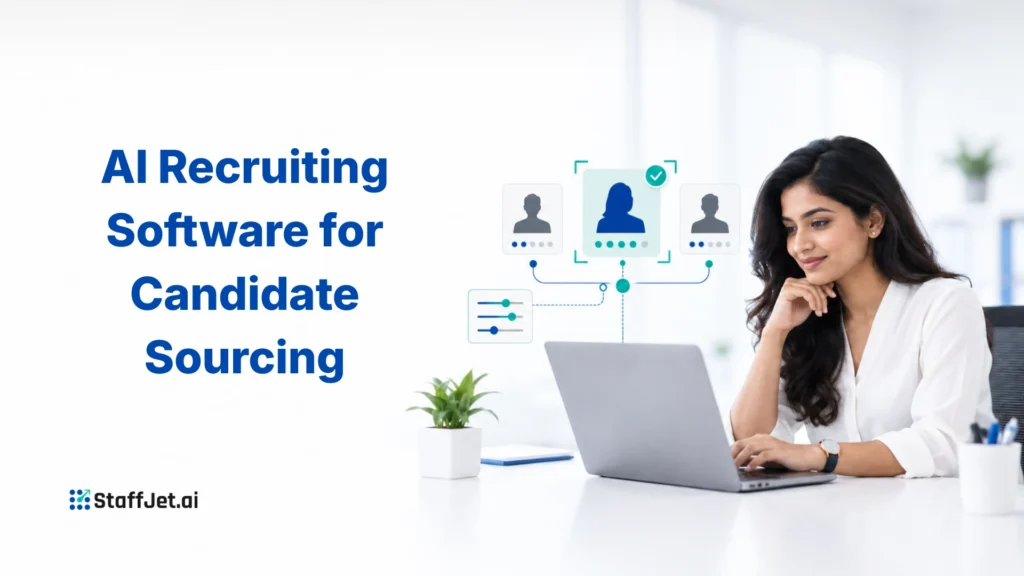
AI recruiting software for candidate sourcing helps recruiters find and prioritize candidates by comparing job requirements with candidate skills, experience, profiles, and resumes.
Traditional sourcing often requires recruiters to search profiles, review resumes, compare skills, and decide which candidates deserve further review.
AI recruitment software can automate parts of this process.
The recruiter first defines the job requirements. The software can then compare candidate information with those requirements and help identify relevant profiles.
LinkedIn’s 2025 Future of Recruiting report found that 70% of recruiting professionals using or testing generative AI expected better hiring efficiency. [LinkedIn, 2025] (LinkedIn)
Why is traditional candidate sourcing becoming difficult with AI recruiting software?
Recruiters can spend too much time searching, sorting, and reviewing candidates before they reach the people most relevant to the role.
The problem becomes harder for roles that require specific skills.
Recruiters may need to review:
- Many candidate profiles
- Large numbers of resumes
- Different skill combinations
- Similar job titles with different experience
- Candidates who meet some but not all requirements
LinkedIn reports that recruiters are using AI to reduce routine work and spend more time on higher-value activities. [LinkedIn, 2025] (LinkedIn)
AI tools for candidate sourcing can help with the first stage of this work by finding and prioritizing candidates against the job requirements.
How does AI recruiting software find potential candidates?
AI recruiting software can review candidate information and compare it with the skills and experience required for a job.
The process can be simple:
- The recruiter defines the job requirements.
- Candidate profiles and resumes are reviewed.
- Relevant skills and experience are identified.
- Candidates are compared with the role.
- More relevant candidates are prioritized for review.
This reduces the amount of manual work needed at the start of hiring.
LinkedIn’s research shows that AI is being used to automate routine recruiting tasks and help recruiters focus on more strategic work. [LinkedIn, 2025] (LinkedIn)
How does AI recruiting software improve candidate-job matching?
AI can help recruiters compare candidates against the actual requirements of a job instead of relying only on job titles or individual keywords.
For example, a software role may require:
| Job requirement | What recruiters can check |
| Required skill | Does the candidate have the skill? |
| Relevant experience | Has the candidate used it in a suitable role? |
| Role experience | Does past work match the position? |
| Overall requirements | Does the profile meet the main job needs? |
This approach supports standardized candidate evaluation
LinkedIn also identifies skills-based hiring as an important part of how AI is changing recruitment. [LinkedIn, 2025] (LinkedIn)
The goal is not to let software make the final hiring decision. The goal is to help recruiters review the most relevant candidates first.
How does AI recruiting software help recruiters discover better-fit talent faster?
AI can reduce repetitive candidate review and help recruiters focus their time on candidates who appear more relevant to the role.
This can improve recruiter productivity in three ways:
- Less manual profile review
- Faster candidate prioritization
- More time for candidate conversations and hiring decisions
LinkedIn reported that recruiters using or testing generative AI saved an average of 20% of their workweek. This is an industry research finding, not a StaffJet metric. [LinkedIn, 2025] (LinkedIn)
For businesses hiring at scale, reducing repetitive work can help recruiters manage more hiring activity without spending the same amount of time on every profile.
How does AI recruiting software improve sourcing for hard-to-fill roles?
AI can help recruiters focus on specific skills when a role has a smaller or more difficult talent pool.
This is especially useful for technical and specialist roles.
ManpowerGroup reported that 80% of employers in India struggled to find the talent they needed in 2025. [ManpowerGroup, 2025] (ManpowerGroup)
For these roles, recruiters can focus on:
- Specific technical skills
- Relevant work experience
- Role requirements
- Related candidate experience
- Skills that may be missed during a quick manual review
AI powered candidate sourcing software can support this process by helping recruiters identify relevant candidates before moving to deeper evaluation.
The final decision should still remain with the hiring team.
How does AI recruiting software help recruiters combine AI sourcing with human judgment?
AI should support recruiter decisions, not replace them. Recruiters still need to review experience, role fit, and candidate context.
AI can help with:
- Initial candidate matching
- Profile prioritization
- Resume review
- Repetitive screening work
Recruiters should handle:
- Candidate discussions
- Final fit checks
- Hiring decisions
- Context that may not appear in a resume
SHRM reported in 2026 that over-reliance on automated hiring decisions can reduce human judgment in recruitment. [SHRM, 2026] (SHRM)
A strong process therefore uses AI for repetitive work and people for decisions that require context.
What should businesses look for in AI recruiting software for candidate sourcing?
Businesses should assess whether the recruitment software improves sourcing, matching, screening, and hiring decisions instead of choosing a product only because it uses AI.
A practical checklist is:
| What to check | Why it matters |
| AI profile matching | Helps compare candidates with job needs |
| Resume screening | Reduces manual first-stage review |
| Candidate prioritization | Helps recruiters focus on relevant profiles |
| Skills assessment | Adds another stage of candidate review |
| Interview process | Helps continue evaluation after sourcing |
| Dashboard reporting | Gives the team one place to review hiring activity |
| Human review | Keeps recruiters involved in decisions |
Businesses asking, “What is the best AI recruiting software for sourcing?” should compare the complete hiring process, not only the sourcing feature.
A tool that finds candidates but does not support the next stages may still leave recruiters with significant manual work.
What results can businesses expect from AI recruiting software?
Businesses can expect AI to reduce repetitive work and speed up candidate prioritization, but hiring quality should be measured using their own recruitment results.
StaffJet’s approved platform metrics are:
| StaffJet metric | Stated result |
| Candidate shortlisting | 10x faster |
| Cost-per-hire | 60% lower |
| Hours saved per year | 70% |
| Hiring timeline | 24 hours |
These are StaffJet’s stated metrics. They are not independent industry benchmarks.
LinkedIn’s research also found that 70% of recruiting professionals using or testing generative AI expected improved hiring efficiency. [LinkedIn, 2025] (LinkedIn)
For HR leaders, the main measures should remain practical:
- Time-to-hire
- Cost-per-hire
- Recruiter time
- Candidate quality
- Candidate drop-off
- Hiring outcomes
How does AI recruiting software fit into StaffJet?
StaffJet is an AI-powered recruiting platform that connects candidate matching, screening, assessment, interview, and reporting in one hiring process.
StaffJet AI recruiting software includes AI profile matching and AI resume screening.
These features help recruiters review and prioritize candidates before moving them to the next stages.
StaffJet also includes:
- AUTO ASSESSMENT
- AUTO INTERVIEW
- Unified dashboard
AUTO INTERVIEW is a live AI interview that lasts 20–30 minutes at a booked time slot.
As an AI recruiting platform, StaffJet supports the hiring process from job posting through candidate matching, resume screening, skills assessment, interview, and dashboard reporting.
The platform is an end-to-end AI hiring intelligence platform, not just an ATS.
What is the practical checklist for using AI recruiting software for candidate sourcing?
Start with clear job requirements, use AI to prioritize candidates, and keep recruiters responsible for final decisions.
Recruitment teams can use this checklist:
- Define the skills required for the role.
- Separate required skills from preferred skills.
- Use AI to match candidate profiles with the role.
- Review the highest-priority candidates.
- Check whether good candidates are being missed.
- Use assessment and interviews to continue the evaluation.
- Track time-to-hire and cost-per-hire.
- Review hiring results and improve the process.
This gives recruiters a clear process for using AI without giving up human review.
What are the key takeaways about AI recruiting software for candidate sourcing?
AI recruiting software can make candidate sourcing faster, but better hiring still depends on clear job requirements, good candidate review, and human decisions.
The main points are:
- Candidate sourcing is not only about finding more profiles.
- The goal is to find profiles that match the job.
- AI can reduce manual profile and resume review.
- Skills-based matching can help with specialist roles.
- Recruiters should review AI recommendations.
- Hiring teams should measure business results.
- The best AI hiring process combines software with human judgment.
Find Better-Fit Candidates Faster
AI recruitment is moving toward faster candidate matching, simpler screening, and more structured hiring decisions.
LinkedIn’s 2025 research shows that recruiting teams are already using AI to improve efficiency and focus more time on higher-value work. [LinkedIn, 2025] (LinkedIn)
AI recruiting software like StaffJet supports this shift by connecting candidate matching, screening, assessment, interview, and reporting in one hiring process.
StaffJet, an AI recruitment platform, can help recruitment teams build a faster and more structured hiring process.