AI Hiring vs Manual Hiring: What the Data Says in 2026
AI hiring uses automation to screen, score, and evaluate candidates. Manual hiring relies on people doing that work by hand.
Your team spends 20 to 30 hours on every open role under a manual process. That time goes to resume sorting, email follow-ups, and scheduling, not finding the right person.
This blog compares both approaches on speed, cost, quality, and candidate experience, with data from LinkedIn, SHRM, Eightfold AI, Greenhouse, and Harvard Business Review, so you can decide which method fits your team.
AI Hiring vs Manual Hiring, Which One Actually Works Better?
AI hiring outperforms manual hiring on speed, cost, and consistency. Manual hiring still matters for final decisions that require human judgment.
AI handles the work that slows your team down, screening hundreds of applications, scoring candidates, running video evaluations, and sending assessments. It does this in hours.
Manual hiring puts a person behind every one of those tasks. That means slower timelines, inconsistent scoring, and candidates slipping away while your team is still coordinating.
The strongest approach combines both: AI gets you the right shortlist fast, your team makes the final call. According to Insight Global’s 2025 AI in Hiring Survey, 93% of hiring managers said human involvement remains essential even after adopting AI tools.

Why Does Manual Hiring Take So Much Longer Than It Should?
Manual hiring takes 36 to 42 days on average for tech roles, and your strongest candidates leave the market in 10 days. (LinkedIn Talent Solutions)
The problem is the process is sequential. Every step waits on the one before it. Post the job. Wait for applications. Sort resumes. Email candidates. Reschedule the ones who do not reply. Run phone screens one by one. Pass a shortlist to the hiring manager who has their own calendar to work around.
Two to three weeks pass before you reach the first real interview. By then, your top candidates have accepted offers elsewhere.
What Is Manual Hiring Actually Costing Your Business?
Every open role costs your team 20 to 30 hours of manual work, before the vacancy cost even starts. (StaffJet hiring data)
Those hours go to resume screening, follow-up emails, interview scheduling, and feedback collection. None of it is strategic. All of it could be automated.
For a company hiring 20 people a year, that adds up to 400-plus hours of recoverable staff time annually. According to Greenhouse and GoodTime’s 2025 AI ROI in Talent Acquisition research, teams using AI for screening and scheduling report 20 to 40% lower cost-per-hire.
Every extra day a role stays open also carries a productivity cost. Manual hiring stretches that window by weeks compared to AI-assisted processes.
How Does Bias Enter Manual Hiring Without Anyone Noticing?
When a recruiter manually reviews 200 resumes, research shows fewer than 40 get real attention, meaning 160 candidates never get a fair look.
The rest get filtered by familiarity: recognisable university names, known company brands, or degrees that pattern-match to previous hires. None of these reliably predict job performance.
According to Second Talent’s 2026 AI Recruitment Statistics report, properly implemented AI hiring reduces bias by 56 to 61% across gender, racial, and educational categories.
Manual evaluation quality also shifts depending on the reviewer, the time of day, and how many resumes landed in the inbox. That inconsistency costs you good candidates.
What Does AI Hiring Actually Do at Each Stage?
AI hiring automates the five stages that consume most recruiter time: screening, scoring, video evaluation, skills testing, and interview assessment.
Here is how the process works on a platform like StaffJet:
- Job Posted: Applications from LinkedIn, Naukri, Indeed, and your careers page sync into one system automatically.
- AI Profile Matching: Every resume is scored against the job description for technical skills, experience, and role fit. Only top matches proceed.
- Video Screening: Shortlisted candidates record responses to structured questions. AI scores clarity, confidence, communication, and relevance.
- Skills Assessment: Candidates complete role-specific tests, coding, writing, aptitude, or MCQs, before the interview stage.
- AI Interview: Structured questions with full transcripts, scores, and performance summaries generated automatically.
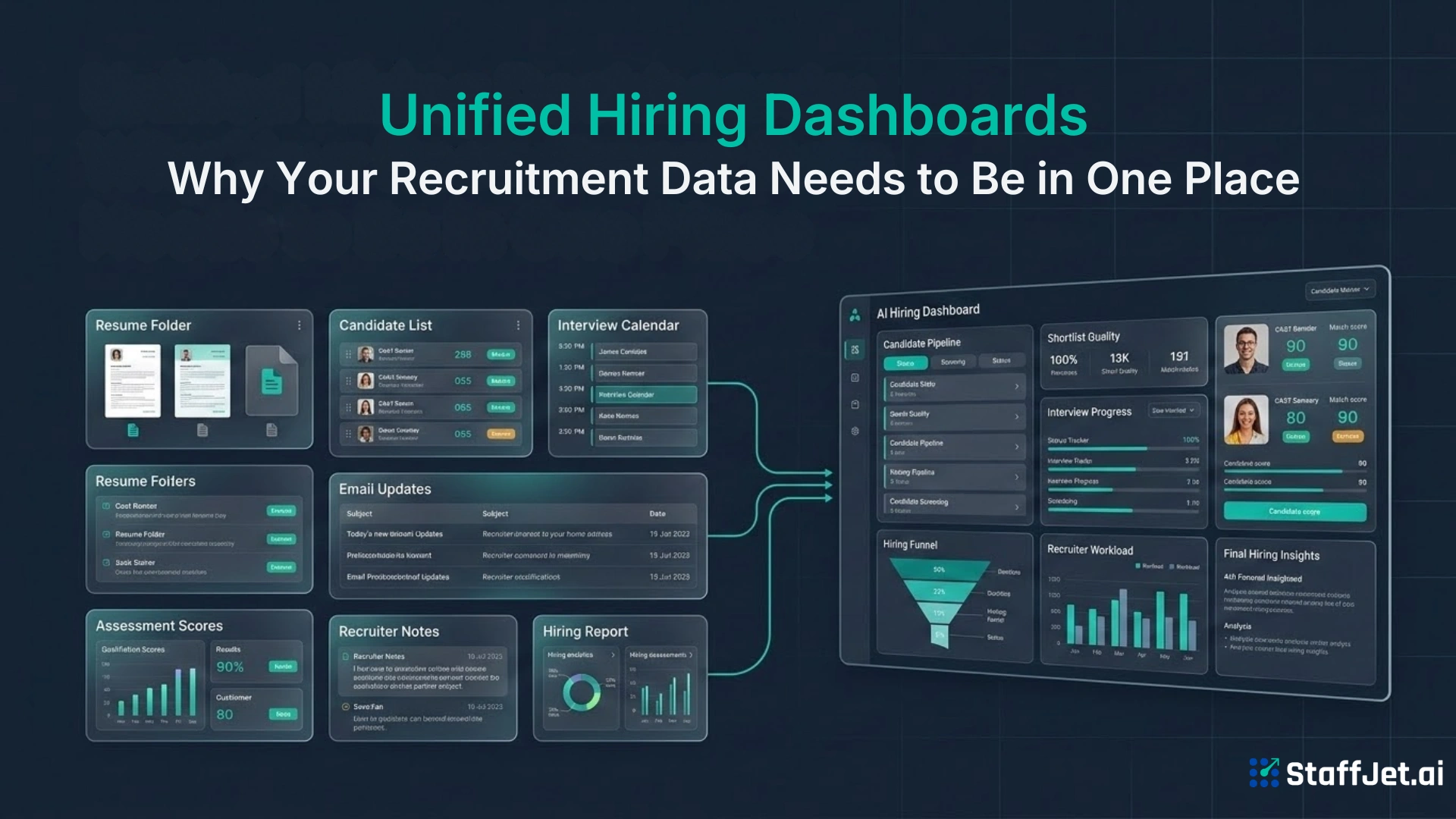
- Unified Dashboard: Every candidate’s journey, scores, and evaluation summary in one place. One-click reports for final comparison.
Not all stages are required. You enable only what each role needs.
What Does AI Hiring Evaluate That a Resume Cannot Show?
A resume shows what someone has done. AI hiring evaluates whether they can do the job you are offering, right now.
Manual screening relies on resume review and unstructured conversation. Both are poor predictors of performance. A polished resume can mask weak skills. An unconventional background can hide exceptional ability.
AI adds three layers manual processes rarely apply at scale: video screening tests communication under structured conditions, skills assessments verify actual task capability, and structured interviews evaluate decision-making through consistent question sets.
According to Harvard Business Review’s 2024 research, structured AI-supported interviews show 24 to 30% higher assessment consistency than unstructured manual interviews. That consistency directly reduces the risk of a bad hire.
How Does AI Hiring Compare to Manual Hiring on Speed?
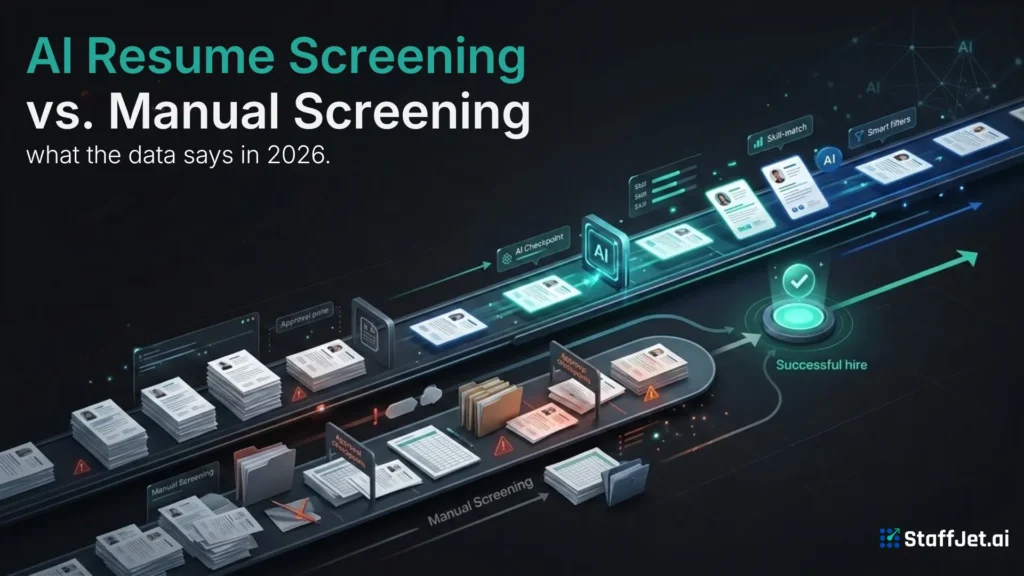
AI hiring cuts time-to-hire by up to 50%, from 45 to 60 days manually down to 15 to 20 days with AI.
The difference is parallelism. Manual hiring is sequential: one step waits on the last. AI runs multiple evaluations at once. The moment a candidate applies, scoring begins. Your recruiter wakes up with a ranked shortlist, not a full inbox.
According to Eightfold AI’s 2025 benchmarks, teams using AI screening report up to 40% faster time-to-shortlist for high-volume roles.
According to Hirebee’s 2025 data, the average time-to-hire reduction across AI adopters is 50%.
For a team hiring 20 roles a year, cutting time-to-hire from 45 to 20 days means 500 fewer vacancy-days annually. That is 500 days of recovered productivity.
How Much Does AI Hiring Save on Cost Per Hire Compared to Manual?
Teams using AI for screening and scheduling report 20 to 40% lower cost-per-hire. (Greenhouse and GoodTime, 2025)
Savings come from three places: fewer agency fees, less job board spend, and the recruiter hours recovered from manual tasks.
There is also a capacity multiplier. One recruiter managing manual hiring handles one or two roles at a time. With AI handling screening and scheduling, that same recruiter manages three to five roles without quality dropping.
According to Second Talent’s 2026 analysis, the average ROI of AI recruiting adoption is 340% within 18 months. Savings compound across every role you hire.
AI Hiring vs Manual Hiring, Which Method Gets You Better Final Candidates?
AI hiring delivers better final candidates because it evaluates more signals, more consistently, with less noise.
Manual hiring produces variable results. Evaluation quality shifts by recruiter, by day, and by inbox volume. AI applies the same scoring framework to every candidate, every time.
According to Second Talent’s 2026 report, AI screening tools achieve 89 to 94% accuracy in resume parsing and skill matching.
According to SHRM’s AI in HR research, organisations using AI recruitment tools report 31% faster hiring times and a 50% improvement in quality-of-hire metrics.
The result: hiring managers meet fewer candidates but every one of them is worth serious consideration.
How Does Candidate Experience Differ Between AI Hiring and Manual Hiring?
Poor candidate experience in manual hiring costs companies up to 22% in potential revenue. (CareerBuilder)
Manual hiring keeps candidates waiting. They apply, hear nothing for a week, get a call with no set structure, wait again for feedback, and repeat across multiple rounds. Many drop off before you even reach them.
AI hiring changes this. Candidates know what they are evaluated on upfront. They record video responses on their own schedule. They complete assessments when it suits them. No waiting on a recruiter’s calendar. Feedback comes faster.
For companies competing with larger brands for the same talent, a faster and more transparent process is a real advantage. Candidates notice when a hiring process respects their time.
Is AI Hiring the Right Move for Your Team Right Now?
AI hiring works best for teams dealing with volume, speed pressure, compliance requirements, or limited recruiting bandwidth.
If you fill one senior role every six months with a focused, consultative process, manual hiring makes sense for that context. That is not where most hiring pain lives.
The pain is five open roles, two recruiters, and a business that needs people in three weeks. Or compliance-heavy roles requiring audit trails. Or an HR team spending more time scheduling than building pipeline.
The modular nature of AI hiring means you do not change everything at once. Enable AI screening for high-volume roles. Add video screening where communication matters. Use skills assessments for technical roles. Build the process around what each role needs.
How Do You Switch From Manual to AI Hiring Without Disrupting Your Team?
You do not need IT, a long implementation, or a full process overhaul. You need one open role and an afternoon.
Post the job description. Let AI screen overnight. Review the ranked shortlist the next morning. Run video screening on your top 10. Check scores. Meet your top 3 to 5.
That first run shows your team what changes. Less email. Fewer unqualified interviews. A shortlist that is actually short.
Most teams who run one role through StaffJet do not go back to doing it manually. Qualified candidates appear in your pipeline within days, not weeks.
Key Takeaways
- Manual hiring takes 36 to 42 days on average. AI hiring brings that down to 15 to 20 days. (LinkedIn, Eightfold AI 2025)
- AI hiring saves 20 to 40% on cost-per-hire by automating screening and scheduling. (Greenhouse/GoodTime 2025)
- AI screening achieves 89 to 94% accuracy in skill matching. Manual screening is inconsistent and bias-prone. (Second Talent 2026)
- Structured AI interviews are 24 to 30% more consistent than unstructured manual interviews. (HBR 2024)
- AI hiring reduces bias by 56 to 61% when properly implemented. (Second Talent 2026)
- Poor candidate experience in manual hiring costs up to 22% of potential revenue. (CareerBuilder)
- AI hiring ROI averages 340% within 18 months of adoption. (Second Talent 2026)
- 93% of hiring managers say human involvement is still essential even with AI tools in place. (Insight Global 2025)